Long ago, Sagbata was not yet called by that name. He came from the land of Ananu, and his birth name was Azö. From the start, Azö was known for his stubbornness and disobedience. His parents, unable to tame his restless spirit, sold him. But wherever he went, he behaved the same way, defying authority and ignoring rules.
The people who bought him soon realized his rebellious nature was no ordinary defiance. They decided to sell him to Death itself. “Now, if Death buys you and you continue these tricks, if you refuse to obey him, then we shall see what becomes of you,” they warned.
Death accepted Azö, determined to show him the order and respect demanded in the realm beyond life. He planted fields of millet and instructed Azö to guard them. “When the birds come to eat this millet, you must drive them away,” Death said.
Azö, true to his nature, replied, “I do not wish to do this. I cannot chase the birds from their food.”
“Why do you resist?” Death demanded. “You are my servant. You must obey.”
Thus began their quarrel. Azö, unflinching, muttered, “Here is a man with long eyelashes who dares insult me.” Death, angered, warned, “Do you know what we do to those who insult us here? You shall see.”
“I am not afraid of you,” Azö responded boldly.
Death decided to confine him. At night, he locked Azö in a room, intending that he would die of hunger. But Azö, ever clever, refused to sleep. For seven long days, he kept vigil, knowing that sleep would mean his death. On the seventh day, Death came to check, thinking Azö had succumbed. But he had not. Frustrated, Death realized, “This man cannot stay. He will destroy my house if he remains.” And so, Death sold him to another master.
This cycle of buying and selling continued, and eventually, Azö returned to his homeland. His body bore sores from the relentless hardships. People asked, “Azö, why are you covered in sores?” He replied plainly, “Because they sold me and resold me, again and again.”
Even his own brothers mocked him. “You have become like a mound of earth, worn down until flattened,” they jeered. Yet they had never endured the trials Azö had faced.
One day, joking with his brothers, Azö said, “One does not insult Death. Yet I insulted him. I am now called Keledjegbè Kutö. I am greater than Death itself. Death may have millet, but he cannot chase away the birds.”
Before his trials, Hevioso had been his friend. While Azö was away, his people made Hevioso the head of the household. But when Azö returned, healed and strong, he was offered kingship. This reignited the old quarrel with Hevioso. “What they gave me, you cannot take,” Hevioso said, but Azö claimed the throne, and Hevioso was left powerless.
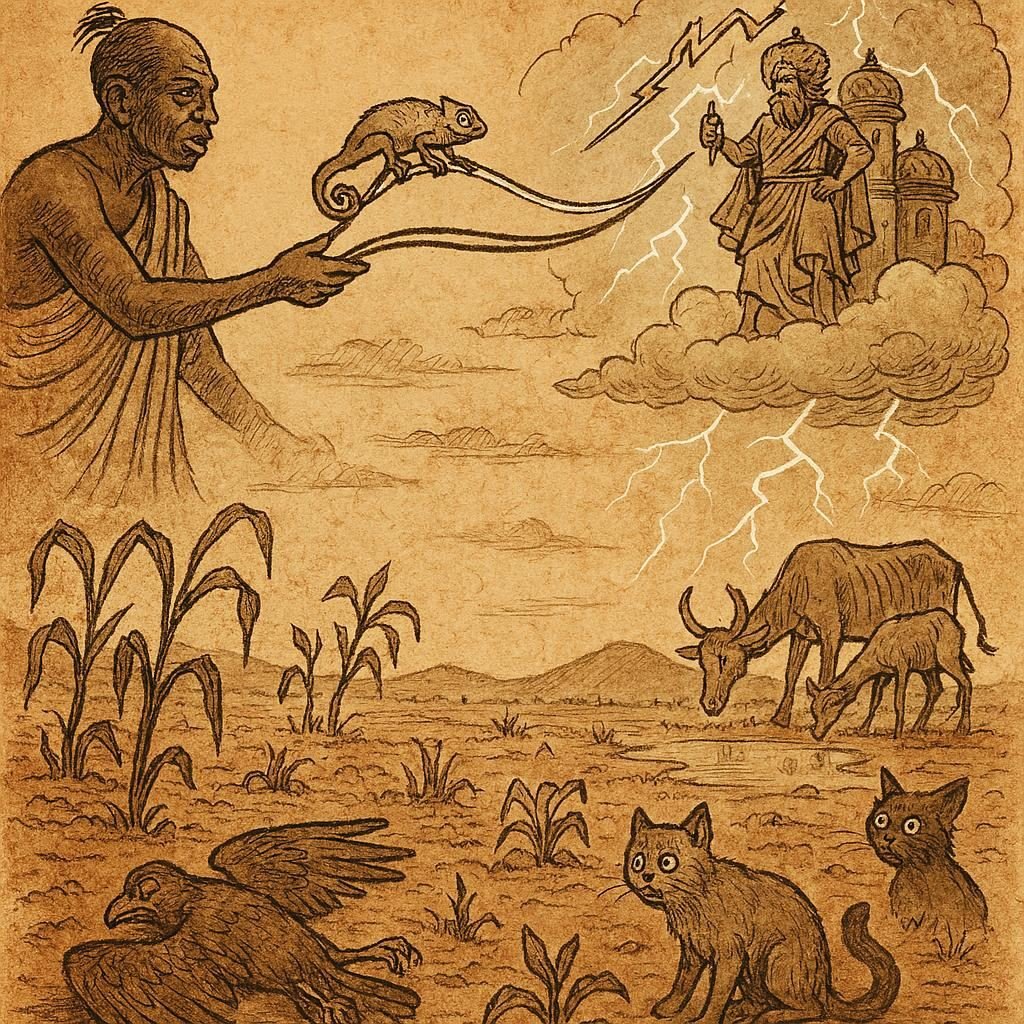
As king, Sagbata commanded a field to be cultivated. Corn was planted, but when the rains should have come, Hevioso, still enraged, withheld them. The land dried; crops withered. Animals and humans alike suffered, thirsting for water. The people cried out, “That evil man has returned among us!”
Desperate, Sagbata summoned all creatures, eagle, vulture, cat, and chameleon. With his magic, he wove threads of white and black cotton, spoke over them, and sent them skyward to plead for water.
Eagle volunteered first but was struck down by Hevioso. Next, the cat nearly reached the heavens before lightning ended its journey. Finally, Chameleon, servant of the Sun-god Lisa, approached. Sagbata instructed, “Go to Hevioso and beg him to send water so that the people, animals, and harvest may survive.”
Chameleon moved with caution. As Hevioso hurled thunderbolts, Chameleon hid beneath the cotton threads. Eventually, he reached Hevioso’s palace gates. Guards asked his purpose, and he replied, “Sagbata sends me to tell you that humans, animals, and crops are dying. He begs you to send water.”
Hevioso consented. He handed Chameleon a jar and a calabash, instructing him to deliver them to Sagbata and to gather his people. But he warned Sagbata: from that day forward, he could not command the celestial realm, and Hevioso would control the skies.
Thus, the rule of the sky and the earth was delimited, and the boundaries between mortal and divine authority were forever marked.
Moral Lesson
The tale of Sagbata teaches that rebellion carries consequences, yet courage and cunning can overcome even the most formidable forces. Respect for divine order and the limits of power is essential for harmony between heaven and earth.
Knowledge Check
Who was originally called Azö?
Azö was the original name of Sagbata, known for his disobedience.
Why was Azö sold to Death?
His persistent disobedience led his first owners to sell him to Death as a final test.
How did Azö survive Death’s locked room?
By refusing to sleep for seven days, avoiding the fate Death intended.
Who was Hevioso in relation to Azö?
Hevioso was Azö’s friend and temporary household head during his absence.
Which creature successfully delivered Sagbata’s message to Hevioso?
Chameleon, servant of the Sun-god Lisa, safely delivered the message.
What central theme does the story convey?
Courage, cunning, and respect for divine authority maintain balance between heaven and earth.
Source: Beninese Folktale