In a small clearing in the heart of the Kenyan forest, Monkey’s home had grown barren. The bulbs, wild yams, termites, and insects that had once fed him and his family were now gone. Hunger gnawed at his belly, and with no food left in sight, he realized he could not survive any longer in his own land. He made a difficult decision: he would leave his home and seek work elsewhere among strangers, hoping to find food and shelter.
After a long journey along winding forest paths and sparkling riverbanks, Monkey arrived at the home of his great uncle, the wise and gentle Orang Outang, who lived under the shade of a giant fig tree beside the Tana River. Orang Outang welcomed him warmly. “Rest here, my nephew,” he said, offering him fresh fruits, water from the river, and a place to sleep among the cool leaves. Monkey worked diligently in his uncle’s home, helping gather firewood, fetch water, and prepare meals. Days passed, and soon Monkey knew it was time to return to his own land.
As a parting gift, Orang Outang presented Monkey with two magical tools. “Here is a bow and arrow,” he said, “with which you can hit and catch anything you desire. And here is a fiddle. Play it, and any creature will dance, no matter how wild.” Monkey accepted the gifts with gratitude, feeling a spark of hope for the journey ahead.
READ THIS: The Man Who Never Lied
Monkey’s first encounter on his way home was with Brer Wolf, an old and cunning friend who had been prowling the forest all morning, attempting to catch a deer, but with no luck. Monkey showed Wolf the bow and arrow on his back and promised to help. Wolf led him to a deer grazing under the acacia trees. Monkey raised the bow, took careful aim, and let the arrow fly. In a swift motion, the deer fell. Together, Monkey and Wolf feasted, their hunger finally satisfied.
Yet, the meal did not end in friendship. Wolf’s heart twisted with jealousy. He begged Monkey for the bow and arrow, but Monkey politely refused. Wolf’s anger grew, and he threatened Monkey, claiming that his greater size and strength gave him the right to the bow. When Jackal passed by, Wolf accused Monkey of stealing the magical weapons. Jackal, always curious and crafty, listened carefully to both sides. Realizing the dispute was too serious to settle alone, he suggested they bring the matter to the forest court, where Lion, Tiger, and other animals could judge fairly.
To “protect” the bow and arrow until the trial, Jackal decided to take them. However, instead of safeguarding them, he devoured everything edible around him. Chaos erupted in the clearing as the animals argued, shouted, and fought over the remains. After much confusion, Monkey and Wolf finally agreed to appear before the court.
The trial began under the tall baobab tree, with Lion presiding. Monkey’s evidence appeared weak, and Jackal’s testimony, cunningly against him, made matters worse. The court judged swiftly: theft was the greatest of offenses, and Monkey was sentenced to hang.
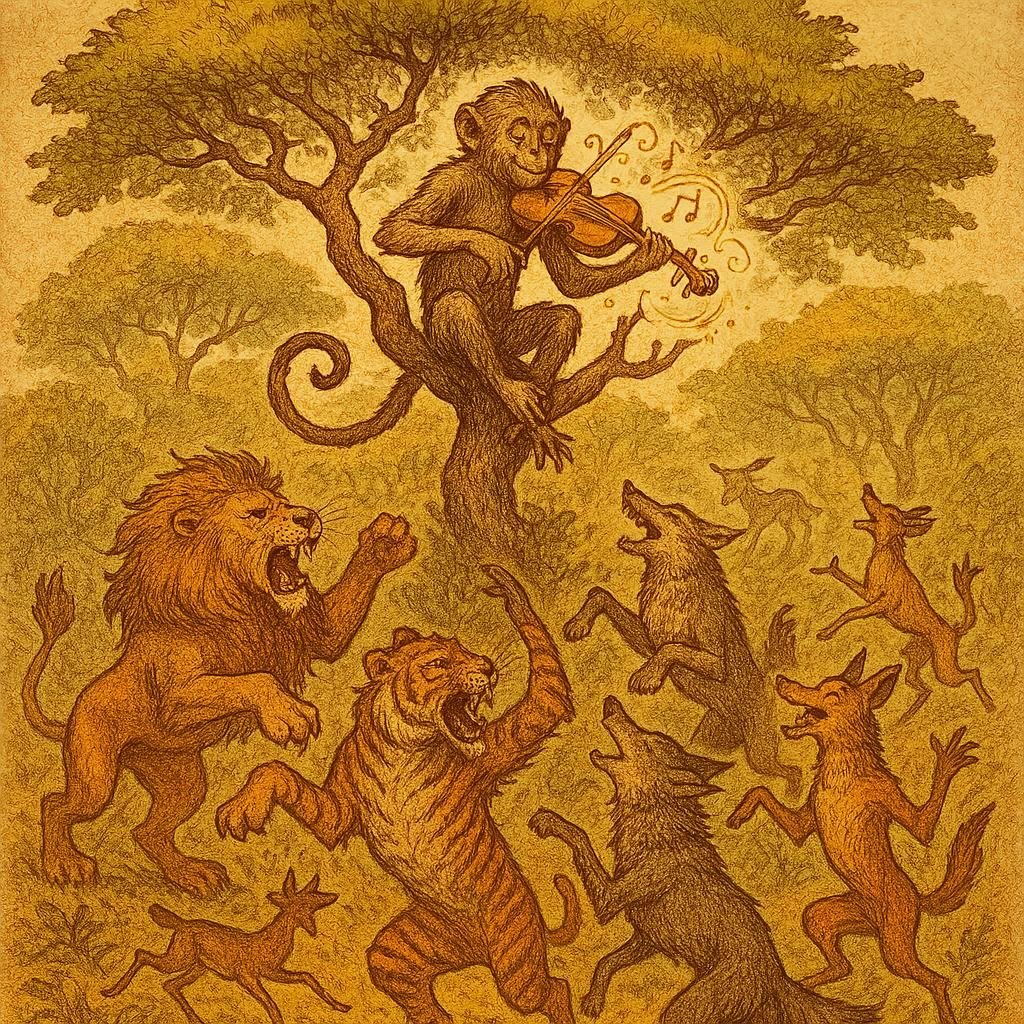
But Monkey was granted one final favor: he could play his fiddle. He placed the instrument against his chest, eyes half-closed, and drew the bow across the strings. The first note of “Cockcrow” rang out, bright and magical. Immediately, the animals began to stir. Lion, Tiger, Wolf, and even Jackal could not resist. Their legs moved, their tails twitched, and soon the entire court danced in uncontrollable delight. The melody grew faster and faster, whipping the animals into a whirlwind of movement. Some collapsed, exhausted, but still kept their feet in motion, powerless against the magic of the music.
Wolf gasped, “Please, Cousin Monkey, stop! We cannot keep up!” But Monkey played on, lost in the beauty of the music. Lion, panting after a wild dance with his young lion wife, growled, “My entire kingdom is yours, Monkey, if you will only stop playing!”
Monkey, calm and clever, replied, “I do not want your kingdom. Withdraw the sentence, return my bow and arrow, and you, Wolf, must admit you tried to steal them.”
“I acknowledge! I acknowledge!” Wolf cried. Lion withdrew the sentence, and Monkey played a few more notes for good measure before collecting his bow and arrow and climbing high into a sturdy acacia tree. The animals, fearing the magic of his music, dispersed to distant parts of the forest. Monkey had triumphed, not with brute strength, but through intelligence, skill, and a touch of musical magic.
Moral Lesson
The Monkey’s Fiddle shows that cleverness and skill often outweigh jealousy and brute strength. When faced with unfairness, using one’s talents wisely and staying true to oneself can turn the tide of any conflict. Intelligence, patience, and creativity can bring justice where force alone fails.
Knowledge Check: The Monkey’s Fiddle
Who helped Monkey when he left his home?
His great uncle, Orang Outang, provided shelter, food, and work.
What magical gifts did Monkey receive, and what powers did they hold?
A bow and arrow that could hit anything, and a fiddle that made any creature dance.
Why did Monkey and Wolf go to the forest court?
Wolf falsely accused Monkey of theft, and Jackal involved the court to settle the dispute.
How did Monkey save himself from the court’s sentence?
By playing the charmed fiddle, forcing all the animals to dance uncontrollably.
What lesson does the story teach about jealousy and greed?
Greed and envy, like Wolf and Jackal’s behavior, lead to trouble, while cleverness and skill bring success.
What role did music play in Monkey’s victory?
The fiddle’s music allowed Monkey to assert control and restore justice without violence.
Cultural Origin: Kenyan folktale, East Africa