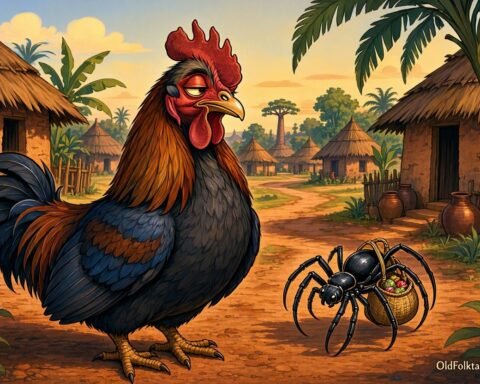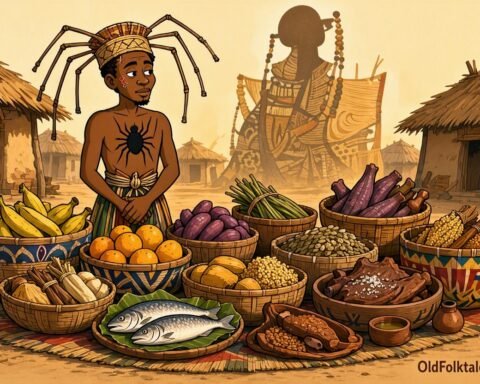
In the ancient forests of Ghana, where towering trees formed green cathedrals and mysterious shadows danced between the leaves, lived the most cunning spider the world had ever known. His name was Ananse, though few remembered that his full name was actually Kweku Ananse, for he had been born on a Wednesday according to the traditional Akan naming customs. This detail mattered little to most, for Ananse had earned his reputation not through his birth name, but through his endless scheming and insatiable greed for knowledge and possessions.
Ananse possessed a mind as intricate as the webs he spun, always plotting and planning new ways to gain advantage over others. His eight legs carried him swiftly through the forest as his clever brain devised schemes that would make him the most powerful creature in all the land. But of all his desires, none burned stronger than his hunger for wisdom itself.
One fateful day, as golden sunlight filtered through the canopy and birds sang their morning songs, Ananse conceived what he believed to be his most brilliant plan yet. “Why should wisdom be scattered among all the creatures of the world?” he muttered to himself, his many eyes gleaming with cunning ambition. “If I could gather all the wisdom in the world into one place, I would become the most powerful being that ever lived!”
Also read: Kweku Ananse and the Baboon
And so began Ananse’s extraordinary quest. He scurried from village to village, from forest to river, from mountain to valley, collecting every piece of wisdom he could find. He gathered the knowledge of the farmers about when to plant and harvest their crops. He collected the understanding of the hunters about tracking animals through the dense bush. He took the wisdom of the elders about settling disputes and maintaining peace in communities. He even gathered the simple wisdom of children about finding joy in small things.
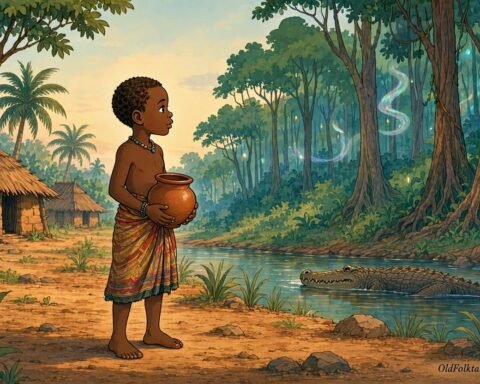
Day after day, week after week, Ananse worked tirelessly at his task. He convinced people to share their knowledge by promising great rewards, he tricked others into revealing their secrets, and he eavesdropped on conversations to steal precious insights. Slowly but surely, he filled an enormous clay pot with all the wisdom he had collected, watching with satisfaction as the vessel grew heavy with the accumulated knowledge of the world.
When at last he was satisfied that he had gathered every last bit of wisdom from every corner of the earth, Ananse stood back and admired his treasure. The large pot sat before him, seemingly ordinary in appearance but containing extraordinary power within its clay walls.
“Now I have all the wisdom of the world for myself!” he declared triumphantly, dancing around the pot with glee. “I shall be the wisest, most powerful creature that has ever existed!” His excitement was so great that he could barely contain himself as he imagined all the advantages this wisdom would bring him.
But even in his moment of triumph, Ananse’s suspicious nature began to gnaw at him like hunger in an empty belly. “What if someone discovers my pot of wisdom and tries to steal it?” he worried, his eyes darting nervously around his dwelling. “I must find the perfect hiding place where no one will ever think to look.”
After much deliberation, pacing back and forth across his home with his eight legs clicking against the floor, Ananse made his decision. “I shall hide the pot on top of the tallest tree in the entire forest!” he announced to himself. “No one would ever think to climb so high, and even if they did, they would never be able to reach it.”
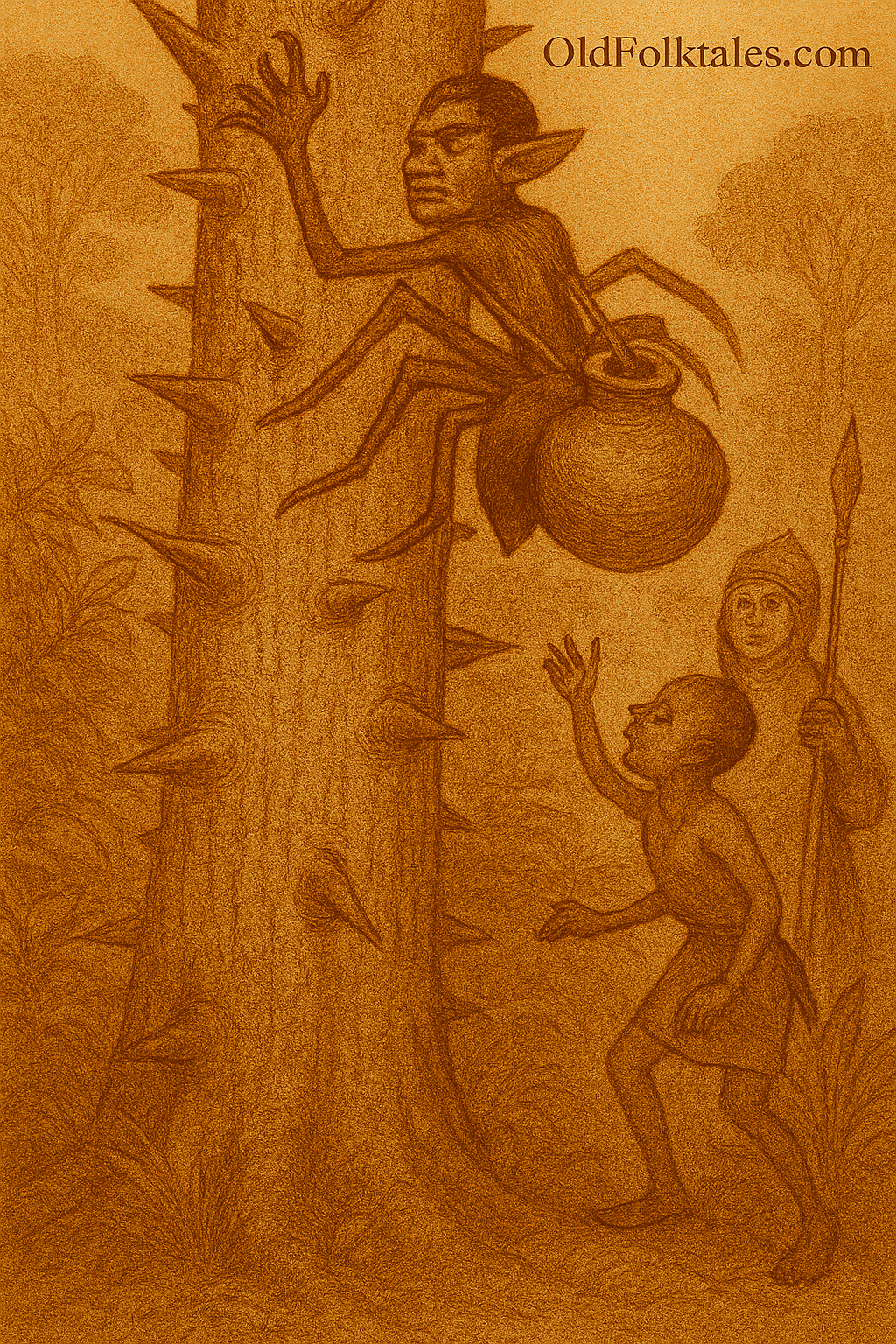
Ananse tied the precious pot securely around his neck with a strong vine rope, positioning it so that it hung heavily in front of his body. Then he set off into the depths of the forest, searching for the perfect tree. After hours of exploration, examining countless towering giants, he found exactly what he was looking for: the tallest silk cotton tree in the entire forest, its massive trunk rising like a pillar toward the sky, its thorny bark gleaming in the dappled sunlight.
But as Ananse approached the base of the enormous tree and prepared to begin his climb, he immediately encountered a problem he had not anticipated. The large pot hanging in front of his body made it impossible for him to grip the tree trunk properly. Every time he tried to wrap his legs around the massive trunk, the pot got in his way, bumping against the thorny bark and preventing him from getting a secure hold.
Again and again he attempted to climb, growing more frustrated with each failed effort. The thorns scratched at his legs and the pot banged painfully against the tree, but still he could not make any upward progress. Sweat beaded on his forehead as he struggled, and his breath came in short, angry gasps.
Unknown to the frustrated spider, his young son had been watching this entire spectacle from a safe distance, hidden behind a cluster of broad leaves. The little spider had observed his father’s increasingly desperate attempts to climb the tree, and being naturally curious, he had remained to see what would happen next.
Finally, unable to contain himself any longer, the young spider called out from his hiding place. “Father!” he said in his clear, innocent voice. “What are you trying to do?”
Ananse, startled by the unexpected voice, nearly lost his grip on the tree entirely. He looked around wildly until he spotted his son among the leaves. “Well,” he replied, trying to maintain some dignity despite his obvious predicament, “I have in this clay pot all the wisdom of the world, and I am going to hang it on the top of this tallest tree, away from everybody. Then I will be the wisest creature in the whole wide world!”
The young spider considered this information for a moment, tilting his small head thoughtfully as he observed his father’s continued struggles with the unwieldy pot. Then, with the simple clarity that often comes from innocent observation, he offered a suggestion that would change everything.
“I have an idea, Father,” he said brightly. “Why don’t you hang the pot behind you instead of in front of you? Then you will be able to climb the tree much more easily.”
Ananse paused in his efforts, struck by the obvious brilliance of this simple solution. With some embarrassment at not having thought of it himself, he carefully repositioned the pot so that it hung down his back instead of his front. To his amazement and delight, he found that he could now climb the thorny silk cotton tree with ease, his legs free to grip the trunk securely while the pot rested safely against his back.
Up and up he climbed, higher than any creature had ever climbed before, until he reached the topmost branches of the great tree. There he sat, breathing heavily from his exertion but filled with triumphant joy at having finally achieved his goal. The pot of wisdom rested securely beside him on a sturdy branch, and all the world spread out below him like a vast green carpet.
But as Ananse sat there in his moment of victory, a troubling realization began to creep into his mind like a shadow across the sun. He looked down at the pot that contained all the wisdom of the world, then thought about the simple but brilliant suggestion his young son had offered just moments before.
“Wait,” he said aloud, his voice filled with growing confusion and dismay. “I thought I had all the wisdom in the world. I thought I had gathered every bit of knowledge and understanding that existed.” He stared at the pot, then looked down toward the ground where his son waited far below.
“But my own son just showed wisdom that was not in my pot,” he continued, his voice growing stronger as the full implications of this revelation struck him. “If there is wisdom outside my pot, then I do not truly possess all the wisdom in the world after all.”
The truth hit Ananse like a lightning bolt, illuminating his understanding in a way that all his collected wisdom could not. He had been so focused on gathering and hoarding knowledge that he had failed to recognize the simple truth that wisdom cannot be contained or controlled by any single being.
“No one person can have all the wisdom in the world,” he declared, his voice carrying across the forest with the weight of profound realization. This statement, born from his moment of enlightenment high in the silk cotton tree, would echo through generations and become a truth that people still recognize and share today.
In his excitement and frustration at this discovery, and perhaps feeling somewhat foolish about his grand scheme, Ananse accidentally knocked the precious pot from its perch on the branch. Down, down, down it fell, tumbling through the air until it struck the ground far below with a tremendous crash that echoed through the entire forest.
The clay pot shattered into countless pieces, and all the wisdom that had been stored inside scattered to every corner of the world like seeds carried on the wind. Knowledge and understanding spread far and wide, reaching every village and settlement, every creature and plant, ensuring that wisdom would never again be concentrated in one place or possessed by one being.
And so it was that Ananse’s greed and desire for power ultimately served to benefit all the world’s creatures. His failed attempt to hoard wisdom resulted in its fair distribution among all living things, teaching everyone the valuable lesson that knowledge grows stronger when it is shared rather than hidden away.
Moral Lesson
This timeless tale teaches us that wisdom and knowledge are meant to be shared, not hoarded. Ananse’s attempt to possess all wisdom ultimately demonstrates that true understanding comes from recognizing our limitations and learning from others, even from those we might consider less experienced than ourselves. The story reminds us that even children can offer insights that escape adults, and that collaboration and sharing lead to greater wisdom than selfish accumulation ever could.
Knowledge Check
Q1: What does Ananse represent in Ghanaian Akan folklore traditions? A: Ananse serves as the archetypal trickster figure in Akan culture, representing both cleverness and the dangers of excessive greed and pride. He embodies human traits like ambition and cunning while also serving as a cautionary example of how these qualities can lead to self-defeating behavior when taken to extremes.
Q2: What is the significance of calling him “Kweku Ananse” in this folktale? A: The name “Kweku” follows traditional Akan naming customs, indicating he was born on a Wednesday. This cultural detail connects the story to authentic Ghanaian traditions and shows how folktales preserve cultural practices, demonstrating that even mythical characters follow real-world naming conventions of the Akan people.
Q3: Why does Ananse choose the silk cotton tree specifically for hiding his wisdom? A: The silk cotton tree (cecropia) is one of the tallest trees in West African forests and holds special significance in many African cultures as a sacred or spiritual tree. By choosing this tree, Ananse seeks the highest possible hiding place, but the choice also symbolizes his attempt to reach beyond human limitations and claim divine-like power over knowledge.
Q4: What does the son’s simple solution represent in this Ghanaian story? A: The son’s practical suggestion represents the wisdom that comes from fresh perspective and humble observation. His ability to see a simple solution that his father missed demonstrates that wisdom is not about accumulation of knowledge but about clear thinking and the ability to approach problems without preconceived notions or excessive pride.
Q5: How does the pot breaking serve the story’s message about wisdom sharing? A: The accidental breaking of the pot represents divine intervention ensuring that wisdom returns to its natural state of being shared among all people. This dramatic conclusion shows that attempts to monopolize knowledge ultimately fail, and that wisdom scattered freely benefits everyone more than wisdom hoarded by an individual.
Q6: What cultural values does this Akan folktale promote about community and knowledge? A: The story promotes core Akan values of collective wisdom, humility, and the importance of learning from all community members regardless of age or status. It emphasizes that knowledge belongs to the community rather than individuals, and that even the youngest person can contribute valuable insights to solving problems.