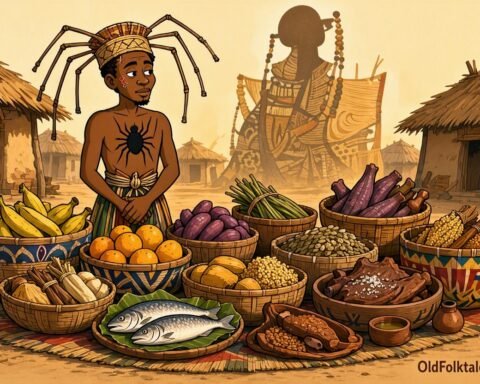
In the days when animals spoke with human voices and walked upright like people, a terrible famine descended upon the animal kingdom like a dark cloud that refused to pass. The earth had grown hard and cracked under the relentless sun, and the once-abundant forests had withered to mere shadows of their former glory. Rivers that had flowed with crystal-clear water now lay as dusty beds of parched clay, and even the most resourceful creatures struggled to find a single morsel to fill their empty bellies.
Among all the suffering animals, none felt the pangs of hunger more keenly than Ijapa the tortoise. His usually bright eyes had grown dim with want, and his heavy shell seemed to grow heavier with each passing day as his strength ebbed away. Day after day, he wandered through the barren landscape, turning over every stone and searching beneath every dried leaf, hoping desperately to find even the smallest scrap of food to sustain himself and his beloved wife.
But as Ijapa’s situation grew more desperate, he began to hear whispers of something extraordinary that filled his heart with both hope and envy. The birds of the forest, despite the famine that plagued the land below, were preparing with great excitement for their most cherished annual celebration, the magnificent feast in the sky. This legendary gathering, held high above the clouds in the realm where only winged creatures could venture, was spoken of in hushed, reverent tones by those fortunate enough to have attended in previous years.
The stories that filtered down from the sky-realm were enough to make any hungry creature’s mouth water with desperate longing. Tables stretching as far as the eye could see, laden with the most delicious delicacies imaginable – roasted nuts golden and glistening, fruits so ripe and sweet they seemed to glow with their own inner light, grains cooked to perfection, and treats so exotic and wonderful that no earthbound animal had ever tasted their like. The birds spoke of this heavenly banquet with such joy and anticipation that Ijapa could hardly bear to listen, knowing that such abundance was forever beyond his reach.
Or so it seemed.
But Ijapa the tortoise was renowned throughout the animal kingdom for his cleverness and his refusal to accept defeat, even when faced with seemingly impossible obstacles. As he lay beneath his favorite tree one evening, his empty stomach growling with hunger, a brilliant plan began to form in his cunning mind. If only birds could attend the sky feast because they possessed the gift of flight, then perhaps, just perhaps, he could find a way to fly as well.
The very next morning, as the sun painted the sky with shades of gold and crimson, Ijapa set his ambitious plan into motion. With his most charming smile and his smoothest, most persuasive voice, he began visiting every bird in the forest. To the proud peacock, he claimed that his own few dull feathers looked shabby and embarrassing, and could he perhaps borrow just one magnificent plume to improve his appearance? To the swift swallow, he explained that he was conducting an important study of bird feathers and needed a sample of her sleek flight feathers for scientific purposes. To the wise owl, he suggested that sharing feathers was a noble act of friendship that would strengthen the bonds between all forest creatures.
One by one, with a different story for each bird he approached, Ijapa collected feathers of every size, shape, and color imaginable. Some were brilliant blue like pieces of captured sky, others were fiery red like flames dancing in the wind, and still others were golden yellow like rays of pure sunlight. With painstaking care and sticky tree sap, he glued these borrowed plumes all over his shell and body, creating a magnificent, rainbow-colored disguise that was more spectacular than any bird the forest had ever seen.
On the morning of the great feast, as the birds gathered to begin their celestial journey, Ijapa emerged from his hiding place in his glorious feathered costume. The assembled birds gasped in amazement at this strange, beautiful creature they had never seen before. His borrowed plumage shimmered and gleamed in the morning light, creating patterns of color so dazzling that some birds had to shield their eyes.
“Who are you, magnificent stranger?” asked the eagle, speaking for all the curious birds. “We have never seen your like in all our years flying through these skies.”
With perfect composure and not a trace of nervousness in his voice, Ijapa replied, “My name is ‘All of Us.’ I have traveled from distant lands to join in your celebrated feast.”
The birds, impressed by his exotic appearance and exotic name, welcomed him warmly into their group, and together they began their flight toward the heavenly realm. Ijapa’s heart soared higher than his borrowed wings as he rose above the familiar treetops and into the endless blue sky, leaving behind the famine-stricken earth below.
When they finally arrived at the celestial feasting ground, Ijapa could hardly believe his eyes. The reality far exceeded even the most glowing descriptions he had heard. Tables made of polished cloud stretched in every direction, groaning under the weight of the most sumptuous feast imaginable. The air itself seemed to sparkle with the aroma of a thousand delicious dishes, and Ijapa’s empty stomach clenched with anticipation.
As the birds settled around the magnificent tables, preparing to begin their feast, Ijapa saw his opportunity to execute the second part of his clever plan. With an innocent expression that concealed his cunning intentions, he asked in a loud, clear voice that carried across the entire gathering: “Friends, tell me – to whom does all this wonderful food belong?”
Without hesitation, the birds replied in unison, as was their ancient custom: “All of us! This feast belongs to all of us!”
Ijapa’s eyes lit up with triumph as he declared with great satisfaction: “Ah, then this feast belongs to me, for that is my name ‘All of Us!’ Since I am ‘All of Us,’ all this food is rightfully mine!”
Before any of the astonished birds could protest or object to this outrageous claim, Ijapa began devouring the feast with incredible speed and enthusiasm. He gobbled up roasted grains by the beakful, swallowed entire fruits in single bites, and consumed dish after dish of the celestial delicacies while the hungry birds could only watch in growing horror and rage.
When the birds finally recovered from their shock and tried to grab the gluttonous impostor, their claws caught only feathers, which came loose in their grasp as the sticky sap had dried and weakened. One by one, Ijapa’s beautiful disguise fell away, revealing the familiar dark shell and cunning face of the tortoise they all knew from the forest below.
The birds’ fury knew no bounds. They had been tricked, humiliated, and robbed of their most sacred annual celebration by this clever but selfish reptile. In their anger, they decided on a punishment that would match the severity of his crime.
“You wanted to reach the sky through trickery,” declared the eagle, his voice shaking with righteous anger. “Now you can find your own way back to the earth!”
As the birds prepared to abandon him in the heavenly realm, Ijapa realized the terrible predicament he had created for himself. Swallowing his pride, he begged them to carry at least one message to his wife below.
“Please,” he pleaded, his voice trembling with fear, “tell my dear wife to gather every soft thing in our home – all the mattresses, pillows, and blankets she can find – and lay them outside our house. If I must fall from this great height, at least let me have a soft place to land.”
The birds, still seething with anger at his deception, agreed to carry a message to his wife, but their vengeful hearts led them to deliver very different words than those Ijapa had requested.
“Your husband sends word from the sky,” they told the tortoise’s wife. “He says you must bring out all the furniture in your house and place it in the yard – every chair, every table, every hard wooden thing you own.”
The faithful wife, trusting in her husband’s wisdom even when his instructions seemed strange, did exactly as the birds commanded. She dragged every piece of furniture from their home and arranged it in a great pile outside.
High above, Ijapa took a deep breath, closed his eyes, and leaped from the sky realm. Down, down, down he fell, the wind whistling past his ears as the ground rushed up to meet him. But instead of landing on the soft mattresses he had requested, he crashed with tremendous force onto the pile of hard wooden furniture his wife had so carefully arranged.
The impact was catastrophic. Ijapa’s beautiful, smooth shell – which had been his pride and protection for all his life – shattered into countless pieces with a sound like breaking pottery. As he lay there in agony, surrounded by the fragments of what had once been his perfect armor, his wife rushed to his aid with tears streaming down her face.
Working with infinite patience and love, she gathered every single piece of his broken shell and carefully glued them back together with tree sap and clay. Though her skilled hands restored the shell’s function, nothing could ever make it smooth and perfect again. The cracks and lines where the pieces had been rejoined remained visible forever, creating the distinctive pattern that all tortoises carry to this day.
Moral lesson
This timeless tale teaches us that cleverness without wisdom, and trickery motivated by greed, inevitably leads to consequences that far outweigh any temporary gain. Ijapa’s intelligence could have been used to help his community during the famine, but instead, his selfish deception not only robbed others of their rightful feast but also brought lasting punishment upon himself. True success comes not from outsmarting others for personal advantage, but from using our talents to benefit everyone.
Knowledge Check
Q1: Who is Ijapa in Nigerian folklore and what role does he play in this story? A: Ijapa is the tortoise trickster figure in Nigerian Yoruba folktales, similar to Anansi in West African traditions. In this story, he serves as the clever but greedy protagonist whose cunning plan backfires, teaching lessons about the consequences of deception.
Q2: Why did Ijapa choose the name “All of Us” for his disguise at the sky feast? A: Ijapa cleverly chose this name knowing that when the birds said the feast belonged to “all of us,” he could claim the entire meal for himself by declaring that “All of Us” was his name, thus tricking them out of their food.
Q3: What does the sky feast symbolize in this Nigerian folktale? A: The sky feast represents abundance and privilege that seems out of reach. It symbolizes how exclusive opportunities can tempt us to use dishonest means to access what we desire, but such deception comes with severe consequences.
Q4: How does this story explain why tortoises have cracked shells? A: This etiological tale explains that tortoises originally had smooth shells, but Ijapa’s shell was shattered when he fell from the sky onto hard furniture. His wife glued the pieces back together, creating the distinctive cracked pattern all tortoises carry today.
Q5: What cultural values does this Nigerian folktale promote? A: The story emphasizes traditional Yoruba values of honesty, community sharing, and the importance of considering consequences before acting. It warns against greed and deception while highlighting how individual selfishness can harm the entire community.
Q6: What role do the birds play in Ijapa’s punishment, and what does this represent? A: The birds represent justice and community response to betrayal. Their decision to change Ijapa’s message to his wife shows how deception breeds more deception, and how breaking trust with a community leads to isolation and consequences.