In a sun-baked village where the desert winds carried the scent of frankincense and cardamom, and palm trees cast precious shade over dusty streets, there stood an ancient well at the heart of the community. This well was more than just a source of water, it was the lifeline of the village, where women gathered each morning and evening, their clay pots balanced expertly on their heads as they exchanged news and gossip.
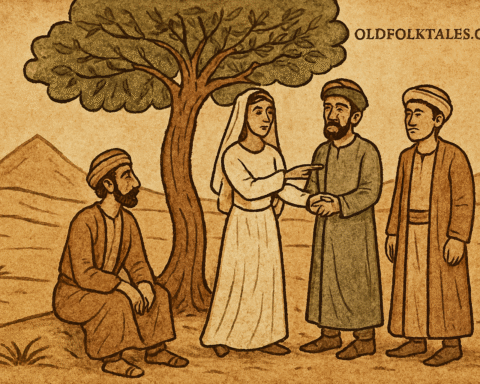
The village sheikh, a man of considerable learning and religious authority, had taken it upon himself to draw water from the well for the community. His white turban gleamed in the blazing sun as he worked the rope and pulley, filling vessel after vessel with the precious liquid. The villagers respected him for his knowledge of the holy scriptures and his apparent devotion to serving others.
But beneath his pious exterior lurked desires that contradicted everything he preached. Among the women who came to collect water each day was one who had captured his attention completely. She was a married woman, known throughout the village for her virtue and intelligence, her dark eyes bright with wisdom and her manner graceful yet modest.
Also read: The Handsome Porter’s Dream
The sheikh’s obsession with her grew stronger each day. When her young son would approach the well with the family’s water jar, the sheikh would shake his head firmly. “No, child, you’re too small to carry such a heavy load safely,” he would say, his voice carrying false concern. “Send your mother to fetch the water instead.”
Day after day, this pattern continued until finally the woman had no choice but to come to the well herself. The moment she appeared, walking gracefully across the dusty courtyard with her empty jar, the sheikh’s eyes would light up with barely concealed desire.
“Ah, sister, your beauty rivals the stars themselves,” he would whisper when no one else was within earshot. “Your intelligence shines brighter than the full moon. Surely Allah has blessed you above all other women.”
His flattering words, spoken with the authority of a religious leader, gradually worked their way into her heart despite her better judgment. She found herself looking forward to these encounters, her pulse quickening when she heard his voice. The sheikh’s learning and eloquence created a dangerous charm that she struggled to resist.
As days passed, the woman fell deeper under his spell, but she was wise enough to recognize the dangerous path she was treading. She became quiet and thoughtful, her usual cheerful conversation with neighbors replaced by long silences. Her husband noticed the change in her demeanor, the way she would stare into the distance lost in contemplation.
Finally, unable to bear the burden of her secret any longer, she made a decision that would prove her wisdom and loyalty. She approached her husband one evening as they sat together in their modest home, the oil lamp casting dancing shadows on the mud-brick walls.
“My dear husband,” she began, her voice heavy with concern, “I must share something troubling with you. The village sheikh has been making advances toward me, and I fear his intentions are far from honorable. I’ve tried to discourage him subtly, but he persists. I didn’t know what to do, so I’ve decided to tell you so that we can solve this problem together without causing a fight or scandal.”
Her husband’s face darkened with anger, but he was impressed by his wife’s honesty and wisdom in coming to him. They talked long into the night, their voices low and urgent as they devised a plan that would teach the sheikh a lesson he would never forget.
“You must tell him that I’ll be away tomorrow night,” her husband said, his eyes gleaming with cunning. “Promise him that you can be together all evening and all night. But as soon as he arrives and you’ve locked the door, I’ll return home and knock loudly, pretending I’ve come back unexpectedly. Then you can disguise him in women’s clothing and claim he’s a housemaid.”
The next day at the well, the woman approached the sheikh with apparent shyness, her eyes downcast in a way that made his heart race with anticipation.
“A person of great wisdom has many eyes, which means he can understand everything,” she said softly. “So I believe you have understood what I’ve been feeling. I was silent before because my husband was always present, but he’s going away tonight on business. This is our chance. Come to me after evening prayers, and we can talk and… do whatever we like.”
The sheikh’s excitement was barely contained. His hands trembled as he drew water, and his mind raced with anticipation. “When exactly should I come?” he asked eagerly.
“Come as soon as you’ve finished your evening prayers,” she replied, then walked away with graceful steps that seemed to float above the dusty ground.
As the day wore on, the sheikh grew increasingly anxious about his wife’s suspicions. He had never left home in the evenings before, and he needed a convincing explanation for his unprecedented absence.
“My dear wife,” he said that evening, adjusting his prayer cap nervously, “I must go out tonight until about ten o’clock. There’s a particularly difficult verse in the Holy Quran that requires interpretation, and several scholars have asked me to attend a meeting to discuss its meaning.”
His wife looked surprised but pleased. “If it concerns religious matters, then of course you must go. It’s your duty as a learned man to share your knowledge.”
With his alibi established, the sheikh hurried through the narrow streets to the woman’s house, his heart pounding with anticipation. She welcomed him warmly, spreading her finest carpet on the floor and serving him sweet tea in delicate glass cups. The soft glow of oil lamps created an intimate atmosphere that made the sheikh believe his desires were about to be fulfilled.
But just as he raised the tea to his lips, she quietly turned the key in the door lock. This was the signal they had arranged, and immediately her husband began pounding on the door from outside.
“Wife! Wife!” he shouted with convincing frustration. “I couldn’t find transportation! The bus broke down, so I’ve had to return home!”
The sheikh’s face went white with terror as he realized the trap he had walked into. “What shall we do?” he whispered frantically.
“Don’t panic,” the woman said with remarkable calmness. “Put on my dress and headscarf, and I’ll tell my husband you’re a housemaid I’ve hired to help with the work.”
With no other choice, the sheikh hurriedly put on the woman’s clothing, the fabric feeling foreign and shameful against his skin. The woman wrapped her scarf around his face to hide his beard and opened the door.
Her husband entered carrying a large sack on his shoulder. “Wife, look what good fortune! I’ve brought you a whole sack of maize that I bought at an excellent price.”
“How wonderful!” she exclaimed with apparent delight.
“You’re lucky the housemaid is here,” her husband said, glancing at the disguised sheikh, “because this maize needs to be pounded into flour, and there’s so much of it. Bring the mortar and pestle, and let her start working immediately.”
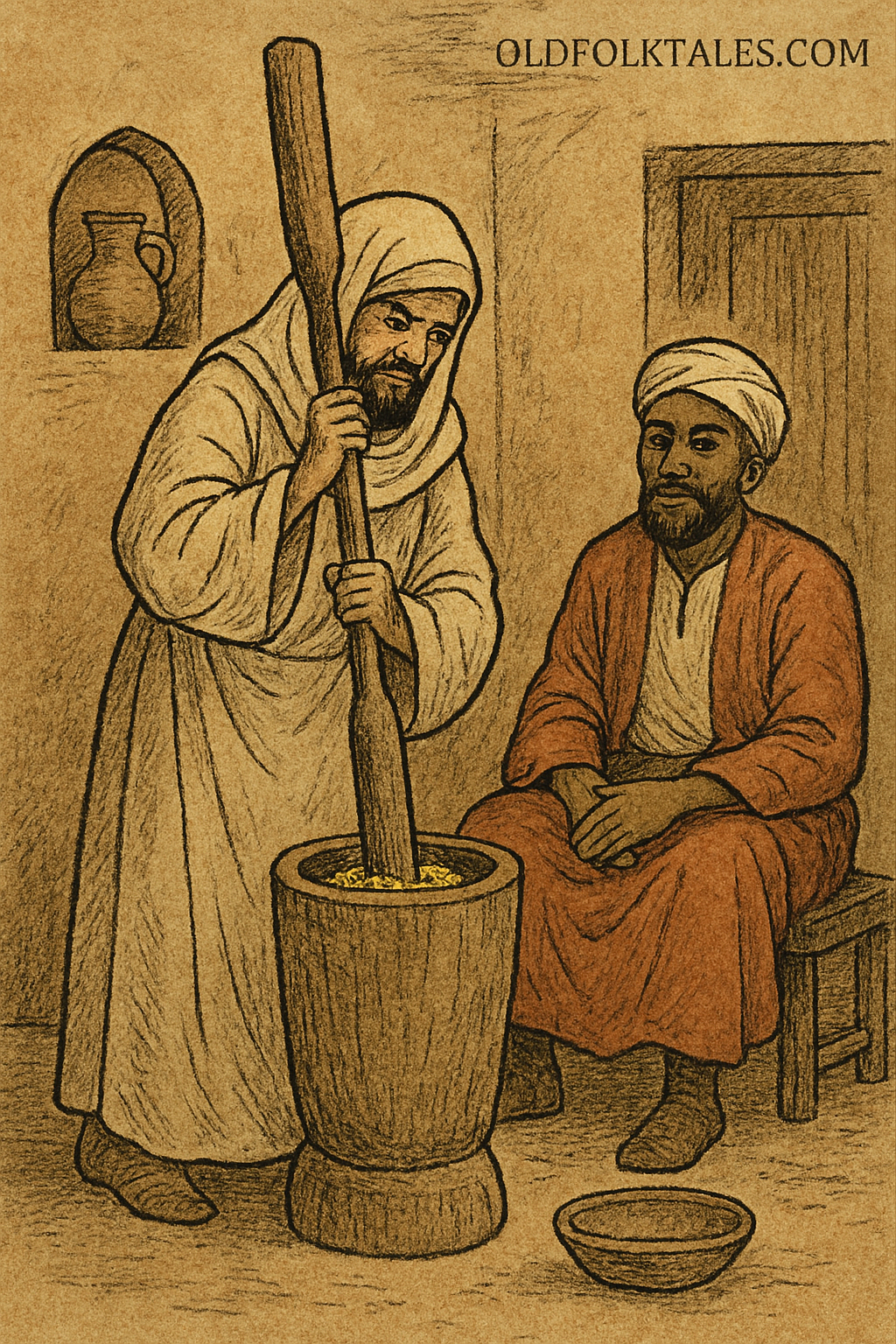
The sheikh found himself handed a heavy wooden pestle and directed to a large stone mortar. With no choice but to maintain his disguise, he began the backbreaking work of pounding grain. The husband sat close beside him, making casual conversation and ensuring the “housemaid” couldn’t escape or reveal his true identity.
Hour after hour, the sheikh pounded maize, his back aching and his arms burning with fatigue. “Why won’t this husband leave?” he thought desperately. “I’m so tired of pounding all this grain.”
The work continued relentlessly until every grain had been reduced to fine flour. Only then did the wife dismiss her “helper.” “Well done, you’ve worked very hard. You may go now.”
The sheikh fled through the dark streets, still wearing the woman’s dress, his body aching and his pride thoroughly crushed. When he arrived home, his wife stared at him in shock and horror.
“Husband! You’re wearing a woman’s dress! Don’t you know the Holy Quran strictly forbids men from wearing women’s clothing? This is a grave sin!”
The sheikh’s quick mind immediately concocted an elaborate explanation. “Oh, my dear wife, I couldn’t help it! We were discussing the verse about Satan being the evil one, and suddenly Satan himself appeared at our meeting! He began beating everyone present, and in my desperation to escape, I grabbed a woman’s dress that was nearby. Even Satan would be ashamed to strike a woman, so he let me flee safely.”
His wife’s expression softened with concern and admiration. “Then you did exactly right to escape, even if it meant wearing forbidden clothing to save yourself.”
The next day, when the woman came to the well, she approached the sheikh with another invitation. “My husband is definitely traveling tonight. I’m certain he’ll be gone, so please come to my house again.”
The sheikh shook his head emphatically, his body still aching from the previous night’s ordeal. “Oh no,” he replied with bitter experience, “I don’t want to spend another evening pounding maize. If I wanted to do that kind of work, I have plenty of grain at home.”
Moral Lesson
This Middle Eastern folktale celebrates the wisdom of honest communication in marriage and the triumph of cleverness over improper desires. The story teaches that when faced with unwanted advances, seeking help from one’s spouse and working together as a team can create solutions that protect honor while teaching valuable lessons to those who would disrupt families. It also shows how lies and deception ultimately trap the deceiver in their own web of falsehoods.
Knowledge Check
Q1: How did the sheikh manipulate the situation to get the married woman to come to the well?
A1: The sheikh refused to give water to the woman’s young son, claiming the boy was too small to carry it safely, forcing the mother to come to the well herself where he could flatter and pursue her.
Q2: What wise decision did the woman make when she realized the sheikh’s intentions?
A2: Instead of keeping the situation secret or handling it alone, she honestly confessed everything to her husband and asked for his help in solving the problem without causing scandal or conflict.
Q3: What elaborate plan did the married couple devise to teach the sheikh a lesson?
A3: They planned for the woman to invite the sheikh over when her husband was supposedly away, but then the husband would return unexpectedly, forcing the sheikh to disguise himself as a housemaid and perform hard labor.
Q4: How did the sheikh explain his appearance in women’s clothing to his own wife?
A4: He claimed that during a religious discussion about Satan, the devil himself appeared and began beating everyone, so he wore women’s clothing to escape because even Satan wouldn’t strike a woman.
Q5: What does the sheikh’s final refusal represent in this Middle Eastern folktale?
A5: His refusal to visit again shows he learned his lesson about pursuing married women, as he associated the experience with hard work and humiliation rather than pleasure, effectively curing his improper desires.
Q6: What cultural values does this folktale promote regarding marriage and community?
A6: The story promotes marital loyalty, honest communication between spouses, the importance of protecting family honor, and the idea that religious authority should not be abused for personal desires.