Once, in the dry, open lands of Puntland, there lived a man with two wives. His first wife bore him only daughters, seven in all, while the second wife gave him sons. Because of this, the man favored the second wife and called her “Many Poles,” a name suggesting strength, like the poles that held up a great hut. The first wife, though virtuous, was belittled and nicknamed “Woman with House,” for to him her daughters were no honor.
By custom, the hut of the first wife was always placed to the right, the position of dignity. But in his favoritism, the man shut the door of his first wife’s hut, forcing her to use the door of her rival, and moved her dwelling to the left, the place of lesser standing. He gave all priority to the second wife and her sons, humiliating the woman who had stood with him longest.
Time passed, and the land grew dry. The rains did not come, and the grass thinned. It became necessary for the people to move. The man took his horse and his favored wife, leaving the first wife and her seven daughters behind with nothing. His intention was cruel: he wished them to perish in the emptiness of the abandoned place.
READ THIS: The Lion, King of the Animals: Somali Folktale
Yet God’s mercy does not abandon the forsaken. Rain fell upon the very ground where the despised wife and her daughters had been left. Grass grew tall, and their few goats and sheep thrived. They lived in health and blessing while the others wandered.
The husband, by tradition, went scouting for pastures. One evening he returned by chance to the very place he had deserted, not recognizing it in the darkness. He called out, “Who lives here?”
His eldest daughter replied, “It is us, your children. Do you not know us?”
Shocked, he entered, and she offered him warmth. “Come in, Father. It rains outside. I will make a fire for you.”
The man sat by the fire. The daughter, seeing opportunity, whispered to her mother: “He has returned. Though he despised you, God may still grant you a son. Do not be angry. Clean yourself, prepare with perfume, and lie with him.”
The first wife obeyed, and that night the husband slept with her. By dawn, however, he left without acknowledgment, returning to the second wife, dragging her back to live beside the first. He dismissed the matter, convinced no son could come from his neglected wife.
When the pregnancy became visible, the second wife mocked her cruelly. “Even this child is not his. She cannot bear a son.”
The husband, too cowardly to face his second wife’s scorn, denied his role. But the eldest daughter, wise beyond her years, had prepared her mother. “Take proof,” she had said. And so the first wife showed the husband’s ring and shoe, taken as he slept. None could deny the truth: the child belonged to him.
Still, the husband scoffed. “Even if the child is mine, I know it will be a girl.”
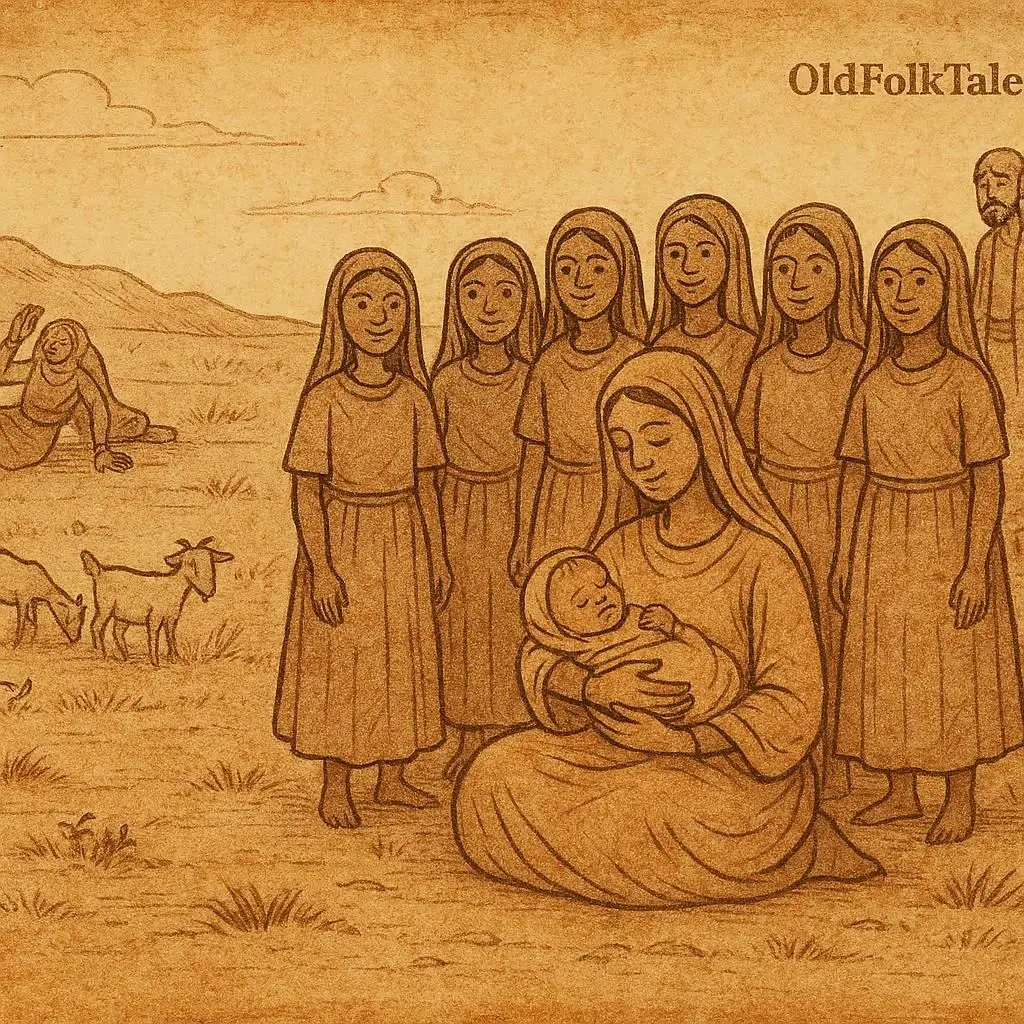
Time for another migration came. The first wife, heavy with child, was abandoned again, left with her daughters while her husband rode away with horses and wealth. Alone, she labored, and gave birth to a son. Overjoyed, she named him Durbananti, the name her husband had reserved for the heir born of his favored wife.
Carrying her newborn, a stove, and an iron, she declared boldly: “Let the ground move, and let the sky move, I have borne a son named Durbananti, the true inheritor of this land.”
She followed after the others, her voice and her courage echoing across the plains. When the husband heard, he was struck with awe. He turned to his second wife and declared, “Your son is no longer Durbananti. That name belongs to the son of my first wife.”
The second wife, hearing this, was so shocked that she collapsed and died. Thus, the despised woman became the mother of the true heir, vindicated by her faith, her daughters’ wisdom, and God’s justice.
Moral Lesson
This tale teaches that worth is not measured by favoritism, pride, or shallow judgments, but by the unseen justice of God. Those who scorn others may find themselves humbled, while those who endure cruelty with dignity may be lifted higher than they ever imagined. The story warns against arrogance and partiality and reminds us that the blessing of life and destiny belongs to God alone.
Knowledge Check
Q1. Who were the two wives in the story, and how did the husband treat them differently?
The first wife had seven daughters and was scorned, while the second had sons and was favored.
Q2. Why did the husband leave his first wife and daughters behind?
He abandoned them during migration, hoping they would die.
Q3. How did the first wife prove her pregnancy was her husband’s?
She presented his ring and shoe, taken as he slept beside her.
Q4. What was the significance of the name Durbananti?
It was the chosen heir’s name, which the first wife gave to her son, affirming his inheritance.
Q5. How did divine intervention help the abandoned wife and daughters?
Rain and grass came to their land, ensuring survival when others had none.
Q6. What caused the death of the second wife?
Shock and despair when the husband declared the first wife’s son as the true Durbananti.
Source: Somali folktale, Puntland.