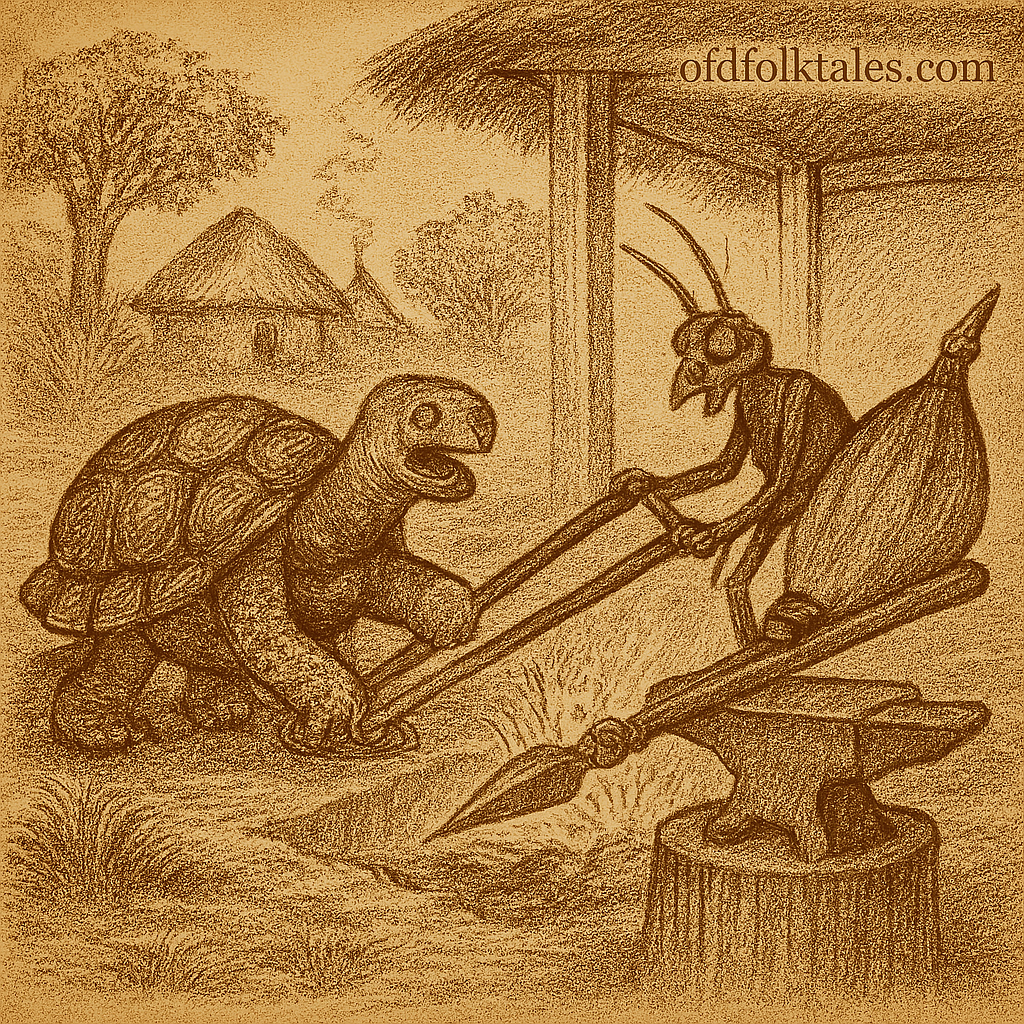
In the bustling heart of an African village, where the sound of hammering metal rang out from dawn until dusk and sparks flew like tiny stars against the smoky air, stood the forge of Kudu the Tortoise. His reputation as a master blacksmith had spread throughout the region, and creatures from far and wide came to his workshop to sharpen their tools, repair their weapons, and craft new implements for their various trades. The forge was more than just a place of work, it was a gathering point where news was shared, friendships were forged, and sometimes, as fate would have it, the seeds of great conflicts were unknowingly planted.
Tortoise took pride in his craft and in the generosity he showed to his customers. His bellows, crafted with the skill that comes from years of experience, were freely available to any who needed to work their own metal, and his anvil bore the marks of countless projects that had been shaped upon its surface. The old reptile moved with deliberate precision around his workshop, his ancient eyes taking in every detail, his weathered shell bearing the scars and burn marks that testified to decades spent working with fire and metal.
On this particular morning, as golden sunlight streamed through the open doorway of the forge and the air thrummed with the familiar energy of a working day, Etanda the Cockroach arrived at the smithy carrying his most prized possession. This was no ordinary weapon, but a spear so magnificent and renowned that its fame had spread throughout the animal kingdom and beyond. The spear’s craftsmanship was legendary, its balance perfect, its point sharp enough to pierce the toughest hide, and its reputation such that even the mention of “Etanda’s Spear” was enough to strike fear or admiration into the hearts of all who heard it.
Also read: Why Bats Avoid Sunlight
Cockroach, despite his small size, carried himself with the confidence that came from owning such a remarkable weapon. His dark carapace gleamed in the forge’s firelight as he approached Tortoise’s bellows, eager to begin whatever metalwork had brought him to the village that day. But as he positioned himself at the leather bellows and began the rhythmic work of pumping air into the forge fire, his compound eyes caught sight of movement in the dusty street beyond.
“Kudu,” Cockroach called out, his voice tight with sudden anxiety, “I see Kuba approaching, and I fear he means to catch me. What shall I do? Where can I hide from his sharp eyes and swift feet?”
Tortoise, without looking up from his work at the anvil, gestured toward a patch of tall grass that grew wild near the edge of his compound. “Go quickly and hide yourself there among the grass,” he advised in the calm tone of one who had seen many such predicaments before. “Stay low and still until the danger passes.”
Without hesitation, Cockroach abandoned his work at the bellows and scurried toward the indicated hiding place, leaving behind his famous spear lying conspicuously beside the forge. His small form disappeared into the grass just as Kuba the Chicken strutted into the compound, his bright feathers catching the morning light and his keen eyes immediately spotting the abandoned weapon.
Chicken’s head tilted with curiosity as he examined the magnificent spear, recognition dawning in his bright eyes. “Tortoise, my friend,” he inquired, his voice carrying the excitement of one who has made an important discovery, “is this not Etanda’s famous spear? The one that all creatures speak of with such awe?”
“Indeed it is,” Tortoise replied matter-of-factly, his hammer continuing its steady rhythm against the hot metal on his anvil. “Do you have business with its owner?”
Chicken’s eyes gleamed with predatory interest. “Yes, very much so! Where might I find this Cockroach? I have been hoping for such an opportunity for quite some time.”
Tortoise paused in his work just long enough to gesture toward the grass where Cockroach had concealed himself. “He has hidden himself in that patch of grass over there. You are welcome to catch him if you can.”
With the swift efficiency that made chickens such effective hunters of insects, Kuba strutted over to the hiding place and quickly located the trembling Cockroach. In one swift motion, he caught and swallowed the small creature whole, famous spear and all now belonging to the victor by right of conquest.
As Chicken prepared to leave the forge, satisfied with his successful hunt, Tortoise called out to him with the casual tone of one making a reasonable request. “Before you go, friend Kuba, would you be so kind as to work these fine bellows for me? I have much work to complete today, and your assistance would be greatly appreciated.”
Chicken, feeling generous in victory and willing to return the favor of information that had led to his success, readily agreed to help. He positioned himself at the bellows and began the steady work of pumping air into the forge fire. But as he worked, his sharp eyes caught sight of another figure approaching through the village street, and his confident demeanor immediately transformed into nervous anxiety.
“Alas, Tortoise,” Chicken exclaimed, his voice rising with alarm, “I see Uhingi the Genet approaching, and I fear greatly that she will see me here. Where can I go to avoid her attention?”
“Go quickly and hide in the same place where Cockroach concealed himself,” Tortoise advised without looking up from his work. “The grass will provide adequate cover if you remain still and quiet.”
Chicken immediately abandoned the bellows and rushed to hide in the tall grass, leaving behind both his presence at the forge and any claim to Cockroach’s spear, which remained where it had been left.
When Uhingi the Genet arrived at the forge, her sleek form moving with the fluid grace that made her such an effective hunter, her keen eyes immediately spotted the abandoned spear. Her whiskers twitched with interest as she recognized the famous weapon.
“Tortoise,” she inquired in the smooth voice that was characteristic of her kind, “is this not the renowned spear that belongs to Etanda the Cockroach? I recognize its distinctive craftsmanship from the many stories I have heard.”
“It is indeed,” Tortoise confirmed, his tone remaining conversational and helpful. “Are you seeking its owner for some particular purpose?”
“Yes, I have been hoping to encounter him,” Genet replied, her eyes gleaming with predatory anticipation. “Where might I find this Cockroach?”
“I am afraid you are too late for that,” Tortoise replied with what might have been regret or amusement. “Chicken has already swallowed him, spear and all.”
Genet’s ears perked up with renewed interest. “And where might I find this Chicken who has consumed such a prize?”
Tortoise gestured toward the grass where Chicken now hid. “He has concealed himself in that patch of grass over there, no doubt hoping to avoid exactly the kind of encounter you represent.”
With the deadly efficiency that had made her reputation as a hunter, Genet stalked over to the hiding place and quickly located and caught Chicken, consuming him and thus inheriting by conquest both Cockroach and his famous spear.
As Genet prepared to leave, Tortoise once again made his request for assistance. “Before you depart, friend Uhingi, would you be willing to work these bellows for me? The day’s work requires much fire, and your help would be invaluable.”
Genet, perhaps feeling magnanimous after her successful hunt, agreed to assist. But as she began working the bellows, her sharp senses detected the approach of another creature, one that filled her with immediate dread. Her sleek body tensed as she recognized the distinctive scent and sound of Nje the Leopard approaching through the village.
“I must go immediately,” Genet declared, her voice tight with fear. “I cannot allow Leopard to see me here. Where can I hide?”
“Use the same hiding place that has served the others,” Tortoise suggested calmly. “The grass will conceal you if you remain motionless.”
Genet quickly abandoned her work and rushed to hide in the grass, joining the invisible chain of predator and prey that was building in that seemingly innocent patch of vegetation.
When Leopard arrived at the forge, his powerful frame rippling with barely contained energy and his golden eyes immediately fixing on the famous spear, he approached Tortoise with the confident bearing of one who feared no other creature in the forest.
“Old friend,” Leopard inquired in his rumbling voice, “is this not the legendary spear that belongs to Etanda? I have heard many stories of its remarkable properties.”
“It is indeed that very spear,” Tortoise confirmed. “Are you interested in meeting its owner?”
“Very much so,” Leopard replied, his predatory instincts fully engaged. “Where can I find this Cockroach?”
“You are several steps removed from that possibility,” Tortoise explained patiently. “Kuba the Chicken swallowed him.”
“And where is this Chicken?” Leopard’s interest shifted to the more substantial prey.
“Uhingi the Genet has eaten him,” Tortoise replied matter-of-factly.
Leopard’s eyes gleamed with satisfaction. “And where is this Genet? She would make a worthy addition to my territory.”
“Do you wish to catch her?” Tortoise asked, as if the answer were not obvious. “Go and find her—she has hidden herself in that patch of grass over there.”
With the deadly efficiency that made him the apex predator of his domain, Leopard stalked over to the hiding place and quickly caught and killed Genet, adding her to the chain of consumption that had begun with Cockroach’s simple visit to the forge.
As Leopard prepared to leave, Tortoise made his familiar request. “Before you go, mighty Nje, would you honor me by working these bellows? Your strength would make the task much easier than it has been for your predecessors.”
Leopard, feeling generous in his victory and perhaps seeing the wisdom in maintaining good relations with the village blacksmith, agreed to assist. But as he took his position at the bellows, his keen senses detected the approach of a creature that filled even his fearless heart with unease.
“Kudu!” Leopard exclaimed, his voice carrying an urgency that had not been present when facing any of the previous threats. “I see a Man approaching with a gun upon his shoulder, and I do not want to encounter such a dangerous creature. I must hide immediately!”
“Go quickly to the grass,” Tortoise advised with the same calm tone he had used for all the others. “Conceal yourself well, for humans are indeed dangerous to your kind.”
Leopard, despite his pride and strength, immediately abandoned his work and rushed to hide in the same patch of grass that had concealed all the others, joining the invisible chain that was now complete.
When the Man arrived at the forge, his weathered face showing the marks of many seasons spent hunting and surviving in the African wilderness, his experienced eyes immediately recognized the famous spear lying beside the bellows.
“Blacksmith,” the Man inquired, his voice carrying the authority of one accustomed to getting straight answers, “is this not the wonderful spear that belongs to Cockroach? Its reputation has reached even human settlements.”
“It is indeed that very spear,” Tortoise confirmed, his tone as conversational as it had been with all the previous visitors.
“And where is this Cockroach?” the Man asked, his interest clearly professional.
“Chicken swallowed him,” Tortoise replied simply.
“And the Chicken?”
“Genet ate him.”
“And the Genet?”
“Leopard killed her.”
The Man’s eyes sharpened with the interest of a hunter who has found worthy prey. “And where is this Leopard?”
For the first time in the entire sequence of events, Tortoise hesitated, perhaps recognizing that he was about to complete a chain of circumstances that would have lasting consequences far beyond his forge.
“Where is Leopard?” the Man asked again, his voice carrying the weight of inevitable conclusion.
Tortoise looked toward the patch of grass where the great predator lay hidden, then back at the Man with his deadly gun. “Do you want him?” he asked finally. “Go and catch him—he has hidden himself over there in the grass.”
With the methodical precision that had made humans the most successful hunters in all of Africa, the Man approached the hiding place and shot Leopard dead, thus completing the chain of predation that had begun with a simple cockroach seeking to use the blacksmith’s bellows.
And so it was that Leopard died, who had killed Genet, who had eaten Chicken, who had swallowed Cockroach, who owned the wonderful spear, at the smithy of Tortoise.
But this was not merely the end of one chain of events—it was the beginning of a conflict that would echo through generations. For when the other leopards learned that a man had killed their brother, and when men learned that leopards posed such a threat that they must be hunted, the eternal war between humanity and the great cats began, a conflict that continues to this day in the wild places of Africa.
Moral Lesson
This folktale illustrates how small actions can set off chains of consequences that spiral far beyond our ability to predict or control. Tortoise’s seemingly innocent helpfulness created a sequence of predation that ultimately led to the fundamental conflict between humans and wild animals. It teaches us to consider carefully how our actions, even those meant to be helpful, might contribute to larger patterns of conflict and consequence.
Knowledge Check
Q1: What made Etanda the Cockroach’s spear so special in this African folktale? A: Cockroach’s spear was wonderfully crafted and so famous that it was known by all people and creatures throughout the region, making it a highly recognizable and coveted weapon.
Q2: How did Tortoise contribute to the chain of predation at his forge? A: Tortoise consistently told each creature where to hide (in the same grass patch), then revealed each hidden creature’s location to their natural predator, creating a deliberate chain of consumption from Cockroach to Chicken to Genet to Leopard.
Q3: What was the final consequence of this chain of circumstances? A: The chain ended when a Man with a gun shot Leopard, which according to the story established the eternal enmity and ongoing conflict between humans and wild animals, particularly leopards.
Q4: How does this folktale resemble “The House that Jack Built”? A: Both stories use a cumulative narrative structure where each new element builds upon the previous ones, ending with a summary that traces back through the entire chain of connected events.
Q5: What role did fear play in the behavior of each animal visitor? A: Each creature (Cockroach, Chicken, Genet, and Leopard) was afraid of their natural predator and asked Tortoise for help hiding, which ironically led to their capture when Tortoise revealed their hiding places.
Q6: What does this African folktale teach about unintended consequences? A: The story demonstrates how seemingly innocent actions (Tortoise’s “helpful” directions) can create chains of events with far-reaching and unpredictable consequences, ultimately establishing permanent conflicts between species.