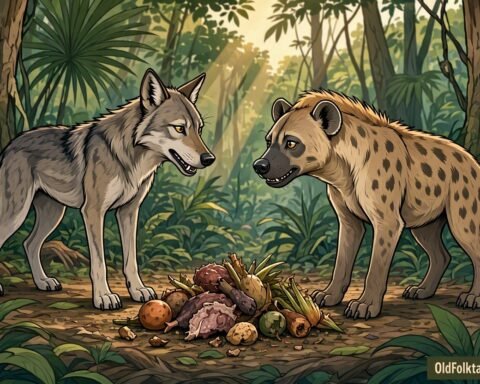
In a small town long ago, four unlikely neighbours lived together: Njabu the Civet, Ngweya the Hog, Mbama the Boa, and Kudu the Tortoise. They shared the same community, and in the evenings, they would often sit together, talking in the street after sunset. One such evening, Tortoise called for attention. “Friends, I have something important to say! Tomorrow, let us go on a journey. We will walk through the forest to the sea, to buy salt.” The others nodded in agreement. “Yes,” they said, “so it shall be.” And when the night grew late, each one returned home to rest, preparing for the journey ahead.
At daybreak, they rose early and gathered together. Tortoise had one final instruction before they departed. “Now, remember this, my companions. As we travel, none of us is to begin any new affair along the way. We must go straight to the sea without delay.” Again, they all agreed, and so their journey began.
The forest stretched wide and long. They walked steadily, hoping to reach their evening campsite without interruption. But before long, Civet began groaning loudly. “Ah, my stomach aches! My stomach aches!” Tortoise asked sharply, “And what do you mean by that?” Civet answered, “My bowels trouble me, and I must relieve myself.”
READ THIS: The Plea for Mercy: An Equatorial Guinea Folktale on Truth and Patience.
Tortoise waved toward the bushes. “Then step aside and do it there. We shall wait.” But Civet shook his head. “No, not here. I must return all the way to my mother’s garden in the town.”
Tortoise grew angry. “Did I not warn you? When we made our plan, I told you all: no new matters along the way. Yet here you are, beginning trouble!” Despite this, Civet ran back quickly to his mother’s kitchen garden, while the others waited on the path. Hours passed until at last he returned in the night, declaring cheerfully, “Now I am well.”
The next morning, they set out once more. But soon Boa cried out, “Oh, my stomach! My stomach aches!” Again, Tortoise demanded, “And what does ‘stomach ache’ mean for you?” Boa replied, “It means hunger seizes me.” Tortoise answered calmly, “Then let us all eat. We have food prepared for the journey.” But Boa refused. “Not this food. I must go and find something else.”
He slipped away and soon spotted a red antelope. Coiling his body, Boa crushed and killed it, as was his nature. He drooled saliva over the carcass and dragged it back to camp. Tortoise urged him, “We shall all eat together.” But Boa refused again. “At home we do not share our food; why should we on this journey?” And with that, he swallowed the entire antelope by himself.
Afterward, Boa lay heavy with his meal and declared, “I will not move until this food dissolves.” Tortoise scolded, “First Civet began his foolishness, now you, Boa, begin yours. Did I not warn you?” But they had no choice. For a full month they waited while Boa digested his prey. Finally, he drank deeply from a river to purge the bones and said, “Now I am well. Let us continue.”
They went on until they came to a tree freshly fallen across the path, its leaves still green. Hog leapt easily over it, Boa crawled across, and Civet sprang over as well. They called to Tortoise, “Come, climb over and join us!” But Tortoise struggled in vain, then sat back stubbornly. “No! I shall not move until this tree has rotted away, making me a clear path. Do you not see? Because Civet and Boa delayed us, this tree fell before we passed. Their matters delayed our journey. Now this is my matter, and you must wait for me.”
So, they lingered again. Each morning, Civet and Hog wandered to a nearby plantation where they found corn, yams, and plantains, which they ate greedily. But their lingering brought danger.
One day, a man from another town walked through the forest. He noticed the tracks of animals and studied them closely. “These are the tracks of a tortoise, a hog, a civet, and a boa! Many beasts must be here.” Excited, he rushed back to his village. “Come, men!” he cried. “I have found beasts in the forest!” Hunters gathered with guns, machetes, spears, knives, and nets. They brought their dogs, bells tied around their necks, and set out.
The hunters arrived and their dogs barked furiously. The men shouted and drove the animals into their nets. First, they shot Hog dead. Next, they speared Civet. Then they found Boa lying sluggish after his heavy meals, and killed him too. At last, they discovered Tortoise trying to hide under leaves by the log. They spared his life but bound him tightly with a cord.
The hunters carried the carcasses back to town. “Let us hang Tortoise from the roof and leave the others until tomorrow,” they decided. “It is too late tonight to cut and cook them.”
But near midnight, Tortoise wriggled free. He crept to the bodies of his companions. Over Civet he sighed, “Did I not warn you not to begin any matter on the way? Now you lie dead.” Over Boa he said, “You too disobeyed, and now you are gone.” He reflected, “Had none of us begun these matters, we would have completed our journey safely.” Then he dug a hole beneath the wall and escaped into the forest.
When morning came, the townspeople brought the carcasses outside. They ordered a boy to fetch the tortoise, but he returned saying, “There is no tortoise here.” The people searched but found nothing. At last, they gave up. “Let us eat the others and leave the tortoise, for it has escaped.”
Moral Lesson
This tale teaches the danger of disobedience and delay. Tortoise’s warning was clear: focus on the journey and avoid distractions. Yet Civet, Boa, and Hog each pursued their own desires, and it led them to ruin. The story reminds us that lack of discipline and selfishness can bring destruction not only to oneself but also to companions.
Knowledge Check
Q1: Who were the four main companions in the story?
Njabu the Civet, Ngweya the Hog, Mbama the Boa, and Kudu the Tortoise.
Q2: What was the purpose of their journey?
They set out together to travel to the sea to buy salt.
Q3: How did Civet delay the journey?
He returned home to his mother’s garden instead of relieving himself nearby.
Q4: Why did Boa refuse to share food?
He killed an antelope, swallowed it whole, and declared that companions should not share food.
Q5: What ultimately led to their capture?
Their delays caused them to linger near a plantation, where a man discovered their tracks and brought hunters.
Q6: What is the main lesson of the tale?
Disobedience, selfishness, and delay bring ruin, while discipline and unity ensure success.
Folktale Origin
Source: Fang folktale, Equatorial Guinea.