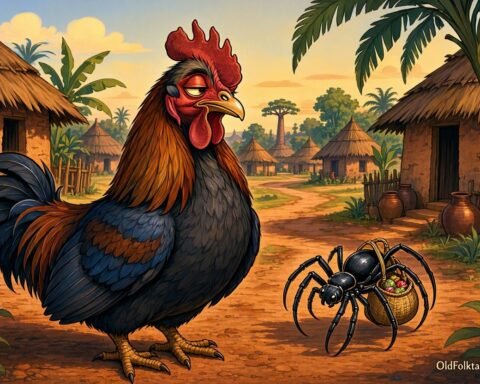
Long ago, in a small village near a town, Parrot and Chicken lived side by side in friendship. They were not wild creatures of the forest but fowls that had chosen to dwell close to humans. The villagers welcomed them, and for a time, the two birds shared food, shelter, and companionship, living in peace as neighbours and allies.
In those days, their bond was admired by others. Chicken, known as Kuba, was proud yet generous, while Parrot, called Koho, was admired for his bright plumage and sharp wit. The two moved about together in the village, and their voices were often heard in harmony, Chicken clucking cheerfully while Parrot repeated words he had learned from humans. Theirs seemed a friendship that would last.
READ THIS: How Fly’s Boast Spread Panic and Crocodile’s Greed Brought Death: An Equatorial Guinea Folktale
One morning, Parrot approached Chicken with an air of excitement. His feathers glittered in the sunlight as he said, “Friend Kuba, I am preparing for a marriage journey. I must appear my finest, for all eyes will be upon me. Will you lend me your beautiful tail feathers for the occasion?”
Chicken, eager to help and believing their friendship unshakable, replied warmly, “Of course, Koho. Take them and wear them proudly. I shall be glad that my feathers help honour you.” With that, Chicken handed over his fine plumage, trusting his companion’s word.
Parrot dressed himself in the borrowed feathers and departed, strutting with elegance. He reached his destination and was greeted with admiration, for the feathers indeed made him more splendid than ever. The marriage celebration was filled with laughter, music, and dance, and Parrot basked in the praise showered upon him.
When the festivities ended, Parrot returned to the village. Yet, as he admired his reflection in a pool of water, he thought to himself, these feathers suit me so well. Why should I part with them? Greed overcame gratitude, and the decision was made: he would not return what he had borrowed.
Soon, Chicken came to him and said kindly, “Friend Koho, I am glad your journey went well. Now, please return my feathers.”
But Parrot, standing tall, replied coldly, “I will not return them.”
Chicken was startled, for he had never expected betrayal from a friend. Trying to hide his hurt, he said with a bitter smile, “Very well then. Keep them, if that is your choice.”
Yet Parrot feigned injury, twisting the truth. “Why do you try to shame me, Kuba? I did not say I would keep your feathers forever. I only meant that we should share them as if we exchanged clothes.”
His words were clever, but his actions revealed his selfishness. Chicken knew then that their friendship was broken.
That very night, Parrot gathered his family. With a powerful beat of wings, they rose into the dark sky and did not return to the ground. From that day forward, Parrot chose the treetops as his home, leaving Chicken behind to remain with humankind.
The next morning, Chicken looked up at the branches, calling out to Parrot, “Koho! Give me back my feathers!” But Parrot only mocked him with a sharp cry: “Wa! Wa!” That cry was not only a refusal but a sneer, a sound that carried both pride and mockery.
From that time until now, whenever a chicken wanders too close to a parrot, the parrot quickly turns aside with a loud “wa!” as if to ward off the bird who once trusted him. The enmity born that day has never faded.
Moral Lesson
This tale teaches that trust, once broken, leaves lasting scars. Chicken’s generosity was repaid with Parrot’s greed and deceit, destroying their friendship forever. Borrowed things must be returned, and promises must be honoured, for dishonesty creates bitterness that echoes through generations.
True beauty lies not in borrowed adornments but in integrity. It is better to be plain and truthful than splendid and false.
Knowledge Check
Q1: Who were the main characters in the story?
Parrot (Koho) and Chicken (Kuba) were the central characters of the folktale.
Q2: What did Parrot borrow from Chicken?
He borrowed Chicken’s fine tail feathers to wear for his marriage journey.
Q3: Why did Parrot refuse to return the feathers?
Parrot felt the feathers suited him and, out of greed, decided to keep them.
Q4: What action did Parrot take after betraying Chicken?
He gathered his family and flew into the treetops, never living on the ground again.
Q5: What does the parrot’s cry of “wa!” symbolize?
It mocks Chicken’s demand for his feathers and reflects lasting enmity between the two.
Q6: What lesson does the folktale teach?
It warns that betrayal of trust destroys friendships and that honesty and gratitude preserve harmony.
Folktale Origin
Source: Fang folktale, Equatorial Guinea.