In the days when spirits walked more freely between worlds and magic dwelt in the simplest acts of kindness, there lived a man blessed with two wives, each bearing him a son. But fate, cruel as winter winds, took the first wife in the bloom of her youth. One of those mysterious illnesses that baffle even the wisest healers claimed her life, leaving behind only sorrow and a young boy who would soon learn the bitter taste of loss.
When the death celebrations ended and the last mourner had departed, the orphaned child was placed in the care of his stepmother, as custom dictated. But this woman’s heart was as cold as river stones. The villagers whispered behind closed doors, calling her “the-wicked-one,” for she violated the sacred traditions that bound families together. Custom demanded that she love the boy as her own flesh, yet she treated him as if he carried the curse of leprosy.
The Life of Toil and Neglect
While her own son lounged in comfort like a prince, eating the choicest foods and sleeping on soft mats, the stepson labored from dawn until darkness fell. She sent him to distant farms to weed grass under the scorching sun, to harvest crops that bent his young back, and to venture into the deep forest where wild animals prowled, all to gather firewood for the cooking fires. At home, every chore fell to his tired hands, sweeping floors, washing dishes, mending tears in clothing.
Also read: The Boys and the Magic Pots
The contrast between the two boys was stark as day and night. Her biological son had never known the weight of a water pot on his head or the sting of thorns while collecting firewood. His hands remained soft while his stepbrother’s grew calloused from endless work. The spoiled child treated his hardworking brother like a slave, barking orders and expecting immediate obedience.
The Fateful Day at the Stream
One evening, as golden light faded behind the hills, the exhausted boy returned from the farm with hunger gnawing at his ribs like a wild animal. His clothes were stained with earth, sweat beaded his brow, and weariness weighed heavy on his young shoulders. Instead of offering him food or rest, the stepmother thrust a basin overflowing with dirty dishes into his trembling arms.
“Take these to the stream and wash every one until they shine,” she commanded without a glance at his haggard face.
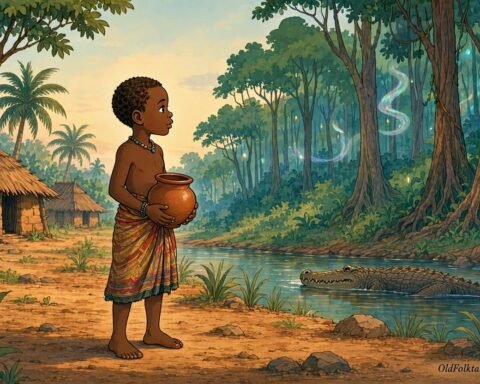
Though protest burned in his throat, the boy knew better than to voice his suffering. He had learned that defiance brought only harsher punishments. Shouldering the heavy basin, he trudged through the gathering dusk toward the rushing waters of the stream, where the rainy season had swollen the current into a roaring torrent.
The water was shockingly cold, numbing his fingers as he carefully scrubbed each dish and bowl. One by one, he cleaned them with the thoroughness his stepmother demanded, stacking the gleaming vessels in the silver basin. But as he reached for the final bowl, disaster struck. The slippery dish slipped from his numb fingers and was instantly swept away by the merciless current, disappearing into the darkness like a lost dream.
The Cruel Punishment
When the boy returned home missing one bowl, his stepmother’s fury erupted like a volcano. Her eyes blazed with anger as she towered over the cowering child, her voice cutting through the night air like a whip.
“You careless fool! How dare you lose my dish?” she shrieked. “You will go back and find it, or don’t bother coming home at all!”
The boy fell to his knees, tears streaming down his dirt-stained cheeks. “Please, Mother, the night is falling fast, and the waters are dangerous. I searched everywhere”
“I don’t care if you have to search until dawn!” she snarled. “Do not return without my dish!”
With nowhere else to turn, the boy lifted his face to the star-scattered sky and called upon his dead mother’s spirit. “Mama, if you can hear me, please help your son,” he whispered, his voice breaking with grief and desperation.
The Magical Encounter
Fear lent wings to his feet as he ran back to the stream, plunging into the icy waters to search for the lost dish. As he waded deeper, following the current’s path, the water rose steadily, first to his knees, then his thighs, and finally to his chest. Just when he thought the river would claim his life, something miraculous occurred. Instead of drowning, he found himself walking on a mystical path that appeared beneath the waters.
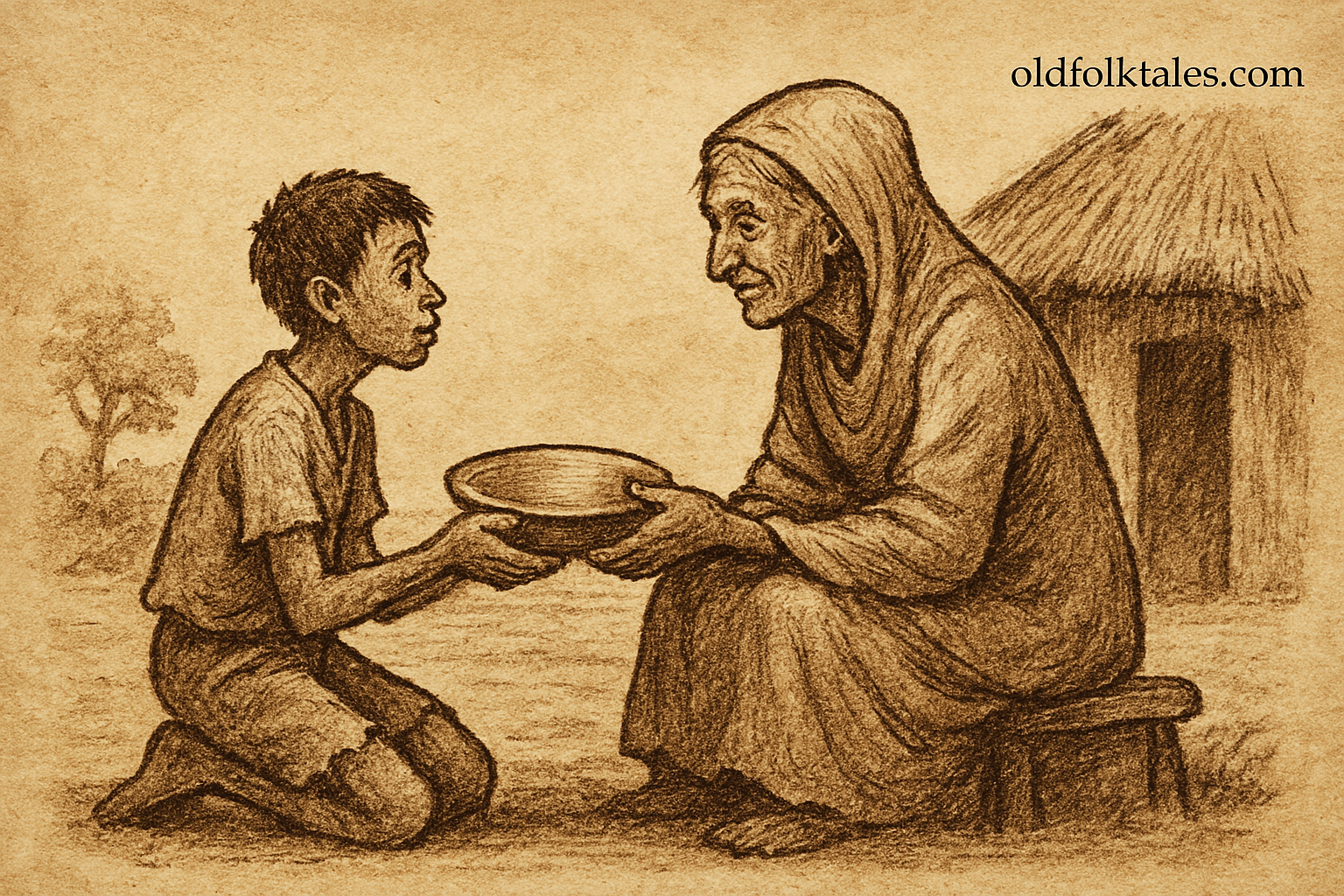
The path led him to a humble dwelling where an ancient woman sat in the doorway, her weathered face kind and knowing. Her eyes held the wisdom of countless seasons, and when she smiled, the boy felt the first warmth he had known since his mother’s death.
“Grandmother, are you at home?” he asked respectfully, using the traditional greeting.
“Welcome, my son,” she replied, her voice gentle as a lullaby.
After hearing his sorrowful tale, the old woman invited him to stay the night. “You look hungry, child. Cook some food for us both,” she instructed. “Behind the house, you’ll find plantains. Pluck some and cook the peelings.”
Though puzzled by her strange request, the boy obeyed without question. When the plantain peels touched the boiling water, they transformed into perfectly ripe fruit. Next, she told him to collect chicken droppings from the coop and fry them. Again, the boy followed her instructions faithfully, watching in amazement as the droppings became a delicious omelet that filled their bellies with satisfying warmth.
The Reward for Obedience
The next morning, bathed in golden sunlight, the grandmother led the boy to the chicken house. “Choose an egg that is black as dirt,” she instructed. Without hesitation, the boy selected the darkest, dirtiest egg he could find, though shinier ones tempted his eye.
“Here is your dish,” she said, placing the lost bowl in his grateful hands. “Take it to your stepmother, but break this egg in front of your father’s house.”
The boy thanked her from the bottom of his heart and began his journey home. The magical path seemed to stretch endlessly, but suddenly he found himself emerging from the stream near his village, the precious dish and mysterious egg safe in his possession.
When he presented the dish to his stepmother, she snatched it away without a word of gratitude. But when the boy broke the egg before his father’s house, wonder beyond imagination poured forth. Money cascaded like a waterfall, followed by magnificent cars, gleaming bicycles, smooth paved roads, and houses filled with electric lights and running water luxuries the poor family had never dreamed possible.
The father, witnessing this miracle, embraced his son with tears of joy and pride. “My boy, you have brought blessings to our entire household!”
The Seeds of Jealousy
But the stepmother’s heart burned with poisonous envy. If that worthless child could gain such wealth, surely her precious son deserved even greater riches. She immediately dragged her pampered boy to the stream and thrust dishes into his soft, unused hands.
The spoiled child threw a tantrum that shook the very trees, screaming and stamping his feet like a wild beast. But his mother’s greed had made her iron-willed. Finally, defeated by her persistence, he slouched to the stream where he spent the afternoon making a mess of the washing. When he returned, his arms and chest were blackened with soot and palm oil, he had never learned to use sand and awawa leaves to clean properly.
Ignoring his poor work, the mother commanded, “Throw this dish into the river and lose it on purpose!”
When evening shadows lengthened, she sent her reluctant son to search for the deliberately lost dish. Following the same magical path as his stepbrother, the boy soon found himself before the old woman’s dwelling.
The Punishment for Greed
Without offering a proper greeting, he rudely demanded, “Old woman, where is my mother’s dish?”
The wise grandmother, seeing the selfishness in his heart, still offered him shelter for the night. When she instructed him to cook plantain peelings and fry chicken droppings, the arrogant boy sneered at her supposed foolishness. Instead, he cooked the plantains and eggs directly, only to watch them transform into worthless peelings and droppings. Both went to bed with empty, growling stomachs.
The next morning, when offered his choice of eggs, the greedy boy’s eyes immediately fixed on the shiniest, most beautiful egg in the coop. Surely, he reasoned, such a magnificent egg must contain greater treasures than his brother’s dirty one.
Without thanks or farewell, he snatched the gleaming egg and hurried home, where his mother waited with hungry anticipation. Together, they fled deep into the forest to break their prize in secret, certain that untold riches awaited them.
But when the egg cracked open, evil spirits burst forth like demons from the underworld—a terrifying masquerade of darkness that fell upon the mother and son with supernatural fury. The forest echoed with their screams before silence claimed them forever. Their greed and wickedness had sealed their doom, leaving only their bones as a warning to future generations.
The Moral Lesson
This powerful tale teaches us that true wealth comes not from what we possess, but from how we treat others and respond to life’s challenges. The orphaned boy’s kindness, obedience, and humble gratitude were rewarded with abundance, while his stepmother’s cruelty and her son’s greed led to destruction. The story reminds us that jealousy is a poison that destroys those who harbor it, and that wisdom often comes disguised in simple requests that test our character.
Knowledge Check
Q1: What key character trait distinguished the two boys in this African folktale? A: The orphaned stepson showed humble obedience and gratitude by following the old woman’s strange instructions exactly, while the spoiled son displayed arrogance and greed by ignoring her guidance and choosing the shiniest egg.
Q2: How did the magical old woman test each boy’s character in this folktale? A: She tested them through seemingly nonsensical tasks, including cooking plantain peels and frying chicken droppings, and by offering them a choice of eggs, revealing their true nature through their obedience or disobedience.
Q3: What symbolic meaning do the dirty egg versus shiny egg represent in this African legend? A: The dirty black egg symbolizes humble acceptance and contentment, bringing forth genuine wealth and blessings, while the shiny egg represents greed and superficial desires, ultimately releasing evil and destruction.
Q4: How does this folktale reflect traditional African family structures and customs? A: The story shows polygamous households, the cultural expectation that stepmothers should treat stepchildren as their own, and the shame associated with visible favoritism within extended family compounds.
Q5: What role does the mystical underwater realm play in this African folktale? A: The underwater realm serves as a magical threshold where spirits test mortals’ character, representing the African belief that supernatural forces observe human behavior and reward or punish accordingly.
Q6: What lesson does this story teach about jealousy and its consequences in African moral tradition? A: The tale demonstrates that jealousy is self-destructive, showing how the stepmother’s envy of her stepson’s blessing led her to make dangerous choices that ultimately resulted in death for herself and her biological son.
Source: The sacred door and other stories: Cameroon folktales of the Beba (1st ed.). Ohio University Press.