In the time when the boundaries between the world of the living and the realm of spirits were as thin as morning mist, there lived a woman whose love for her only child burned brighter than the cooking fires of her village. But fate, relentless as the seasonal floods, claimed her life during the year of the great deluge, when angry waters swept away homes and hopes alike. She departed this world, leaving behind a husband and a young son who would soon learn the bitter taste of abandonment.
The Cruel Stepmother’s Reign
When the mourning period ended and life resumed its rhythm, the widowed man took another wife to help raise his boy and tend his household. This new woman arrived carrying her own burden of five sons, like a hen protecting her abundant brood. But her heart, cold as river stones during the dry season, had no room for the motherless child who reminded her daily of the woman who came before.
Also read: The Boy Who Wouldn’t Listen
The cruelty began in small, cutting ways that sliced deeper than any blade. While her own sons ate their meals from gleaming clean pans, polished until they reflected their faces like still water, she forced her stepson to eat from nkenkap leaves, treating him as if he were unworthy of proper vessels. This humiliation continued through his tender years, past adolescence, and well into manhood, marking him as an outsider in what should have been his own home.
As seasons turned like pages in an ancient book, the boys grew into men who built their own houses, chose wives, and started families of their own. But the pattern of neglect and favoritism remained as constant as the rising and setting sun.
The Princess and the Annual Feast
In this same village lived a chief whose daughter possessed beauty that rivaled the morning star and a spirit as independent as the wind itself. Despite countless suitors who arrived like pilgrims seeking blessing, she rejected every proposal, leaving her worried father to devise a solution. Each year, he hosted a magnificent feast, hoping the princess would finally choose a husband from among the gathered young men who flocked to the palace like birds to ripe fruit.
The stepmother’s eyes gleamed with anticipation each time the annual celebration approached. She would scrub her five sons until their skin gleamed like polished wood, dress them in the finest tob that shimmered with rich colors, and parade them before the royal court like prized cattle at market. But before departing for these grand occasions, she would devise a cruel task for her stepson that ensured his absence from the festivities.
Her method was as ingenious as it was heartless. She would mix a full basket of beans with bucket after bucket of coarse sand, creating a mountain of impossible sorting that would take hours to complete. “Separate every single bean from every grain of sand before we return,” she would command, her voice carrying the authority of absolute cruelty. “If this task remains unfinished when we come home, you will face consequences far worse than your current suffering.”
The Moment of Desperation
During the year of our tale, as laughter and music drifted from the distant palace like tantalizing whispers of a life he could never know, the young man sat before his impossible task. Each grain of sand that clung to the beans felt like a tiny dagger of humiliation. Have you ever experienced the agony of sand caught between your teeth while chewing? That sharp, grinding pain was nothing compared to the anguish that filled his heart as he performed this degrading labor year after year.
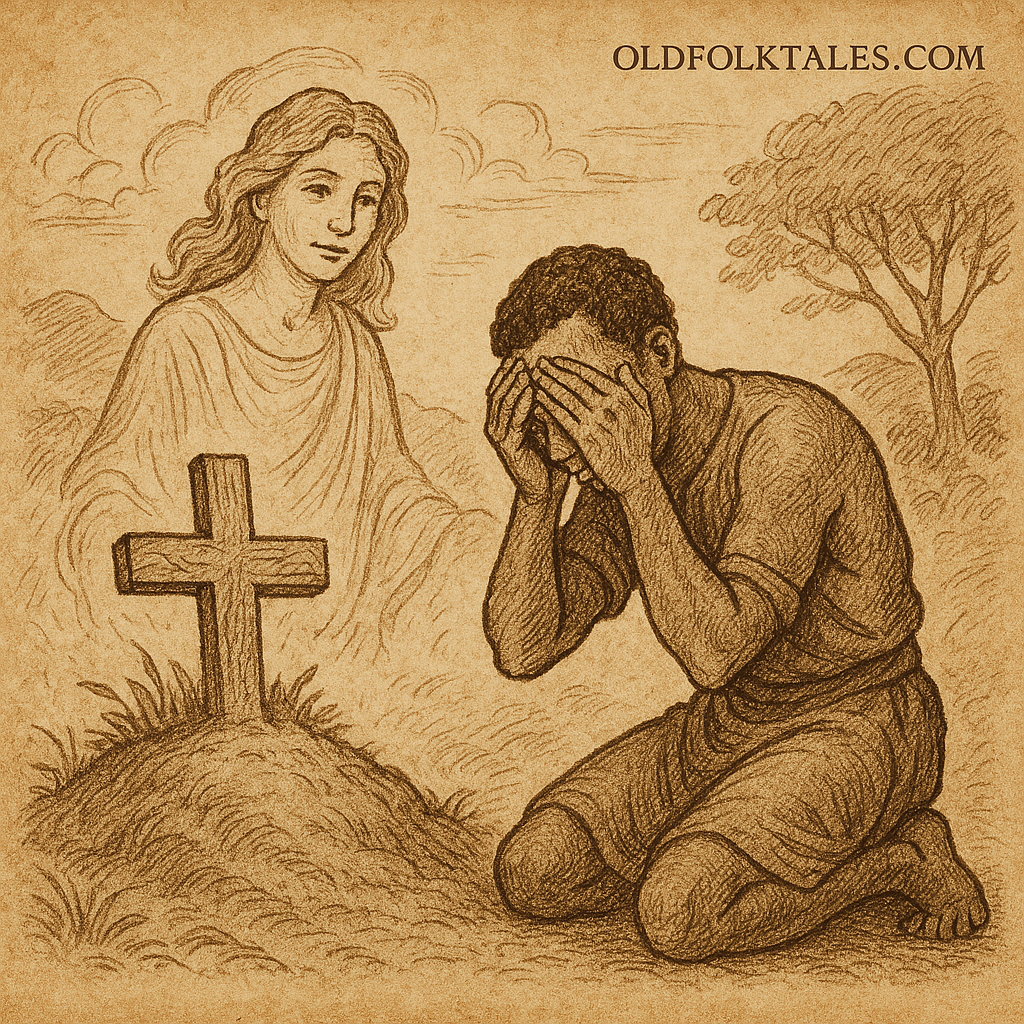
Finally, overcome by despair as heavy as storm clouds, he abandoned the basket and walked slowly to the edge of the nsaa, the sacred burial ground where his beloved mother rested beneath the red earth. Falling to his knees beside her grave, his tears fell like the first drops of the rainy season, soaking into the soil that held her bones.
“Oh, Mother, why did you leave me to face this torment alone?” he cried, his voice breaking like pottery dropped on stone. “Take me with you to the place where suffering ends. I cannot endure this life of humiliation any longer.”
The Miraculous Intervention
When his tears touched the sacred earth of her resting place, the ground trembled and opened like a flower blooming in reverse. From the depths emerged his mother, radiant with the otherworldly beauty of the ancestors, her form shimmering between the world of the living and the realm of spirits.
“My beloved son, what brings you to cry at my grave?” she asked, her voice carrying the warmth of a thousand embraces. “Your time has not yet come. Why do you seek to join me in the land of the dead?”
Through tears that flowed like rivers during flood season, the young man poured out his heart, recounting every indignity, every cruel word, every moment of loneliness he had endured since her death. His mother listened with the infinite patience of the ancestors, her spiritual eyes seeing not just his present suffering but the golden future that awaited him.
Without a word, she scooped all the scattered beans into a gleaming tin, completing in moments what would have taken her son hours of backbreaking labor. Then, with hands that moved like gentle breezes, she washed away the dust and sweat of his toil, anointing his body with precious palm kernel oil until his skin glowed with the luminous beauty of the full moon during rainy season.
She clothed him in a finely embroidered njumpa that shimmered with threads of gold and silver, transforming him from a downtrodden servant into a prince worthy of any royal court. From the spirit realm, she summoned a magnificent horse, its coat black as midnight and its mane flowing like water from a sacred spring.
The Princess’s Choice
Mounted on his supernatural steed, the young man rode toward the palace, his heart thundering with a mixture of fear and exhilaration. The courtyard swarmed with humanity like a great river during migration season, filled with hopeful suitors, curious villagers, and the excitement of potential royal romance. Never had he witnessed such a gathering, and the sight nearly overwhelmed his humble spirit.
From her elevated throne, crafted specially for these annual ceremonies, the princess surveyed the crowd with eyes that had grown weary of seeing the same types of ambitious young men year after year. But when her gaze fell upon the mysterious rider approaching on his magnificent horse, something stirred in her heart like the first flutter of butterfly wings.
Her eyes followed his every movement, drinking in his otherworldly beauty and the graceful way he commanded his mount. As he drew nearer, she felt certainty settle in her soul like a bird finding its perfect nesting tree.
“Father,” she announced, her voice carrying the authority of destiny itself, “my husband has arrived.”
The chief, stunned by his daughter’s sudden declaration after years of rejections, craned his neck to follow her pointing finger. “Where, my child? Which of these young men has finally captured your heart?”
“There, approaching on that magnificent horse. That is the man I will marry.”
The Magical Escape
The young rider dismounted with fluid grace and entered the festival grounds, where music and laughter created a symphony of celebration. The princess, unable to contain her joy, stepped down from her throne and rushed toward him like a river flowing to the sea.
“This is my husband! This is my husband!” she declared to the astonished crowd, throwing her arms around the startled young man.
But the magic that had transformed him came with the temporary nature of all supernatural gifts. Overwhelmed by the princess’s sudden affection and the attention of hundreds of eyes upon him, the young man slipped from her embrace like water through cupped hands and fled toward his waiting horse.
In his haste to escape before the magic could fade and reveal his true identity, one of his shoes fell to the ground. But he dared not stop to retrieve it, for already he could feel the spiritual garments beginning to shimmer and fade like morning dew under the rising sun.
The Search and the Test
Back at his mother’s grave, the magical clothes and horse disappeared into the spirit realm, leaving him once again in his humble work clothes, sitting before the mysteriously completed task of sorting beans from sand. The palace erupted in frantic searching, but the mysterious suitor had vanished as completely as a dream upon waking.
The princess wept tears of heartbreak, her spirit shattered by the brief taste of true love that had been snatched away. Her father, desperate to restore his daughter’s happiness, sent forth the ntsendia, his royal messengers, carrying the lost shoe and a royal decree: every young man in the village must try on the shoe, and whoever it fit would become the prince consort.
Compound by compound, the messengers searched, but the shoe rejected every foot like a lock refusing the wrong key. When they finally arrived at the stepson’s home, his stepmother’s heart raced with greedy anticipation. She hid the young man in the darkest corner of the house and presented each of her five sons in turn.
When the oldest son’s foot proved too large for the delicate shoe, the desperate woman seized a knife and carved away part of his flesh, her greed overcoming maternal love. When that made his foot too small, she realized with growing horror that none of her precious sons would claim the royal prize.
“Are these all the male children in this compound?” the ntsendia inquired with official authority.
The woman’s eyes darted nervously to the corner where her stepson crouched like a shadow. “That wretched creature in the corner… I suppose he could try, though surely such a filthy child could never…” her voice trailed off in stammering uncertainty.
When the young man stepped forward and barely touched his toes to the shoe, it embraced his foot like a lover’s caress, fitting perfectly as if crafted specifically for him. The stepmother’s face twisted with bitter recognition and disbelief that her despised stepson could be the mysterious prince who had captured the princess’s heart.
The New Beginning
At the palace, the chief welcomed his future son-in-law with the warmth due to royalty, providing food, shelter, and honor. But the young man’s heart remained restless, like a bird that remembers the freedom of open skies. One day, while the palace buzzed with the activity of daily life, he slipped away to his mother’s grave for one final conversation.
“Mother, I am here,” he whispered to the sacred earth.
Once again, the ground opened and his spiritual mother emerged, radiant with ancestral wisdom. She dressed him in the same magnificent garments and placed upon his finger a ring that glowed with supernatural power.
“Tell the chief you wish to take your wife to establish your own home,” she instructed. “Journey beyond the seven hills and cross seven rivers. This ring will provide everything you need to build a new life with your beloved.”
The Journey to Happiness
Following his mother’s guidance, the young man approached the chief with his request. The wise ruler, understanding that true love requires freedom to flourish, gave his blessing: “Since you have captured my daughter’s heart completely, you may take her wherever your dreams lead you. Only promise to visit us when you can.”
The couple rode for days across rolling hills and through valleys painted with wildflowers, leaving behind the village where suffering had marked his youth. They traveled until they reached an open plain that stretched toward distant horizons like a canvas waiting for an artist’s brush.
“Do you like this place?” he asked his princess bride.
“Here I can breathe freely,” she replied with playful affection.
As night painted the sky with stars, he made camp beneath a ancient tree, gathering wood for a fire that would warm them through the darkness. When his beloved wife fell asleep under the gentle light of the moon, he stood and spoke to the magical ring his mother had given him.
Like a vision from the realm of dreams, a magnificent compound materialized beside the tree, complete with grand houses surrounded by protective fencing, gardens that promised abundance, and every comfort befitting a royal couple.
“Wake up, my princess,” he whispered gently, touching her shoulder. “Let us go home.”
She woke to find herself surrounded by the paradise that would become their new life, built from love that transcended even death itself.
The Moral Lesson
This profound folktale teaches us that love, especially the love between parent and child, transcends even death itself. The story demonstrates that those who endure suffering with patience and maintain respect for their ancestors will ultimately be rewarded, while cruelty and favoritism bring only bitterness and regret. It reminds us that true transformation comes not from material wealth or status, but from the spiritual support of those who genuinely love us, and that sometimes we must journey far from familiar places to find our true happiness and purpose.
Knowledge Check
Q1: What role does the dead mother’s spirit play in this African folktale? A: The mother’s spirit serves as a divine protector and provider, emerging from her grave to transform her suffering son with magical clothes, complete his impossible tasks, and ultimately guide him to a new life of happiness and prosperity.
Q2: How does the shoe test reveal character differences in this traditional story? A: The shoe test exposes the stepmother’s desperate greed when she mutilates her own son’s foot to try to force a fit, contrasting with the natural, perfect fit on her stepson, symbolizing that true worthiness cannot be faked or forced.
Q3: What cultural elements appear in this African folktale regarding family and social structures? A: The story reflects traditional polygamous households, the cultural expectation of stepmothers caring for stepchildren, royal marriage customs, the importance of ancestral graves (nsaa), and the role of royal messengers (ntsendia) in official business.
Q4: What symbolic meaning does the magical ring represent in this African legend? A: The magical ring symbolizes the mother’s final gift of independence and creative power, enabling her son to build his own life and home, representing the transition from dependence to self-sufficiency guided by ancestral wisdom.
Q5: How does the princess’s behavior differ from typical folktale princesses? A: Unlike passive princesses, this African princess actively rejects multiple suitors for years, immediately recognizes her true love when she sees him, publicly declares her choice, and willingly leaves her royal home to start a new life with her chosen husband.
Q6: What lesson does this folktale teach about perseverance through suffering? A: The story demonstrates that those who endure mistreatment with dignity and maintain connection to their spiritual roots will eventually be rewarded, while patience and respect for ancestors lead to transformation and ultimate happiness.
Source: The sacred door and other stories, Cameroon folktales of the Beba (1st ed.). Ohio University Press.