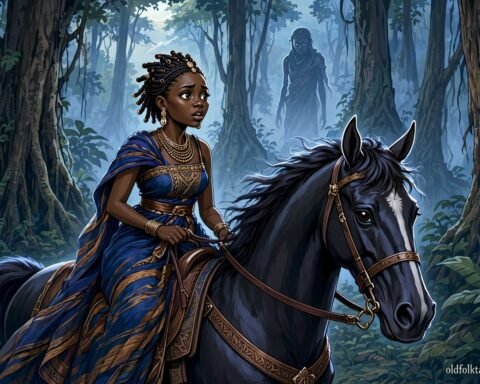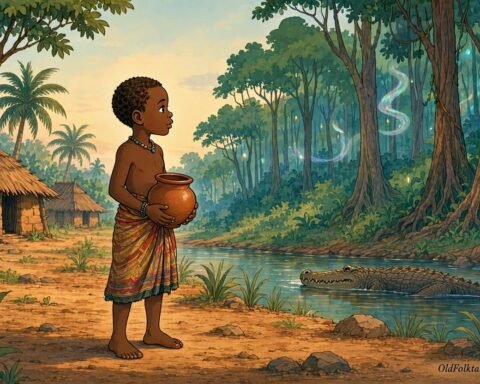
The dry season had arrived with its familiar promise of harvest and renewal. Across the village, families prepared for the annual ritual of gathering the last precious achu-cocoyams from the earth before preparing the soil for new plantings. The air was thick with anticipation and the scent of parched earth waiting for rain.
On this particular morning, a woman gathered three of her children, her son Mandiengoh and her two daughters, Atah and Maweghndia, for the journey to their family farm. The children chatted excitedly as they walked the familiar path, unaware that this day would test the very bonds of obedience that held their family together.
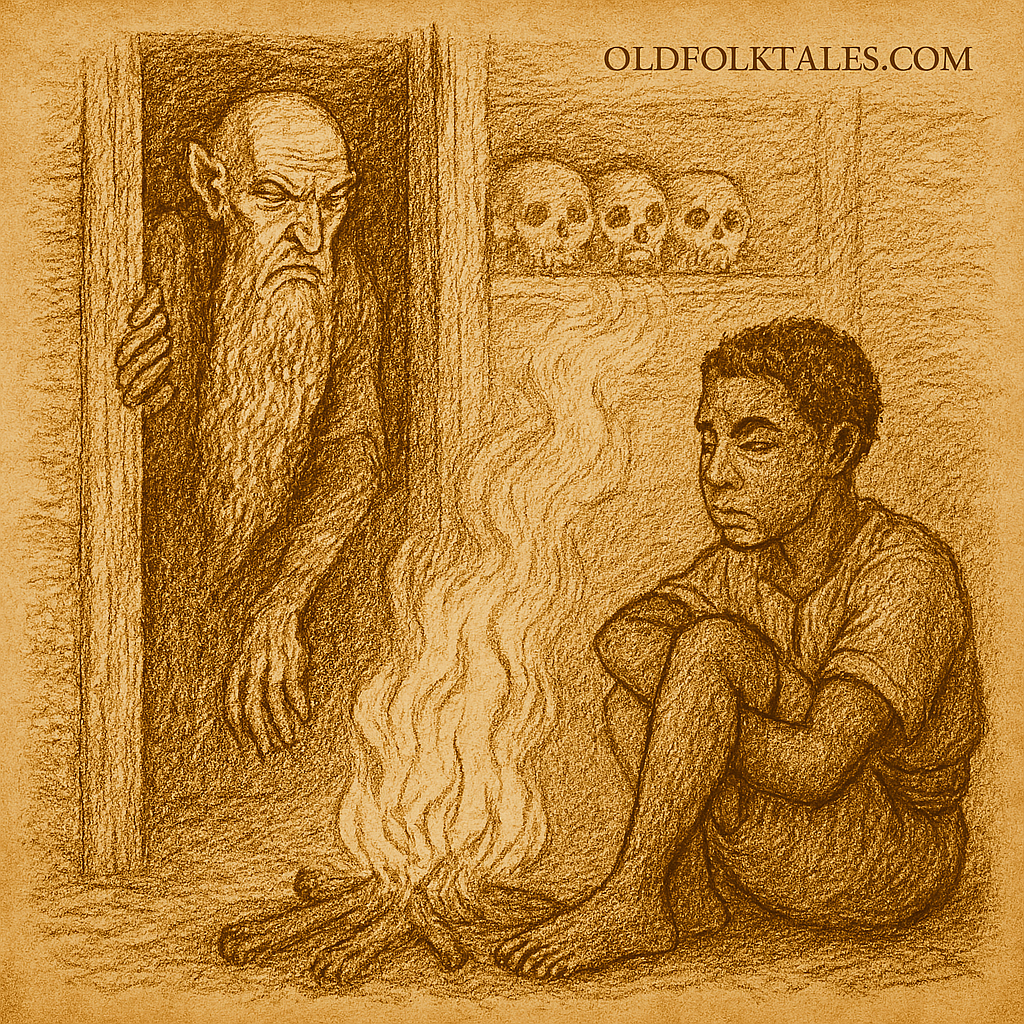
Upon reaching their plot of land, the woman stopped abruptly. There, hunched over their precious cocoyam patch, was a figure that made her blood run cold. The man was unlike any she had ever seen, his fingernails had grown long and dirty, curling like claws from his gnarled hands. His teeth jutted from his mouth in sharp, yellowed points, and his head was completely bald, gleaming in the morning sun. Most striking of all was his beard, which cascaded down his chest in tangled, unkempt strands that spoke of years without care or companionship.
Also read: Mother’s Magic from the Grave
Despite her fear, the woman approached with the respectful courtesy her culture demanded. Her voice trembled slightly as she offered the traditional greeting.
“Father, did your day break?”
The creature’s response came in a voice like gravel scraping against stone, ancient and worn. “Yes, my daughter. And yours?”
“We are well. We’ve just come here for some food. And you?” she replied, studying his otherworldly features more closely.
“I am hungry, and since I have no one to take care of me, I’ve come to harvest some cocoyams,” he answered, his strange eyes never leaving her face.
The woman’s heart raced as recognition dawned. This was no ordinary man but a spirit dwelling in human form—a ghost, and not one of the benevolent ancestors who watched over families, but something darker. One of the malevolent spirits born from ogres, the kind that fed on human flesh and collected souls like trophies.
“You don’t have a wife?” she asked, hoping to learn more about this dangerous being.
“No.”
“You don’t have children?”
“No.”
“No brothers? Uncles? Sisters?”
“No, I don’t have any family,” the ghost replied with a hint of sadness that might have been genuine—or carefully feigned.
“Is that why you’ve kept such a long beard?” she pressed.
“I don’t own a pair of scissors,” he grunted, running his clawed fingers through the matted hair.
“I can be of help,” the woman offered, her mind already working on a plan of escape.
No sooner had the words left her lips than the sky exploded in fury. A brilliant flash of lightning split the heavens, followed immediately by the gathering of dark, menacing clouds that swirled overhead like a great cauldron of storm. Violent winds bent the trees nearly to breaking, and then the rain came—not in gentle drops, but in long, slashing sheets that turned the world into a blur of water and wind. Thunder crashed overhead with such force that the children pressed close to their mother, trembling with fear.
“I live over there,” the bearded figure said, raising one gnarled finger to point toward a distant structure barely visible through the storm. “You can take shelter and wait out the rain.”
With no other choice and three frightened children to protect, the woman accepted his offer. They followed the strange figure through the torrential downpour, their feet slipping in the rapidly forming mud. The more they walked, the heavier the rain seemed to become, and curiously, the house appeared to retreat further into the distance with each step they took, as if the very landscape was playing tricks on them.
Finally, they could see wisps of smoke spiraling up through the thatched roof, and the ghost led them into a room thick with the haze of burning wood. The woman and her children gratefully settled near the hearth, where flames danced hypnotically and warmth began to chase away the chill that had seeped into their bones. The fire was wonderfully somnific, its heat drying their soaked clothes and creating a cocoon of comfort that made their eyelids heavy.
As the wood fire burned brighter and the smoke began to clear, the woman’s eyes adjusted to her surroundings. What she saw behind the ghost’s mud-bed made her blood freeze in her veins rows upon rows of human skulls, clean and white, arranged like trophies along the wall. The sight confirmed her worst fears about their host’s true nature.
Thinking quickly, she called her son to her side and whispered urgently under her breath, “Go home and don’t come back.” Then, raising her voice to sound natural, she said, “Go to the house and bring the pair of scissors I put on the windowsill in your father’s house.”
But Mandiengoh, warm and comfortable by the golden embers, refused to move. He simply sat down and scooted even closer to the fire, ignoring his mother’s desperate request.
Hiding her panic, the woman called her oldest daughter. “Atah, go and get the scissors,” she said loudly, then whispered as the girl passed, “Go and don’t come back.”
Atah, wise and obedient, understood immediately. She left the ghost’s house and ran straight home, never to return.
Time passed slowly as the woman and her remaining daughter, Maweghndia, worked together to maintain the fire. The mother would add more firewood while her daughter knelt and blew on the embers until the flames exploded upward, engulfing the fresh wood in brilliant orange tongues.
After what felt like hours, the woman sighed dramatically. “Maweghndia, I don’t know why your sister hasn’t come back with those scissors yet. Go and see what is happening, and be quick about it.”
Maweghndia, like her sister before her, took the hint and fled to safety, never to return to that cursed house.
Now desperate, the woman turned once more to her stubborn son. “Go and see why your sisters are taking so long,” she pleaded, her voice heavy with urgency that only a mother’s heart could convey.
But again, the boy ignored his mother’s words, too entranced by the warmth and comfort of the fire to heed her warnings.
“Oh, children these days,” the woman said to the ghost, forcing lightness into her voice while her heart broke with fear for her disobedient son. “I am going to see what those two girls are up to. They will be sorry they’ve disobeyed me.”
With these words, she left the ghost’s house, abandoning her stubborn son to his fate.
When evening shadows fell across the land, the ghost departed from his dwelling, and curious Mandiengoh, rather than fleeing to safety, chose instead to hide himself under the mud-bed. Soon, the ghost returned with several of his ghoulish brethren, their eyes glowing with hunger and malevolent joy.
The ghost discovered the hiding boy and, without hesitation, chopped off his head. Mandiengoh’s flesh made excellent soup to accompany their feast of cocoyams, and his skull found its place among the growing collection behind the mud-bed, a grim reminder of the price of disobedience.
The Moral of the Story
This tale serves as a powerful reminder that obedience to parents, especially in times of danger, can mean the difference between life and death. Mandiengoh’s stubbornness and refusal to heed his mother’s warnings ultimately led to his doom, while his sisters’ quick understanding and compliance saved their lives. The story teaches that wisdom often comes disguised as parental instruction, and that comfort and immediate pleasure should never override caution and obedience when our safety is at stake.
Knowledge Check
Q: Who is the main character in “The Disobedient Son” folktale? A: The main character is Mandiengoh, a young boy whose refusal to obey his mother’s warnings leads to his tragic death at the hands of an evil spirit.
Q: What does the bearded figure represent in West African folklore? A: The bearded figure represents a malevolent spirit or ghost in human form specifically described as offspring of ogres who prey on humans and collect their skulls as trophies.
Q: What is the primary lesson of “The Disobedient Son” story? A: The story teaches that children must obey their parents, especially in dangerous situations, as parental wisdom and instructions are often meant to protect them from harm.
Q: How do Atah and Maweghndia escape the ghost’s house? A: Both daughters obey their mother’s whispered instruction to “go and don’t come back” when sent on errands, understanding the coded warning and fleeing to safety.
Q: What cultural significance do cocoyams have in this West African tale? A: Cocoyams represent sustenance and the agricultural cycle in West African culture, with their harvest marking the transition between dry and planting seasons, making them a valuable resource worth protecting.
Q: Why does the mother use coded language with her children? A: The mother uses whispered warnings and coded messages because she recognizes the supernatural danger they face and needs to get her children to safety without alerting the malevolent spirit to her true intentions.
Source: The sacred door and other stories, Cameroon folktales of the Beba (1st ed.). Ohio University Press.