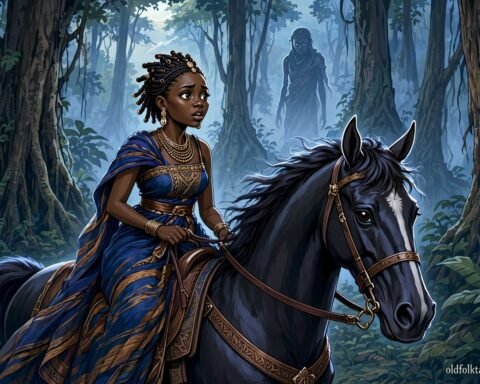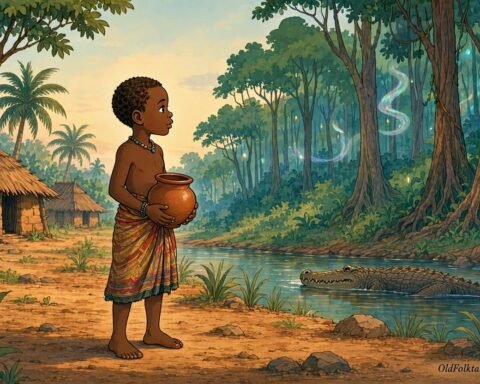
In a village where the red earth met endless skies and ancient trees whispered secrets to those who would listen, there lived four daughters bound together by circumstances rather than blood. Three were sisters by birth, blessed with comfortable lives and their mother’s favor, while the fourth was an orphan who had found shelter under their roof but never warmth in their hearts.
The orphan girl possessed a beauty that seemed to glow from within, like morning sunlight filtering through clean water. Her features were delicate and perfectly formed, her skin smooth as polished wood, and her eyes held depths that spoke of wisdom beyond her years. Perhaps it was this very beauty that stirred such cruel jealousy in her stepsisters’ hearts, for they treated her with constant spite and bitterness that poisoned the very air of their home.
One sweltering day, when the sun hung heavy in the sky like a brass disk and the air shimmered with heat, their mother sent all four girls into the forest to gather firewood. The stepsisters, true to their cruel nature, forced their orphaned companion to do most of the backbreaking work while they lounged in whatever shade they could find, criticizing her efforts and mocking her struggles.
Also read: Mbaka and the Magic Ring
By midday, the heat had become unbearable, pressing down upon them like a living thing that stole their breath and made their clothes cling uncomfortably to their skin. The three sisters decided they needed relief and announced their intention to cool themselves in the nearby river. The orphan girl, exhausted from her labors and sensing their mood, expressed reluctance to join them, but her stepsisters would hear none of her protests. They dragged her along, their grip harsh and unforgiving on her tired arms.
At the riverbank, where ancient trees bent low to kiss the water’s surface and dragonflies danced like jeweled spirits in the dappled light, the girls threw off their clothes with the abandoned joy of youth seeking relief. They leaped into the cool embrace of the flowing water, sending up sprays that caught the sunlight and created brief rainbows in the air.
The river came alive with their laughter and play as they water-drummed with their palms, creating rhythmic beats that echoed off the surrounding forest. They splashed each other with handfuls of cold water, the liquid diamonds flying through the air and landing with delicious shock on heated skin. They scrubbed each other’s backs with gentle care, working away the dust and sweat of their morning’s labor, then floated luxuriously on their backs to rinse away the soap, their hair streaming around them like dark water weeds.
When the orphan girl, feeling vulnerable and alone despite being surrounded by others, asked one of her stepsisters to scrub her back as they had done for each other, the response cut through her heart like a blade. Her stepsister laughed with cruel mockery, the sound harsh and grating compared to their earlier musical laughter, and deliberately turned away, ignoring the orphan’s simple request as if she were nothing more than an annoying insect.
The rejection stung deeper than any physical blow, leaving the orphan feeling more isolated than she had ever felt before. In her hurt and desperation, she moved away from the group and leaned her back against the rough bark of a towering iroko tree, using its ancient trunk to scrub away the dirt and tension that her stepsisters had refused to help remove.
But this innocent act of self-care triggered something supernatural and terrible. As she rubbed against the sacred tree, her smooth skin began to change, developing thick, ugly scales like those of a crocodile. The transformation spread across her back like a living nightmare, and from her armpits sprouted wings, dark and leathery, that marked her as something no longer entirely human.
The horror of her transformation overwhelmed her completely. She fell to the sandy riverbank, crying with the desperate anguish of a woman who has just lost her beloved husband, rolling in the dirt as waves of grief and terror washed over her. Her stepsisters, seeing what she had become, abandoned her without a moment’s hesitation or compassion, fleeing home as if her misfortune might somehow contaminate them.
When their father inquired about his beloved daughter’s whereabouts, the three sisters lied with practiced ease, claiming she had wandered off to gather firewood in a different part of the forest. The heartbroken father set out immediately to search for her, and people say that he never returned, perhaps lost forever in his quest to find his transformed child.
All night long, the orphan girl’s wails echoed through the forest, her cries of despair carried on the wind like the songs of the grieving dead. Her sobs reached the ears of an old woman who lived deep in the woods, a creature of kindness whose heart was moved by such profound suffering. Following the sound of weeping through the dark forest paths, she discovered the transformed girl still sitting beneath the iroko tree, her new form hunched with shame and sorrow.
The old woman’s heart immediately went out to this pitiful creature. She took the girl home to her small compound, offering not only shelter but also the companionship of her own daughter, a kind-hearted girl who readily accepted the newcomer as a friend. In her generosity, the old woman even offered her son’s hand in marriage, but the transformed girl was shocked by such an offer.
“Why would any young man in his right mind want to marry me?” she wondered aloud, her voice heavy with self-loathing and despair at her monstrous appearance.
Though the old woman tried to persuade her with gentle words and patient arguments, the girl stood firm in her refusal. The old woman’s daughter quickly became a true friend to the transformed girl, offering the kind of unconditional acceptance that had been missing from her life. But the son was another matter entirely. He looked upon her with disgust and contempt, refusing to speak with her or even be seen in her presence. Whenever their paths crossed, he would call her a monster, each insult falling like a stone into the pool of her already wounded heart.
“Before I join my ancestors,” the old woman pleaded with her stubborn son, “I want to see you married so I can go to my rest in peace.”
Her son made his promise grudgingly: he would indeed marry, but never to the monster with wings and scales who had invaded their home. His mother’s response carried the weight of prophetic warning.
“A wise man never urinates against the wind,” she chided him with ancient wisdom. “Mark my words carefully, son. Your insensitivity will be your undoing.”
One day, the old woman’s daughter brought exciting news that would change everything. There was to be a dance in the sky, a celestial celebration unlike anything on earth, and she wanted both herself and her transformed friend to attend. For the orphan girl, who had never experienced the joy of dancing or the warmth of community celebration, this invitation filled her heart with desperate hope and excitement.
The two girls prepared with the care of young women attending their first great social event. They braided each other’s hair in intricate patterns that caught the light like woven sunbeams, bathed until their skin glowed with cleanliness, and dressed in their finest clothes that had been saved for just such an occasion.
To reach the celestial dance, they first had to cross the same river where the orphan’s transformation had begun. When they reached its banks, memories flooding back like a painful tide, the orphan girl asked her friend to wait by the water’s edge while she attended to a private matter.
Hidden behind the same iroko tree that had witnessed her curse, something miraculous occurred. The orphan girl underwent another transformation, but this time the scales and wings fell away like discarded clothing, revealing once again the beautiful girl she had been before her cruel stepsisters’ rejection had triggered her monstrous change.
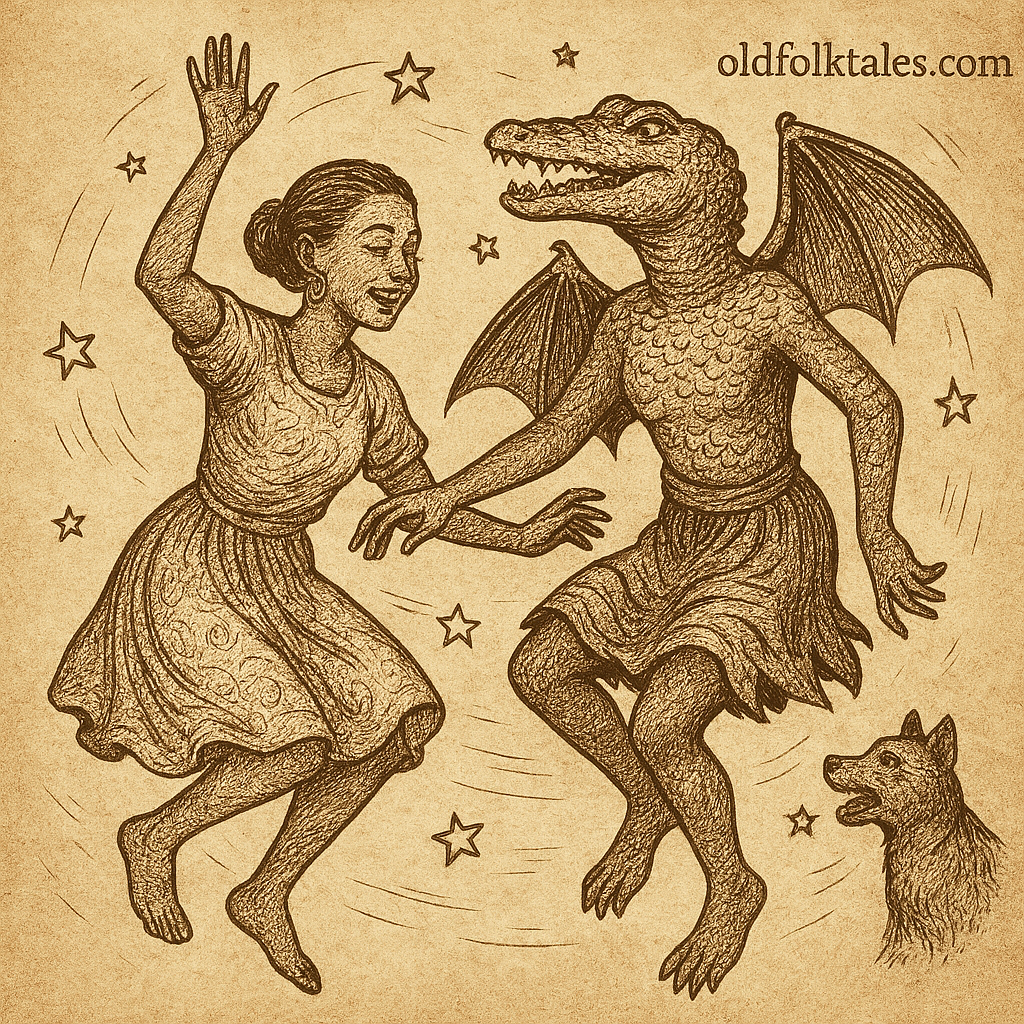
She rejoined her friend, and together they ascended to the dance in the sky, where celestial music filled the air and stars themselves seemed to pulse with the rhythm of the celebration. All the young men present were captivated by the orphan’s restored beauty, thinking her a queen sent to earth by the very stars themselves. Among these admirers was the old woman’s son, who had no idea he was falling in love with the same creature he had scorned and called a monster.
The two girls danced to the tune of the melo, the traditional Beba instrument filling the sky with melodies that seemed to make the very air sparkle with joy. They sang naughty songs to the moon and bawdy songs to the sun, losing themselves in the celebration until exhaustion finally claimed them.
On their return journey, the orphan girl again left her friend by the riverbank while she recovered her monstrous form, ensuring that her secret remained safe. But secrets, like seeds, have a way of growing in unexpected directions.
The old woman’s daughter, consumed by curiosity about her friend’s mysterious behavior, whispered to her mother what she had witnessed. On the second night of the celestial dance, the wise old woman followed the girls and saw the truth of the transformation with her own eyes.
During that second night’s festivities, her son again tried to court the beautiful stranger, but she continued to reject his advances, perhaps recognizing something familiar in his manner. That night, the young man could not sleep, tossing and turning as he was tormented by strange thoughts about the resemblance between the heavenly beauty and the earthbound monster.
On the third and final night of the dance in the sky, the old woman once again followed the girls to the river. This time, however, she waited until they had departed for the sky, then made a decision that would change everything forever. She burned the monstrous form left sitting under the tree, destroying the orphan’s curse but also trapping her in her true, beautiful form.
When the dance ended and the girl returned to find her transformation impossible, she knew immediately that she had been discovered and, in a way, liberated. Her friend apologized for her mother’s actions and begged her to stay with them permanently, no longer needing to hide behind a monstrous disguise.
The next morning brought a scene of poetic justice when the old woman’s son encountered the girl he had despised, now revealed in all her natural beauty. Recognition dawned in his eyes like sunrise, followed immediately by desperate desire and crushing shame for his previous cruelty.
He quickly proposed marriage, but she had not forgotten his earlier insults and treatment. Her response was both a test and a punishment: “If you bring me the tail of a living leopard, you can marry me.”
“But that’s impossible,” he protested, the task seeming as unreachable as the stars themselves.
“Follow a river and you’ll find the sea,” she replied with the mysterious wisdom that often accompanies great trials. “And if you follow bees, you cannot miss honey.”
The young man went to his mother seeking help with this impossible riddle, but she had no patience for the troubles brought on by his own cruelty. “The person suffering from diarrhea is the one who goes to the bush,” she reproached him, turning her back on his pleas.
For weeks, the young man wandered the village like a lost soul, growing more miserable and haggard as he wracked his brain for a solution. The village elders, perhaps sensing that this trial was meant to teach him important lessons, refused to help him.
Finally, while checking his fishing baskets by the river, inspiration struck. He remembered hearing that leopards loved honey above all treats, and a plan began to form. “Isn’t it said that a chick pries the hawk away from the top of the tree?” he mused, his mood changing so dramatically that the entire village noticed.
When honey season arrived, he patiently harvested a full calabash and carried it deep into the forest. Near a leopardess’s cave, where she was nursing new cubs, he climbed a tree and waited. When she emerged seeking food, he dropped honey on her head, neck, jaw, and near her mouth.
The leopardess, intrigued by this sweet gift, looked up and asked for more. After sharing half the calabash, the young man made his request: he needed a leopard’s tail to prove his love. The leopardess, perhaps moved by his honesty or impressed by his cleverness, agreed to help on the condition that he return the tail after proving his love.
She led him into her cave, fed honey to her cubs to make them sleep, and allowed him to cut off one cub’s tail. He took it to the girl as proof of his devotion, told her of his promise, and with her permission, returned it to the leopardess, who magically reattached it.
When the other young men learned of the impending marriage, jealousy erupted among them like poison. They invited him on a hunting expedition and murdered him in the forest, returning to report that he had fallen off a cliff to his death, claiming they had tried but failed to rescue him.
The girl listened to their lies with the patience of someone who sees through deception. Her response was both a test and divine judgment: “I am going to throw a stone from the sky. Whoever catches it will be my future husband.”
The young men eagerly gathered at the designated spot, jostling for position like vultures fighting over carrion. The girl flew high into the sky and hurled down a massive rock, heavier than ngbalii. The men fought to catch it, but the stone crushed them all to death, divine justice served for their murderous jealousy.
Afterward, the girl went into the forest, found her true love’s corpse, and breathed life back into his body with the power that had been hers all along. From that day forward, they both left the earthbound village and went to live among the stars, where their love could flourish beyond the reach of human cruelty and jealousy.
Moral Lesson
This powerful tale teaches us that true beauty comes from within and that our treatment of others reveals our own character. The stepsisters’ cruelty toward the orphan and the young man’s initial rejection of her transformed state both brought consequences, while genuine love and respect ultimately triumphed. The story reminds us that supernatural forces often work to ensure justice, rewarding those who show kindness and punishing those who are cruel or driven by jealousy and greed.
Knowledge Check
Q1: Who is the orphan girl and what causes her supernatural transformation? A: The orphan girl is a beautiful young woman living with cruel stepsisters who becomes transformed into a monster with scales and wings after being rejected when she asks for help scrubbing her back, leading her to use the iroko tree instead.
Q2: What role does the dance in the sky play in the story’s development? A: The celestial dance serves as the magical setting where the orphan girl can temporarily return to her beautiful form, allowing her to experience joy and ultimately catch the attention of the young man who had previously scorned her monstrous appearance.
Q3: How does the old woman demonstrate both wisdom and decisive action in the story? A: The old woman shows wisdom by warning her son about his insensitivity and demonstrates decisive action by burning the orphan’s monstrous form, permanently freeing her from the curse and forcing the truth to be revealed.
Q4: What is the significance of the impossible task involving the leopard’s tail? A: The leopard’s tail task tests the young man’s dedication and ingenuity while teaching him humility. His success through cleverness and honesty with the leopardess proves his worthiness and character transformation.
Q5: What cultural elements from Beba tradition are preserved in this folktale? A: The story includes Beba cultural elements such as the melo (traditional musical instrument), specific sayings and proverbs, the significance of the iroko tree, and traditional concepts of celestial realms and supernatural transformation.
Q6: How does divine justice function in the story’s conclusion? A: Divine justice appears when the jealous young men who murdered the worthy suitor are crushed by the stone they try to catch, while the true lovers are reunited and elevated to live in the sky, showing that good is ultimately rewarded and evil punished.
Source:The sacred door and other stories, Cameroon folktales of the Beba (1st ed.). Ohio University Press.