In the rolling hills of a distant land, eight days’ trek from memory itself, there once stood a village that bore the appearance of any other settlement across the continent. Thatched roofs crowned modest compounds, rivers wound their silver paths through verdant valleys, and children’s laughter should have echoed through the air. Yet this village harbored a darkness so profound that even the hyenas, who our people say will never devour their own young, would have recoiled in horror.
At the heart of this cursed settlement stood an enormous house, its walls stained with secrets too terrible for daylight. Within those walls, the men of this village gathered to feast upon human flesh, having abandoned all bonds of humanity in their descent into cannibalism. They took turns venturing forth to hunt their prey, carrying their victims back in woven bendjob bags like hunters returning with antelope or bush pig.
When a successful hunt concluded, the hunter would present himself before their king, who would personally mount the ceremonial drum. The hollow beats would roll across the landscape dum dum dum dum dum, summoning every man with the rhythmic call gwudum gwudum gwudum gwudum. Even the ancestors must have wept to hear a king debasing himself by beating his own drums, a task meant for servants and courtiers.
Also read: The Sun’s Abandoned Wife
One fateful day, a hunter from this accursed village traveled far beyond his territory and discovered a young girl alone in her family compound while her parents toiled in distant fields. She was an only daughter, the precious heart of her parents’ world, but the cannibal saw only meat for his village’s insatiable hunger. He seized the child, thrust her into his bendjob, and began the long journey home.
When evening shadows brought the parents back from their farm, their calls for their daughter met only silence. They searched every compound, climbed every hill, combed through dense forests until their voices grew hoarse and their hearts heavy with despair. Days melted into weeks, and hope withered like crops in drought. The village elders poured libations for the dead, concluding that wild beasts had claimed the child, and funeral rites commenced.
But the spirits had not finished weaving this tale. Neighbors of the grieving mother, their hearts aching for her endless sorrow, coaxed her to join them at their distant farm. “Come make beds for sweet yams and achu-cocoyams,” they urged. “Work will ease your pain and help your heart heal.” The location proved providential, situated near the main path where travelers frequently passed.
As the women labored under the morning sun, creating rectangular beds of grass and twigs covered with rich soil, the very hunter who had stolen the child appeared on the path. He greeted them with false courtesy: “My mothers, I commend your work.”
“Eeh loo,” the women chorused in response.
“I am desperately hungry,” he continued, scratching his throat. “Would you please give me food? I will eat it, and then my bag will sing beautifully for you.”
The bereaved mother’s generous heart moved her to action. She hurried to harvest cocoyams, then approached one of their smoldering beds where fires burned continuously to create natural ovens. She widened the glowing mouth with a stick, listening to the familiar sounds of crackling flames that would burn for days. The cocoyam skins rustled twa, twa, twa, twa as they roasted in the hot ashes.
When the traveler finished eating, he opened his bendjob and gave the peelings to its hidden contents. “Eat and sing for these women,” he commanded.
From within the bag came a voice so achingly familiar it pierced the mother’s heart like lightning:
tanda meyase djo misi yie u fiake mi boro wato wandele wa, wandele selenge wandele senge senge
“Your bag sings so sweetly,” the mother said, her voice trembling with recognition. “Please, could it sing once more?”
The haunting melody filled the air again, confirming what her maternal heart already knew. When the man requested water to soothe his irritated throat, the clever mother saw her opportunity. She handed him a calabash and pointed toward a nearby spring. “Just three furrows away,” she said.
But as he walked toward the water, the mother’s supernatural power moved the spring farther and farther away, until the frustrated man disappeared from view entirely. In those precious moments, she freed her daughter from the bendjob, hiding the child behind thick shrubs, then filled the bag with a furious swarm of bees before sealing it shut. When the confused man returned with water, he never suspected the deadly substitution.
The journey home proved increasingly troublesome as the bag grew mysteriously heavy and responded to his demands for singing with only ominous humming. At each stop along the way, when he asked for entertainment, the angry bees’ drone grew louder and more menacing.
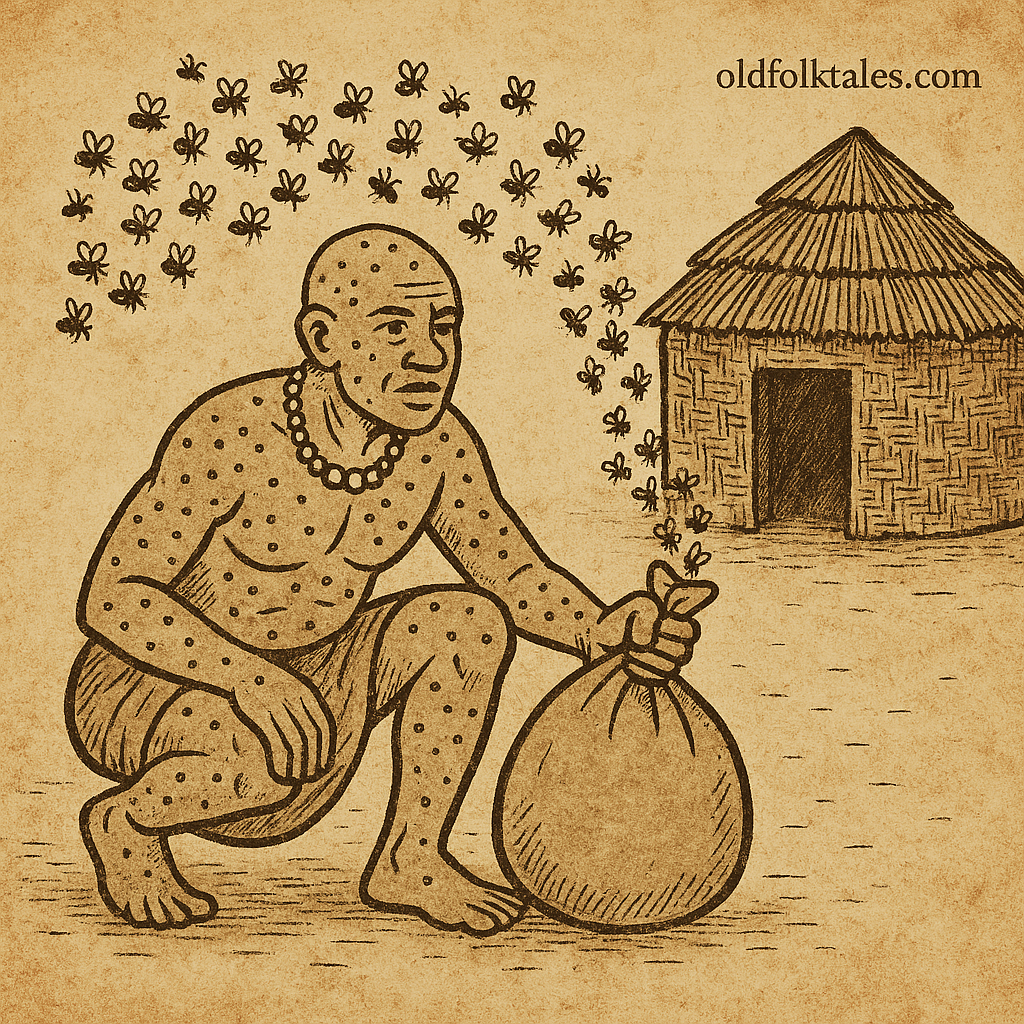
Upon reaching his village, the hunter reported his success to the king, who immediately beat the ceremonial drums with thunderous enthusiasm. But there was one villager who had never been invited to these horrific feasts. Known as nfo nkwagh, the King-of-Scabies, his entire body writhed with festering sores from head to toe. The king had banished him to live under rocks in the forest, fearing contamination.
When the drumbeats echoed through the hills, King-of-Scabies emerged from his exile and arrived first at the house of ceremony. With careful preparation, he carved a hole in the ground, covered it with a flat stone, and created a secret passage to the outside. Then he retreated to the shadows to wait.
The drunken cannibals arrived with their drinking horns and palm wine, celebrating in anticipation of their feast. When darkness approached, they called for the victim to be brought forward. Four men struggled to carry the unexpectedly heavy bendjob to the sacrificial ground.
The moment they opened the bag, divine retribution was unleashed. Zuuzuuu zuuzuuu, zuuzuuh! Swarms of enraged bees erupted like a plague from ancient texts. They sealed every exit before attacking with merciless fury, their stings delivering death to every man in that cursed house save one.
King-of-Scabies, protected by skin so scarred that even the bees could find no unmarked flesh to pierce, quickly removed his stone and escaped through his tunnel. When the buzzing finally ceased, he returned to find himself the sole surviving male in the entire village.
The women and children, hearing the royal drums beat by unfamiliar hands, gathered to learn their fate. When they discovered the horror that had claimed their husbands and sons, not one tear was shed. Instead, they collected every drop of oil and kerosene in their homes and set the house of abomination ablaze. The bonfire blazed so bright it could be seen from villages many days away.
Moral Lesson
This powerful tale reminds us that divine justice often works through the most unexpected instruments. Those whom society shuns and rejects may be the very ones chosen to deliver redemption. The story warns against the dehumanization that comes from treating others as less than human, showing how evil ultimately destroys itself while protecting the innocent and elevating the humble.
Knowledge Check
Q1: What was the significance of the bendjob bag in this Cameroon folktale? A1: The bendjob was a traditional woven carrying bag used by the cannibals to transport their victims, but it became the instrument of divine justice when filled with vengeful bees instead of the stolen child.
Q2: Why was the character known as King-of-Scabies originally banished from the village? A2: King-of-Scabies was exiled because his entire body was covered with festering scabies sores, and the villagers feared contamination, forcing him to live alone in the forest under rocks.
Q3: How did the grieving mother use supernatural powers to save her daughter? A3: She used mystical abilities to move the spring farther away while the hunter sought water, giving her time to rescue her daughter and replace her with a swarm of angry bees.
Q4: What cultural lesson does this folktale teach about justice and redemption? A4: The story demonstrates that divine justice often works through society’s outcasts and that those who practice evil will ultimately face retribution through unexpected means.
Q5: What role do the bees play as symbols in this African folktale? A5: The bees represent divine vengeance and natural justice, serving as instruments of punishment that spare the innocent while destroying the guilty cannibals.
Q6: How does this tale reflect traditional African beliefs about cannibalism and social order? A6: The story reinforces cultural taboos against cannibalism by showing how such practices corrupt entire communities and ultimately lead to destruction, while elevating the humble and protecting the innocent.
Source: The sacred door and other stories: Cameroon folktales of the Beba,” Ohio University Press.