In the heart of Angola, where the bush stretches wide with tall grasses swaying in the wind and the shadows of acacia trees paint the earth, there lived two curious friends: Jackal of Ngonga and clever Hare. Though they often played together, their friendship carried a thin thread of rivalry, each trying to outwit the other. One day, Jackal, full of mischief, invited Hare to join him in the bush for a game of hide-and-seek.
The morning sun hung high, painting the savanna in shades of gold. Jackal turned to Hare with a sly grin and said, “Comrade Hare, come! Let us go to the bush and play.” Hare, never one to refuse an adventure, agreed eagerly. Off they went, their paws stirring the dust as they bounded into the wilderness.
When they arrived, Jackal declared, “I will hide first. You must come and find me.” With that, Jackal slipped quietly into the thickets, his fur blending with the earth. Hare wandered about, sniffing and searching, until at last he spotted Jackal crouched low beneath a bush.
“Ah, Jackal,” Hare said with a laugh, “you are crouching here!”
Jackal sprang up, chuckling loudly, pleased at the start of their game. “Well found, my friend! Let me try again.”
He darted away and disappeared once more, hiding carefully among the shrubs. Hare searched again, his keen eyes scanning the ground. Before long, he spotted Jackal hiding in nearly the same place. “Here you are again!” Hare exclaimed, laughing. Jackal rose, a bit embarrassed, but still grinning.
Now Hare grew bold. “It is my turn to hide. You, Jackal, cannot find me.”
Jackal puffed up his chest with pride. “I shall see you, no matter where you go.”
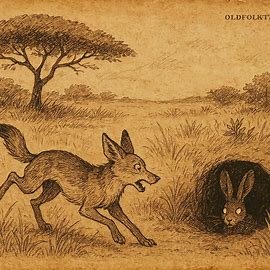
With a sly twinkle in his eyes, Hare scurried away and found a small hole in the earth. He slipped inside, leaving only his big round eyes visible in the darkness. Quiet and still, he waited for Jackal to come.
Jackal trotted about the bush, his nose sniffing for Hare’s scent. At last, he came near the hole. Curious, he peered inside, and there, staring back at him, were two large, gleaming eyes.
A shiver shot through Jackal. His fur bristled. He stumbled back, heart pounding. In terror, he cried, “Oh! I, Jackal, have met an omen! What creature hides in this hole with eyes that glare so fiercely? An omen with eyes to pierce the dark!”
Fear seized him, and without another thought, he fled in haste, his tail tucked low, his paws kicking up dust as he ran.
From inside the hole, Hare burst into laughter. He scrambled out, clutching his belly as he called after his frightened friend. “Jackal, why do you run? You are silly! It was only I, Hare. Did you not boast that you could find me wherever I hid? Yet when you did, you fled crying like a child!”
But Jackal was already gone, racing away from the bush, his ears ringing with shame.
And so the game ended, with Hare victorious not by strength but by wit, leaving Jackal humbled and mocked.
Moral Lesson
This Angolan folktale reminds us that pride often leads to foolishness. Jackal’s arrogance in thinking he could never be tricked made him the perfect target for Hare’s cleverness. Instead of pausing to look carefully and think, Jackal let fear consume him, turning a harmless game into his humiliation.
The lesson is clear: pride blinds us, while humility and wisdom open our eyes. Those who boast loudly often fall hardest, while those who remain patient and clever, like Hare, triumph in the end.
Knowledge Check
1. Who were the main characters in this Angolan folktale?
The story centers on Jackal of Ngonga and Hare, two animal friends with a rivalry.
2. What game did Jackal and Hare decide to play in the bush?
They played hide-and-seek, taking turns hiding and finding each other.
3. How did Hare trick Jackal into becoming frightened?
Hare hid in a hole, leaving only his big eyes visible, which scared Jackal.
4. What was Jackal’s reaction when he saw Hare’s eyes in the hole?
He panicked, believing he had encountered a dangerous omen, and ran away crying.
5. What moral lesson does the story teach?
The tale warns against pride and arrogance while celebrating wit, humility, and cleverness.
6. What is the cultural origin of this folktale?
This is a traditional Angolan folktale.
Source: Kimbundu folktale, Angola.