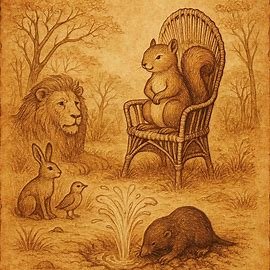
Long ago, in the lands of the Kimbundu people of Angola, the animals gathered to choose a ruler. The forest was alive with chatter as they spoke of leadership, justice, and who among them could guide their community with wisdom. After much talk, their eyes fell upon Squirrel. Agile and bright-eyed, he seemed clever enough to lead, and the animals believed that with patience he could become a fine king. So they declared, “Let us make Squirrel our king.”
Squirrel’s heart leapt with joy at the news. He puffed out his chest, lifted his tail high, and replied at once, “If I am to be king, then let it be today! Not tomorrow, not another time, today!”
The elders frowned. Tradition required preparation. A king could not simply rise without the symbols of authority, the staff, the crown, and other sacred insignia that confirmed his right to rule. “We are searching for the insignia of kingship,” the elders explained. “When these are ready, the throne will be yours.”
But Squirrel stamped his tiny feet and repeated stubbornly, “No! It must be today, at once. I will not wait. Crown me now!”
The Elders’ Doubt
The animals looked at one another uneasily. Whispers spread through the gathering: “If he cannot wait for the rituals, what kind of ruler would he be? Kingship is not seized in haste but carried with patience.”
Still, Squirrel refused to listen. His sharp eyes darted from one elder to another as he demanded their obedience. “Why delay? The throne is mine already. Give it to me today, and let me rule at once!”
His words, instead of inspiring trust, revealed his lack of discipline. The elders shook their heads, for they knew that impatience was a dangerous flaw in any leader.
The Lost Crown
The council of animals withdrew to deliberate. Squirrel remained behind, pacing and chattering loudly, certain he had already won. But his very impatience was sealing his fate.
READ THIS: Jackal and Hare: An Angolan Folktale that Teaches Lessons on Greed, Pride, and Deceit
When the elders returned, their decision was final. “Squirrel,” they said firmly, “your haste has cost you the throne. Kingship cannot be rushed. If you cannot wait for the right moment, you cannot rule wisely. A ruler must govern with patience, not with haste.”
The title of king was taken from Squirrel before it had even been placed upon him. The opportunity that had been within his grasp vanished in an instant. He returned to the trees, left only with his restless energy and his regret.
From that day forward, the animals remembered the lesson: “To-day at once deprived Squirrel of the kingship.”
Moral Lesson
The story of Squirrel teaches that impatience often destroys what could have been achieved with wisdom and restraint. Squirrel was nearly crowned king, but his refusal to wait revealed his unfitness to rule. Leadership requires patience, foresight, and the discipline to act at the right time.
In life, some things cannot be rushed. Success, respect, and authority are built carefully, step by step. Those who demand everything “today at once” risk losing it all. True strength lies in self-control, not in haste.
Knowledge Check
Who was chosen by the animals to be king?
The animals chose Squirrel as their future king.
Why was Squirrel denied the throne?
He was impatient and demanded kingship immediately without waiting for the proper rites and insignia.
What were the animals preparing before crowning a king?
The sacred insignia and symbols of kingship required for leadership.
What lesson does this folktale teach about leadership?
That wisdom, patience, and self-control are necessary for good leadership.
What saying arose from this tale?
“To-day at once deprived Squirrel of the kingship.”
What is the cultural origin of this folktale?
It is a traditional Kimbundu folktale from Angola.
Source: Kimbundu folktale, Angola