Bokeli, son of Njambe-of-the-Sea-Coast, was compared to a snake. Just as a snake sheds its skin, leaving behind something that looks almost as frightening as the creature itself, so too did Bokeli carry a presence that unsettled those who crossed his path. His story, remembered among the Fang people, reveals the danger of pride, the perils of rash judgment, and the strength found in wisdom and patience.
The Daughter of Njambe-of-the-Interior
Njambe-of-the-Interior had a daughter named Jamba, renowned for her beauty. Yet she was considered unapproachable. Many men journeyed to her father’s town to ask for her hand, but none returned alive. The family, known for its fierce ways, tested every suitor, and those who failed were slain. Word spread quickly: “Jamba will never marry.”
Far away by the sea, Njambe-of-the-Sea-Coast had a son named Bokeli. Bold and confident, he declared, “I will marry Jamba.” He prepared for his journey and set out.
Bokeli’s Arrival
When Bokeli entered the town, he strode straight into the public reception house. His appearance stirred admiration. The people exclaimed, “What a fine-looking man!” and greeted him with “Mbolo!” Young women hurried to Jamba with the news: a handsome stranger had come to claim her.
But danger lurked in Jamba’s household. Her mother, lame and covered with sores, was quick to anger. If any man laughed in her presence, she accused him of mocking her affliction, and he was condemned to death. Many suitors had perished this way.
Bokeli, however, possessed a gift, he could understand the language of animals and birds. This gift would soon prove essential.
The Refusal of Food
As Bokeli sat in the reception house, a cock crowed, “If you depend on me for food, you will not eat. I will not be killed for you.” In the kitchen, a wild goat’s leg hanging over the fire added, “You will not eat from me either.”
When Njambe ordered his people to prepare the cock, it fled to the forest. When they turned to the goat’s leg, it rotted before their eyes. Even the wild rat, Ko, hidden on the drying frame, protested, “If it is I, he will not eat.”
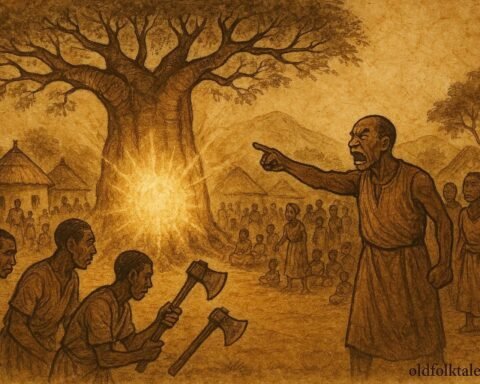
At this strangeness, Bokeli laughed. Jamba’s mother flared with rage. “You mock me!” she cried. Though Bokeli denied it, she shouted to the townspeople, “Catch him! He must die!”
READ THIS: The Giant Goat of Njambe: A Fang Folktale of Cunning and Greed
The Feigned Corpse
Seized by the people, Bokeli was dragged toward the edge of the town. But then he lay motionless, his body cold as death. In truth, he had left his body and returned in spirit to his seaside home, taking on another form. Startled, the townspeople debated. Some urged, “Let us take Jamba and this corpse to his father as proof of marriage.” Others feared revenge. Finally, they sent Etungi, a worthless idler, to deliver the news.
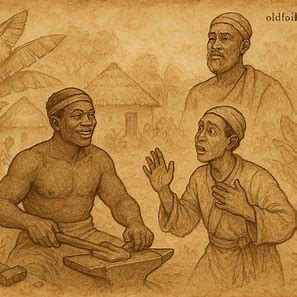
When Etungi reached Bokeli’s town, he passed the smithy without recognizing the man working there. Bokeli called out, “Brother-in-law! Why pass me by? Come, sit in the reception house.” Terrified, Etungi obeyed. Bokeli welcomed him warmly, fed him, and gave him a shirt, a cloth, and a hat as proof of his reality.
The Proof of Life
Etungi returned home, declaring, “Bokeli is alive. I saw him at the bellows.” The people accused him of lying and beat him until he showed the gifts. To confirm, another messenger, Kombe, travelled to the coast. He too found Bokeli alive, working at the smithy. Bokeli received him with food and hospitality, then placed at his feet a rich dowry for Jamba. Kombe carried these gifts home, saying, “It is true.”
Reconciliation
At last, Njambe-of-the-Interior himself set out with his family, carrying goats, fowls, fish, plantains, cloths, and cattle as offerings. They bore the supposed corpse on a bier. Halfway, Njambe instructed his children to wait. “If you hear guns, know I am killed.” He went on with Jamba and his wives.
But at Bokeli’s town, cannons roared in salute. The villagers shouted, “The bride is come!” Misunderstanding the sounds, Njambe’s children fled in fear, thinking their father slain. Yet he soon returned, found them hiding, and commanded them to join the feast.
The Wedding Feast
At Bokeli’s seaside home, the union was celebrated with joy. Oxen and pigs were slaughtered, music played, and the people ate and drank in abundance. Njambe-of-the-Sea-Coast, Bokeli’s father, honored his friend with a spectacular dowry:
- Five million spearheads of iron currency
- One million knives
- One thousand shirts and hats
- One hundred cloths and bales of foreign goods
- Abundant cattle and native treasures
The families departed in peace, and Bokeli and Jamba remained together by the sea.
Moral Lesson
The Fang says, “A snake’s skin looks like a snake.” Appearances can deceive, and pride can destroy. Jamba’s mother mistook laughter for insult and nearly ruined her daughter’s fate. Bokeli, however, triumphed through patience, wit, and the wisdom of listening.
This tale reminds us that anger blinds, while humility and cleverness open the path to peace and prosperity.
Knowledge Check
- Who were Jamba’s parents?
Njambe-of-the-Interior and his wife, a lame woman with sores. - What special ability did Bokeli possess?
He could understand the speech of animals and birds. - Why did Jamba’s mother condemn Bokeli?
She believed he mocked her by laughing in her presence. - How did Bokeli escape death?
He pretended to be a corpse and returned home in spirit to a new body. - What gifts proved Bokeli was alive?
A shirt, a cloth, and a hat given to Etungi. - What is the main moral of the story?
Appearances can deceive; wisdom and patience lead to success.
Source: Fang folktale, Equatorial Guinea.