In the ancient highlands of Ethiopia, where the morning mist danced across golden fields and the royal palace stood proud against the azure sky, there lived a man whose laughter could brighten even the gloomiest of days. His name was Abba Bukkush, though this wasn’t the name his mother had whispered to him as a child. The king himself had bestowed this title upon him, for “Abba Bukkush” means “Father of Laughter” in the old tongue.
Abba Bukkush was no ordinary man. His eyes sparkled with mischief, and his smile could melt the hardest of hearts. Every morning, he would take his place beside the royal throne, his colorful robes a stark contrast to the solemn court officials who surrounded them. The king treasured these moments, for Abba Bukkush had the rare gift of turning the weight of royal duties into moments of pure joy.
The court was a place of whispers and careful words, where every gesture carried meaning and every silence spoke volumes. Yet when Abba Bukkush was present, the atmosphere transformed. His jokes would echo through the marble halls, and even the stern-faced guards would crack smiles behind their ceremonial spears.
Also read: The Cunning Fox and the Monkeys
One afternoon, as golden sunlight filtered through the palace windows, Abba Bukkush sat with his closest friend in the palace gardens. The fragrant jasmine bloomed around them, and the gentle murmur of a fountain provided a peaceful backdrop to their conversation. It was here, in this moment of tranquility, that Abba Bukkush made an observation that would change everything.
“You know,” he said thoughtfully, watching a butterfly dance among the flowers, “our king is truly a good and just man. But I’ve been thinking about that incident with Afewerke last week.” His brow furrowed slightly as he recalled the event. “When Afewerke made those serious mistakes in handling the grain distribution, the king simply overlooked it. Perhaps some form of punishment would have been appropriate not out of cruelty, but to maintain justice and order.”
His words were spoken quietly, meant only for his friend’s ears. But in the intricate web of palace life, even whispered words could travel like wildfire.
The friend, perhaps seeking favor or simply unable to keep such weighty words to himself, hurried to the king’s chambers. There, surrounded by the rich tapestries and golden ornaments that spoke of centuries of royal power, he repeated every word of Abba Bukkush’s observation.
The king’s face darkened like storm clouds gathering over the mountains. His hands gripped the arms of his throne until his knuckles turned white. “Aha!” he thundered, his voice echoing off the stone walls. “So he has started to show disrespect for me, has he?” The betrayal cut deep, this man who had sat beside him, who had shared in his daily joys, now dared to question his judgment.
In his anger, the king devised what he believed to be a fitting humiliation. He summoned three of his most trusted soldiers, their armor gleaming in the torchlight of the throne room. “Go to Abba Bukkush’s house,” he commanded, his voice cold as winter wind. “I order you to defile his mattress. Let this be a lesson in respect.”
The soldiers, bound by duty and unable to question royal commands, made their way through the winding streets to Abba Bukkush’s modest home. The house stood humble but proud, with its mud walls and thatched roof, a stark contrast to the palace’s grandeur.
When they arrived, they delivered their message with the mechanical precision of men following orders. “We have been commanded by the king to defile your mattress,” they announced, their voices betraying their own discomfort with the task.
Abba Bukkush listened calmly, his mind already working like the gears of a master craftsman’s clock. Without protest, he helped them carry his sleeping mat outside into the courtyard, where the afternoon sun cast long shadows across the ground.
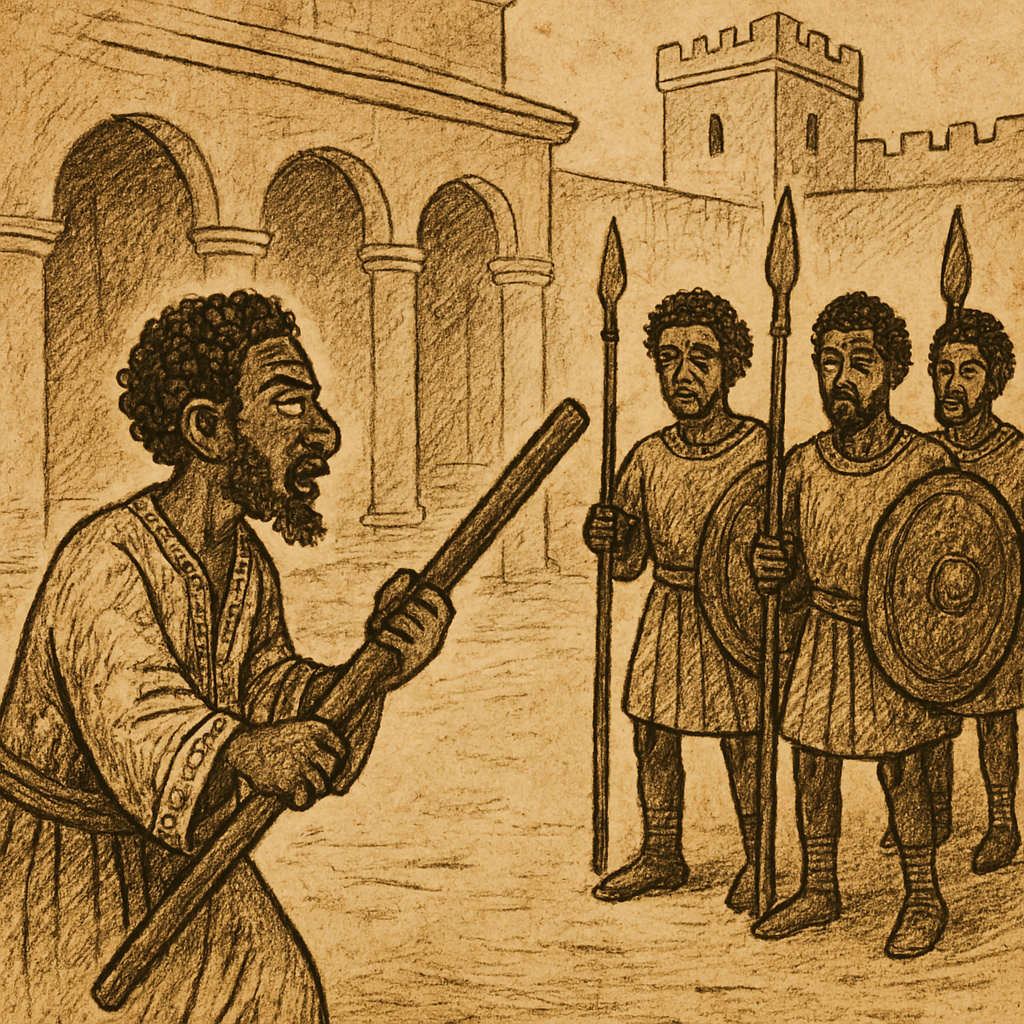
As the soldiers began to prepare themselves for their unpleasant duty, Abba Bukkush disappeared momentarily into his house. He emerged carrying a thick wooden staff, its surface worn smooth by years of use. His eyes held a glint that the soldiers had seen before, the same spark that had made the king laugh countless times.
“Gentlemen,” he said, his voice carrying the authority of a man who had spent years in the royal court, “I have great respect for the king’s orders, and I will not interfere with your duty. However, I must point out something important.” He hefted the staff in his hands, feeling its familiar weight. “His Majesty has specifically ordered you to defecate on my mattress. But notice, he has given no command regarding urination.”
The soldiers paused, confusion clouding their faces like morning fog.
Abba Bukkush continued, his voice becoming more serious. “Therefore, if I see so much as a single drop of urine on my mattress something the king has not authorized, I will be forced to defend my property.” He raised the staff meaningfully. “And I assure you, this stick will find its way to your heads.”
The soldiers looked at each other in growing bewilderment. The biological impossibility of their situation became crystal clear. They stood frozen in the courtyard, caught between their royal duty and the laws of nature itself.
After several long moments of whispered consultation and frustrated gestures, they admitted defeat. With heavy steps and heavier hearts, they returned to the palace, their mission incomplete.
Standing once again before the royal throne, they explained their predicament to the king. As they recounted Abba Bukkush’s clever reasoning, something remarkable happened. The king’s anger began to dissolve like ice in the desert sun. His scowl transformed into a grin, then into hearty laughter that filled the entire throne room.
“Brilliant!” the king exclaimed, slapping his knee with delight. “Absolutely brilliant!” He had remembered why he had given this man the title “Father of Laughter” in the first place. Here was wit sharper than any sword, cleverness that could turn even punishment into wisdom.
“Guards!” the king called out, his voice now warm with renewed affection. “Prepare gifts for Abba Bukkush ,the finest silk, the best honey, golden jewelry fit for a cherished friend. And tell him his place beside my throne awaits him tomorrow, as always.”
Moral Lesson
This Ethiopian folktale teaches us that true wisdom lies not in blind obedience or bitter resentment, but in clever thinking and maintaining dignity even in difficult circumstances. Abba Bukkush shows us that wit and intelligence can transform conflict into understanding, and that sometimes the best response to unfairness is not anger, but creative problem-solving that reveals the absurdity of the situation itself.
Knowledge Check
Q1: Who was Abba Bukkush and what did his name mean? A1: Abba Bukkush was a court jester in ancient Ethiopia whose name means “Father of Laughter.” The king gave him this title because of his ability to make the royal court laugh and bring joy to daily palace life.
Q2: What criticism did Abba Bukkush make about King’s judgment? A2: Abba Bukkush observed that when a man named Afewerke made mistakes, the king didn’t punish him, suggesting that some form of punishment would have been appropriate to maintain justice and order.
Q3: How did Abba Bukkush cleverly avoid the king’s punishment? A3: When soldiers came to defile his mattress, Abba Bukkush pointed out that the king had only ordered defecation, not urination, and threatened to beat them if they urinated. Since the soldiers couldn’t do one without the other, they couldn’t complete their task.
Q4: What does Abba Bukkush’s wit symbolize in Ethiopian culture? A4: Abba Bukkush’s cleverness represents the Ethiopian cultural values of using intelligence and humor to navigate difficult situations, showing that wisdom and wit can be more powerful than direct confrontation.
Q5: What was the king’s reaction when he heard about Abba Bukkush’s solution? A5: The king was amazed and began to laugh heartily, remembering why he valued Abba Bukkush’s wit. He ordered his soldiers to bring gifts to Abba Bukkush and welcomed him back to court.
Q6: What moral lesson does this Ethiopian folktale teach? A6: The story teaches that creative thinking and maintaining dignity can transform conflict into understanding, and that wit and intelligence are often more effective than anger when facing unfair treatment.