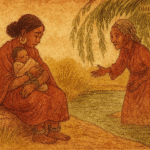
In the days when the moon still walked among humans and trees whispered each other’s names, there was a village at the edge of the great Comoé River, where the forests grew so thick you could disappear just by stepping off the path. In this village lived a boy named Amoin. He was the youngest of five brothers and the smallest among them, but his eyes held something the others did not—a deep, quiet fire, like an ember that never goes out.
Amoin’s brothers were strong. They could climb trees with bare hands, chase antelopes through the brush, and split logs with one swing. But Amoin was different. He was quiet, observant, always watching the sky, listening to the stories the wind carried through the plantain leaves. When the elders told tales by the fire, his brothers would fall asleep. Amoin stayed up, his face lit by flame and wonder, memorizing every word.
The village was ruled by a chief named Kobenan, who was feared more than loved. His rule was long, and his demands many. Every year, he sent the strongest young men into the forest to find the Sacred Horn—a legendary ivory relic said to summon the spirits of the ancestors. It was lost long ago in the forest beyond the Black Swamp, and every year, the village sent boys who never returned.
This year, it was the turn of Amoin’s family.
“I will go,” said the oldest brother, beating his chest. “I am strong enough.”
“No, I will,” said the second. “I am faster.”
Each one boasted, eager to be chosen.
Then Amoin, sitting quietly near his mother’s mortar, stood up. “I will go.”
The courtyard burst into laughter. Even their mother gasped. “Amoin, my son, you are not like your brothers.”
“I know,” he said, calmly. “That’s why I must go.”
The chief agreed, amused. “Let the mouse chase the lion,” he chuckled. “If you return with the horn, I shall make you my heir.”
And so, with nothing but a small satchel of millet cakes, a carved wooden flute, and his father’s old hunting knife, Amoin stepped into the forest while the village watched in silence.
The trees closed behind him like curtains. He walked and walked, deeper than anyone dared, into places where the air was thick with magic and time dripped like honey from the leaves. He followed the river until it bent like a question, then entered the Black Swamp.
The swamp was not black in color but in mood. It was quiet, too quiet. Not a frog croaked, not a bird sang. Amoin felt eyes on him. He knelt by the water and played his flute. The notes floated like feathers.
Then something stirred.
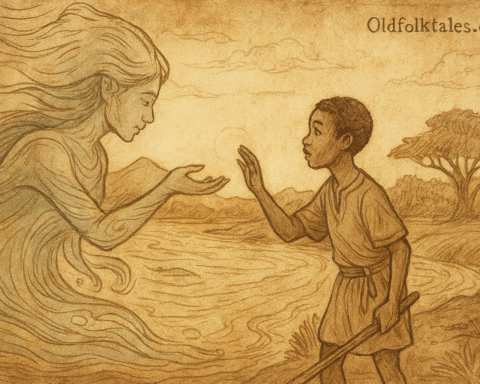
A figure rose from the water, made of reeds and shadow, eyes glowing like fireflies.
“Who plays the song of the first wind?” the creature asked.
“I am Amoin, son of Kossivi, grandson of Ahoua,” he said, his voice steady.
“You should not be here,” said the spirit. “Many came. All failed.”
“I seek the Sacred Horn.”
“To seek is to risk. To find is to change.”
“I am ready,” said Amoin.
The spirit moved aside. “Then pass. But beware. The horn listens. It does not give itself to the proud.”
Amoin passed through the swamp. He came to a clearing where time had stopped. In the center stood a massive tree with a hollow heart. Inside that hollow, the horn glowed like moonlight.
He stepped forward, but a roar shook the forest. A creature emerged—part leopard, part serpent, with teeth of iron.
“You want the horn,” it hissed.
“Yes,” Amoin said.
“Then tell me this,” it growled, circling him. “What is heavier: truth or lies?”
Amoin thought for a long time. “Lies are heavier,” he said. “Because they carry fear. Truth walks light.”
The creature paused. Then bowed.
“You may pass.”
Amoin reached the horn. As his fingers touched it, he heard voices—not in his ears, but in his bones. Ancestors speaking. Spirits humming. His heart filled with stories older than language. He did not just carry the horn now—he carried memory.
When he returned, weeks had passed. The villagers stared. He looked different—not older, but deeper, like the forest had carved wisdom into his skin.
He knelt before the chief and offered the horn.
“You?” the chief whispered. “You brought it?”
Amoin nodded. “But I will not be your heir.”
The chief’s eyes widened.
“The horn does not belong in palaces,” Amoin said. “It belongs to the people.”
He turned and held it up. The village fell silent. The wind shifted. Drums echoed from nowhere. People wept, not knowing why. Something ancient had awakened.
From that day, Amoin was no longer the smallest. He was the boy who returned. He became the keeper of stories, the one who reminded the people that strength was not in muscle but in listening. And at every moon gathering, he played his flute, and the horn glowed, and the ancestors smiled.
✧ Commentary
This Ivorian folktale celebrates quiet strength, wisdom, and the deep power of listening. Amoin represents the overlooked child—the observer, the dreamer—whose path leads not through force but through understanding. It’s a tale rooted in the spiritual landscape of Côte d’Ivoire, where ancestral voices, natural spirits, and storytelling are inseparable from life. The Sacred Horn is a symbol of heritage, and Amoin’s journey reminds us that cultural memory must be carried by those who listen deeply and walk humbly.
✧ Moral
True strength lies not in power but in humility, wisdom, and the courage to walk alone when others mock.
✧ Questions & Answers
1. Q: Who was Amoin and why was he different from his brothers? A: Amoin was the youngest brother, quiet and thoughtful, known for his deep listening and love for stories, unlike his boastful and strong brothers.
2. Q: What did the chief send Amoin to retrieve? A: The Sacred Horn, a legendary relic said to summon ancestral spirits and bring wisdom.
3. Q: What challenges did Amoin face in the forest? A: He encountered a swamp spirit, a riddle from a magical creature, and had to resist fear and pride to claim the horn.
4. Q: How did Amoin answer the creature’s riddle about truth and lies? A: He said lies are heavier because they carry fear, while truth walks light.
5. Q: What did Amoin do with the Sacred Horn upon returning? A: He refused to give it to the chief and instead offered it to the people, believing it belonged to everyone, not rulers.