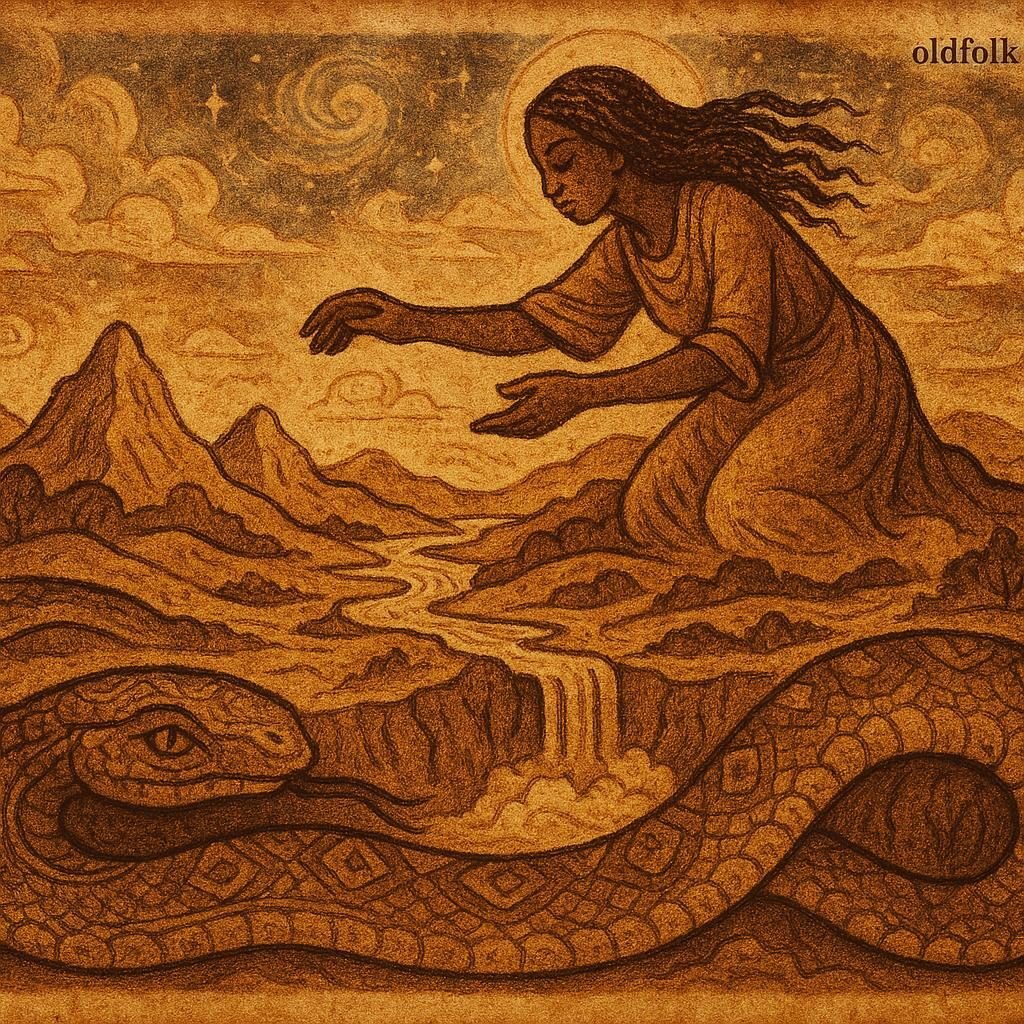
Long before people set foot upon the earth, when the seas were endless and the skies unbroken, the great serpent Aido-Hwedo moved beside the Creator, Mawu. He was her companion and bearer, carrying her on his vast, coiling back as she shaped the world into valleys, mountains, rivers, and seas. Each turn of his body carved valleys. Each mighty coil pushed up mountains. Where he curved away, the hollows filled with water, becoming oceans. Thus, the earth took shape, alive with balance and beauty.
Yet the new world was heavy, trembling under its own weight. To steady it, Mawu commanded, “You shall remain beneath the earth, coiled as a pillow, to hold it firm.” Obedient, Aido-Hwedo sank deep beneath the seas, where he still lies in slumber. When he stirs, the land above trembles, and men say earthquakes are the serpent shifting in his rest. The treasures beneath the earth, iron, copper, and gold, are said to be his hardened droppings, left from those first days when he bore the Creator.
The People Who Descended from the Sky
In the land of Adja, the first human family appeared. A man and a woman descended from the sky, bringing with them sacred gifts. The man carried a wand, striking the ground to declare, “Here shall be our home.” The woman carried a calabash upon her head, filled with the seeds and tools of life.
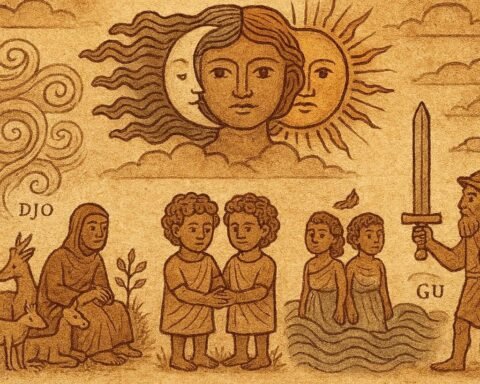
Others soon followed, arriving with the rains. They built shrines, raised altars, and taught the worship of Mawu-Lisa, the divine balance of moon and sun. Their sons each bore wands, guiding their families across the new land. A chameleon, sacred to Lisa, moved with them. Its shifting colors warned of dangers, its hues signaling enemies, storms, or safety.
From these families spread the people of Dahomey. They carried fields upon their shoulders, villages in their footsteps, and the sacred memory of their descent. Every act of farming, worship, and sacrifice was a reminder: humanity had come from the sky, guided by the gods.
The People of Agblo and the Pact with Sagbata
Once, after a great rain, a man named Agblo and his wife emerged from the mists, carrying okra seeds in a calabash. With them came sixty-six companions. They cleared land, planted the seeds, and from their work came the first crops and the beginnings of a lineage.
Among them lived a man named Cheyi. Wandering one day, he discovered a sacred opening in the ground. Descending into the depths, he came upon Sagbata, the god of the earth, enthroned among spirits. Sagbata spoke: “You have found my dwelling. I shall teach you how to worship me, how to honor Mawu and Lisa, and how to lead the rites of sacrifice.”
Cheyi returned with divine knowledge. He built shrines, offered the first fruits, and became Sagbata’s priest. Through him, the cults of Sagbata, Mawu, and Lisa were established, and the people of Agblo remained bound to their gods by a sacred pact that endured for generations.
Legba, Awé, and the Birth of Magic
There was also Legba, favored by Mawu, who declared him first among the gods. She gave him a wife, Konikoni, and he sang joyfully:
“If the house is peaceful,
If the field is fertile,
I will be happy.”
But Legba was restless, filled with knowledge and craft. He created magic charms, the first of their kind. With his power he made a serpent, setting it along the road to bite unsuspecting sellers and buyers at the market. When people fell sick, he offered cures, if they gave him gifts. Soon, others wished for such charms, and Legba taught a man named Awé how to make them.
Awé became master of charms, summoning Legba to help craft medicines, spells, and protections. Yet not all charms were for good, some caused illness, hardship, or sorrow. Awé grew powerful, sought by kings, traders, and families alike.
Proud of his mastery, Awé dared to challenge Mawu. Using cotton and silk threads, he wove a ladder to the sky. He told Mawu, “My knowledge is great. I will measure it against yours.” Mawu tested him. Awé carved a figure of a man, shaping head, limbs, and face, but it remained lifeless. Mawu, by contrast, sowed a grain of corn. In one day it sprouted, ripened, was harvested, milled, and made into food that Awé himself ate. Awé bowed his head. His knowledge, though vast, was incomplete.
Mawu sent Death to follow Awé back to earth. From then onward, Death walked with men. Awé’s magic could not destroy him, but only delay him. Thus Awé and Death became eternal companions, the twin reminders that though humans may learn the secrets of the gods, they remain bound by mortality.
Moral of the Tales
These Beninese folktales remind us of the sacred balance between knowledge and humility, between creation and destruction. They teach that wisdom without reverence leads to pride, but those who honor the gods find guidance and protection. Humanity, descended from the sky, must walk the earth with care, for even great power bends before the will of the divine.
Knowledge Check
Q1: Who is Aido-Hwedo in Beninese mythology?
Aido-Hwedo is the cosmic serpent who carried Mawu during creation and now supports the earth.
Q2: What formed mountains and valleys in the Aido-Hwedo folktale?
Mountains arose where Aido-Hwedo coiled, and valleys formed where he turned.
Q3: What role did the chameleon play in the first human family story?
The sacred chameleon guided the first families, warning them of danger with its colors.
Q4: Who taught the people of Agblo the rites of sacrifice?
Cheyi, after receiving knowledge from Sagbata, the god of the earth.
Q5: What is Legba known for in Beninese folktales?
Legba is known as the first maker of magic charms and a cunning trickster god.
Q6: What lesson does Awé’s failed challenge to Mawu teach?
It teaches that human knowledge is limited and must bow before divine wisdom.
Source: Beninese Folktales