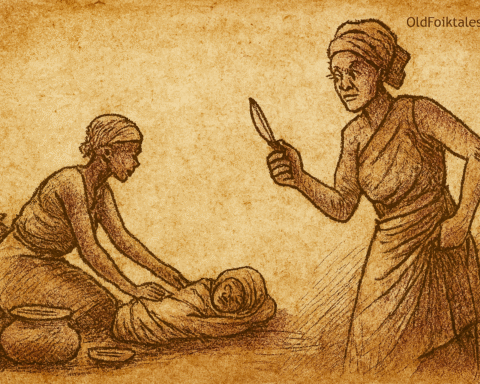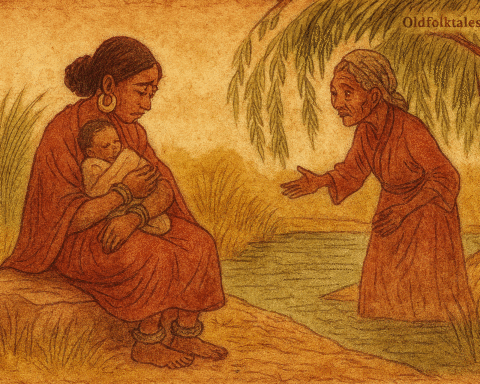
In a time when the world was younger and magic flowed more freely through the land, there lived a boy named Funyi whose life began with both blessing and curse. Born as one of twin brothers to parents blessed by neither fortune nor the favor of the gods, his story started in tragedy. His mother had been one of those women whom the spirits seemed to disfavor every child she bore before the twins had died before seeing sunlight, leading village whispers to claim her womb was cursed.
When the twin boys were finally born, fate dealt another cruel blow. Chebe, Funyi’s twin brother, died at birth, and their mother never recovered from the devastating loss. Their father, consumed by grief for his wife and dead son, became a shadow of a man who abandoned all ambition. He acquired no land, built no wealth, and had nothing to pass on to his surviving son. In his heart, young Funyi felt as though he had neither father nor mother.
But poverty and abandonment could not crush the spirit that burned within Funyi. He possessed an unshakeable determination to succeed in life and, above all, refused to die a bachelor. The young man threw himself into work, learning to clear farms alongside other men and discovering a remarkable talent for hunting rat-moles. His specialty lay in the intricate art of digging for these elusive creatures, he possessed an almost supernatural ability to identify exactly which hole to excavate when the animals vanished into their elaborate underground labyrinths.
Also read: Union Is Strength, United We Stand
Funyi would boast that he was born with an innate understanding of maze geometry, and the village elders nodded knowingly. Among the Beba people, it was well understood that twins possessed special gifts from the gods, and perhaps his brother’s death had awakened even greater powers within him. For the longest time, Funyi never returned from a hunt empty-handed.
One fateful day, however, his legendary luck abandoned him. The hunting party burned the grass according to tradition, waiting for frightened animals to flee into their waiting clubs and cutlasses. While his companions successfully killed cutting-grass and rat-moles, Funyi found himself utterly unsuccessful. His friends teased him mercilessly, reminding him that missing a shot at a bird only gives the hunter tact. But pride consumed Funyi like a fire. His anger got the better of him as he bragged about being the group’s best hunter, refusing to accept the ancient wisdom that even expert hunters must sometimes squat before they aim.
He returned home hungry and despondent, his stomach growling with emptiness. Pride made him refuse the food his father offered, and he went to bed with nothing but bitterness for sustenance.
The next morning, hunger clawed at his insides until he could bear it no longer. Wandering aimlessly through the village, he came upon an old man who lived three compounds away, a kind soul who would change the course of his life forever.
“Father,” Funyi said, his voice weak with hunger, “I am hungry.”
The old man’s weathered face creased with sympathy. “I have already eaten all the food I cooked,” he confessed. “What can I give you, my child? Go behind the house and pick an egg. Find some firewood, roast it, eat it, and drink some water. You’ll live, do you understand?”
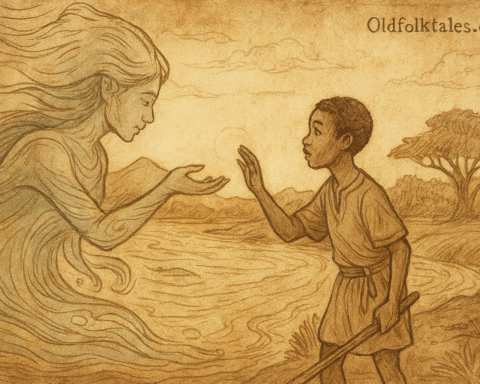
Funyi thanked the generous old man and picked a single egg from the pen. But as he held that simple egg in his hands, something stirred within him, a sense that staying in the village would make him a laughingstock. Instead of simply eating the egg, he chose the path of the wanderer, setting out on what would become an extraordinary quest.
He walked through the night and all the following day, crossing two rivers before reaching a village where he encountered a man tending to a large flock of hens. The farmer’s face bore the weight of worry as he explained his predicament his hens hadn’t laid eggs in months and were growing restless without anything to incubate.
Moved by compassion, Funyi offered his precious egg. “Here, take this egg and put it between your hens,” he said. “They’ll incubate it and you’ll have new chicks.”
The farmer’s joy was infectious, but disaster struck immediately. The hens became so wildly excited over the egg that they fought over it, crushing it to pieces in their frenzy. Funyi’s heart broke as he chanted his growing lament:
“Oh, look what has happened to my egg, the egg the old man gave me, the old man who staved off my hunger, the terrible hunger that ate my insides the day I went hunting and returned without rat-moles.”
The sympathetic farmer gave Funyi an old cutlass in compensation, beginning a chain of exchanges that would define his journey. In the next village, Funyi encountered a builder struggling to make mud bricks using only sticks. Offering his cutlass, he watched the man work with renewed vigor until the tool broke from enthusiastic use.
Again, Funyi recited his growing chain of loss, and the guilty builder compensated him with a long piece of bamboo. This pattern continued as Funyi met a plantain farmer who desperately needed the bamboo for pruning, only to break it while working. The farmer’s gift of plantains fed nursing mothers who had no food for their children, and they rewarded him with palm oil.
The palm oil enriched the soup of hardworking women on a groundnut farm, who gave him bundles of achu. These bundles fed starving pigs whose owner, in gratitude, presented Funyi with a large pig. When Funyi reached a village in mourning, he offered the pig for the death celebration of a young woman, enabling the community to honor their daughter according to custom.
“What can we do to thank you?” the grateful villagers asked.
“You can give me the dead girl,” Funyi replied, stunning them with his unusual request.
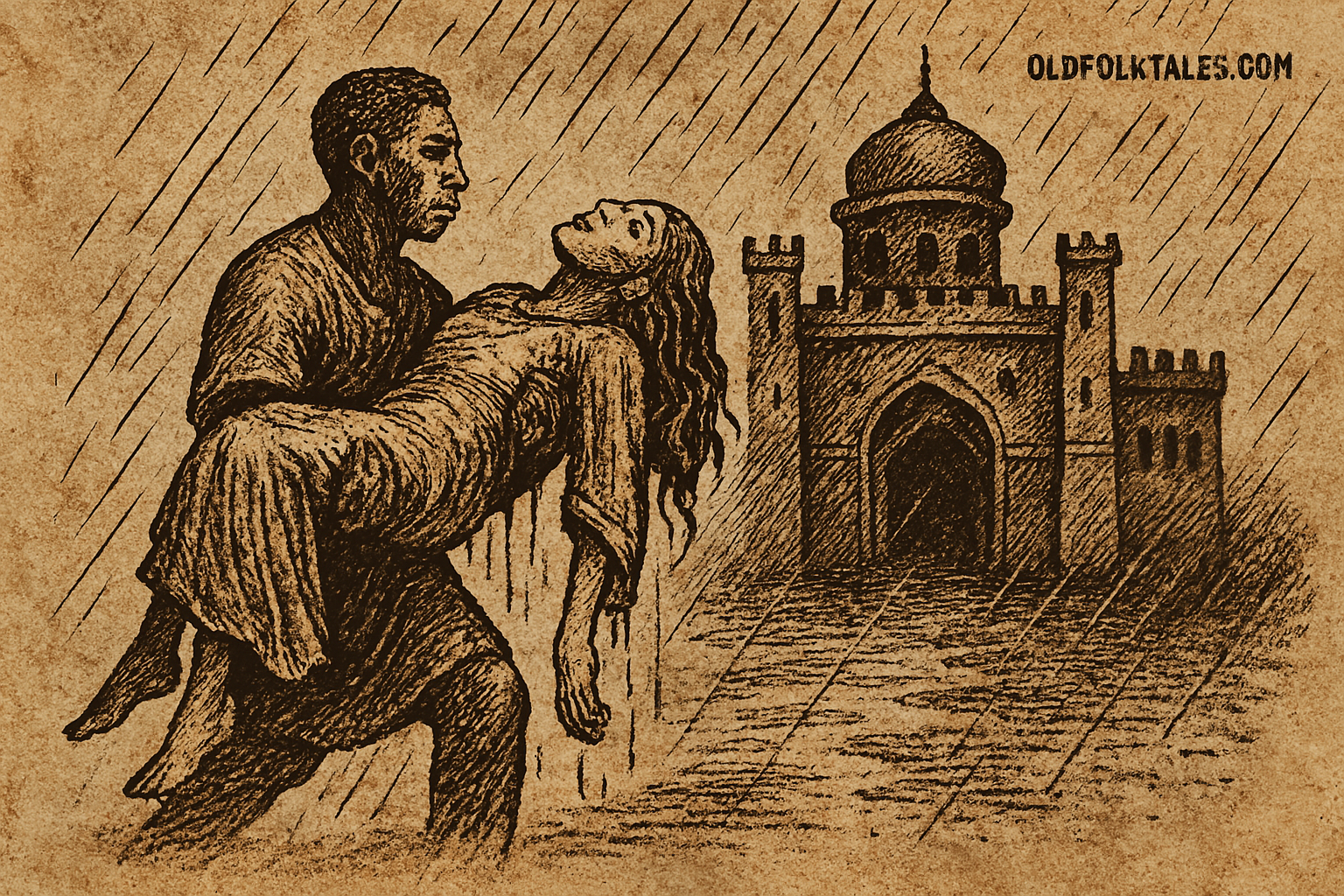
Though taken aback, they honored their debt and gave him the corpse. Funyi carefully washed and perfumed the body, then invoked heavy rains to drench them both before arriving at a distant palace, shivering and cold.
The king welcomed the mysterious traveler, ordering his most respected wife to provide shelter. Funyi placed his burden on the woman’s daughter’s bed, covering it with blankets, claiming the “child” was too tired to sit by the fire. After sharing a meal and spending the night, Funyi asked his hostess to wake his companion.
When attempts failed to rouse the figure, the king himself investigated and pronounced the terrible truth: “She’s dead.”
Funyi’s performance of outrage was magnificent. He recited the complete chain of his journey from the egg to the pig to the dead girl demanding compensation for his loss. The king, bound by the laws of hospitality and justice, faced an impossible dilemma. After consulting with his wives and receiving only stony silence, he decided the woman in whose house the death occurred must sacrifice her own daughter.
But something magical happened during Funyi’s week-long stay at the palace. Night after night, he told the princess his life’s story, sharing every adventure and hardship of his quest. As she listened to tale after tale, his journey began to endear him to her heart. The adventures that had shaped his character revealed a young man of resilience, generosity, and hidden nobility.
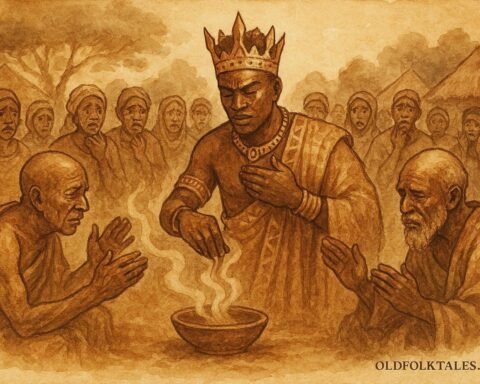
She agreed to become his companion, but only if he would take her back to his village as his equal partner. Before their departure, the king bestowed upon them a special ancestral cup, instructing them to use it for invoking the ancestors and pouring libations whenever they faced need.
Funyi returned home to the envy of his age-group, no longer the poor orphan but a man with a beautiful wife and bright prospects. He poured libation in memory of his mother and his twin brother Chebe, honoring the dead who had shaped his destiny. Only then did he truly begin to live a life of prosperity with his wife and father, his quest complete and his character forever transformed.
Moral Lesson
This powerful tale teaches us that generosity and compassion, even when we have little to give, create ripples that can transform our entire destiny. Funyi’s willingness to share his single egg (despite his own hunger) set in motion a chain of kindness that ultimately led him to love, prosperity, and purpose. The story reminds us that our character is revealed not in our abundance, but in how we treat others when we ourselves are in need.
Knowledge Check
Q1: What supernatural abilities did Funyi possess as a twin, and how did his brother’s death affect these powers?
A: Funyi had an extraordinary gift for understanding maze geometry, allowing him to expertly track rat-moles through complex underground tunnels. According to Beba beliefs, twins receive special gifts from the gods, and his brother Chebe’s death may have awakened even greater powers within him.
Q2: How does the egg transform from a simple meal into the catalyst for an extraordinary journey?
A: Instead of eating the egg given to him by the kind old man, Funyi chose to share it with a struggling farmer whose hens couldn’t lay eggs. This act of generosity, despite his own hunger, began a chain of exchanges that led him through multiple villages and ultimately to finding a wife and prosperity.
Q3: What role does the chain narrative (repetitive recounting) play in this Beba folktale?
A: The repetitive chain narrative serves both as a storytelling device and a way to show how each act of kindness connects to the next. It demonstrates how Funyi’s original generosity with the egg creates an unbroken chain of cause and effect that ultimately leads to his transformation from poor orphan to prosperous married man.
Q4: How does Funyi’s encounter with the dead girl demonstrate his cleverness and understanding of social obligations?
A: Funyi cleverly presents the corpse as a living child to the king’s household, knowing that if something happens to a guest, the host must provide compensation. His understanding of hospitality laws and social obligations allows him to legitimately claim the king’s daughter as recompense.
Q5: What cultural elements from Beba society are preserved in this folktale?
A: The story includes traditional Beba concepts like twin mythology and special powers, ancestral cups for libations, specific foods (achu, plantains), farming practices, death celebration customs, and the importance of hospitality and social obligations between community members.
Q6: How does the theme of transformation work on multiple levels throughout the story?
A: The story shows physical transformation (egg to cutlass to bamboo, etc.), social transformation (orphan to married man), and character transformation (from proud unsuccessful hunter to generous provider). Each exchange teaches Funyi lessons about generosity and community that prepare him to be worthy of love and prosperity.
Source:The sacred door and other stories: Cameroon folktales of the Beba (1st ed.). Ohio University Press.