Long ago, in the rolling green hills of Akim country, there lived a humble villager who owned little more than his hut, his small farm, and a pair of worn sandals. His people lived simply, speaking only their local tongue, rarely traveling far from their villages. But one day, necessity called him to journey to Accra, the bustling coastal town where merchants, sailors, and traders from distant lands gathered to exchange goods.
The Akim-man had never set foot in such a place. He set off with determination, though he carried no knowledge of the languages spoken in the great town. His heart was anxious, yet curious, for he longed to see what lay beyond his familiar village paths.
As he drew near to Accra, he came upon a wide plain where a great herd of cattle grazed. The sight left him astonished. Never in his life had he seen so many cows together. They were sleek, strong beasts, numbering in the hundreds, their horns gleaming in the sunlight. A herdsman stood watch over them. The Akim-man, eager to know, pointed at the herd and asked in his village tongue:
“To whom do all these cows belong?”
The herdsman, who spoke a different language, did not understand. Instead, he shook his head and replied simply:
“Minū.”
Now, in the herdsman’s language, Minū meant “I do not understand.” But the Akim-man, innocent of this, thought it was the name of the cattle’s owner. His eyes widened.
“Ah! So they belong to Mr. Minū! What a rich man this Minū must be!” he exclaimed, filled with wonder.
He continued his journey into Accra.
The Riches of “Honourable Minū”
Not long after entering the town, he came across a grand building. Its walls were high and strong, its windows gleamed with glass, and its doors shone with brass handles. Never had he seen such fine craftsmanship. Curious once more, he turned to a passerby and asked, “Who owns this fine house?”
The man, not understanding the Akim-man’s language, gave the same reply:
“Minū.”
The villager clapped his hands in astonishment. “So this too belongs to Honourable Minū! Surely he is the richest man alive!”
A little further along, he saw yet another building, taller, broader, and more magnificent than the first. Its balconies overlooked the sea, and its walls were painted with vibrant colors. Again he asked a townsman, “Whose house is this, so beautiful and fine?”
Again, the reply came: “Minū.”
“Eh! This Honourable Minū is greater than kings!” cried the Akim-man, shaking his head in disbelief.
The Steamer in the Harbour
At last, his wanderings brought him to the bustling Accra harbour, where traders loaded a grand steamer with cargo. Crates of palm oil, cocoa, timber, and cloth were carried up the gangplank. The ship’s black smokestack puffed proudly, and sailors shouted as they worked. To the Akim-man, it seemed the vessel was as mighty as a moving town upon the sea.
Overwhelmed, he turned to a man standing nearby and asked eagerly, “Please, whose ship is this, with its endless wealth?”
The man answered, as the others had: “Minū.”
The villager almost staggered with amazement. “This Honourable Minū is richer than all the world! He owns herds beyond counting, houses more splendid than palaces, and now even a great ship that sails the seas!”
The Funeral of Honourable Minū
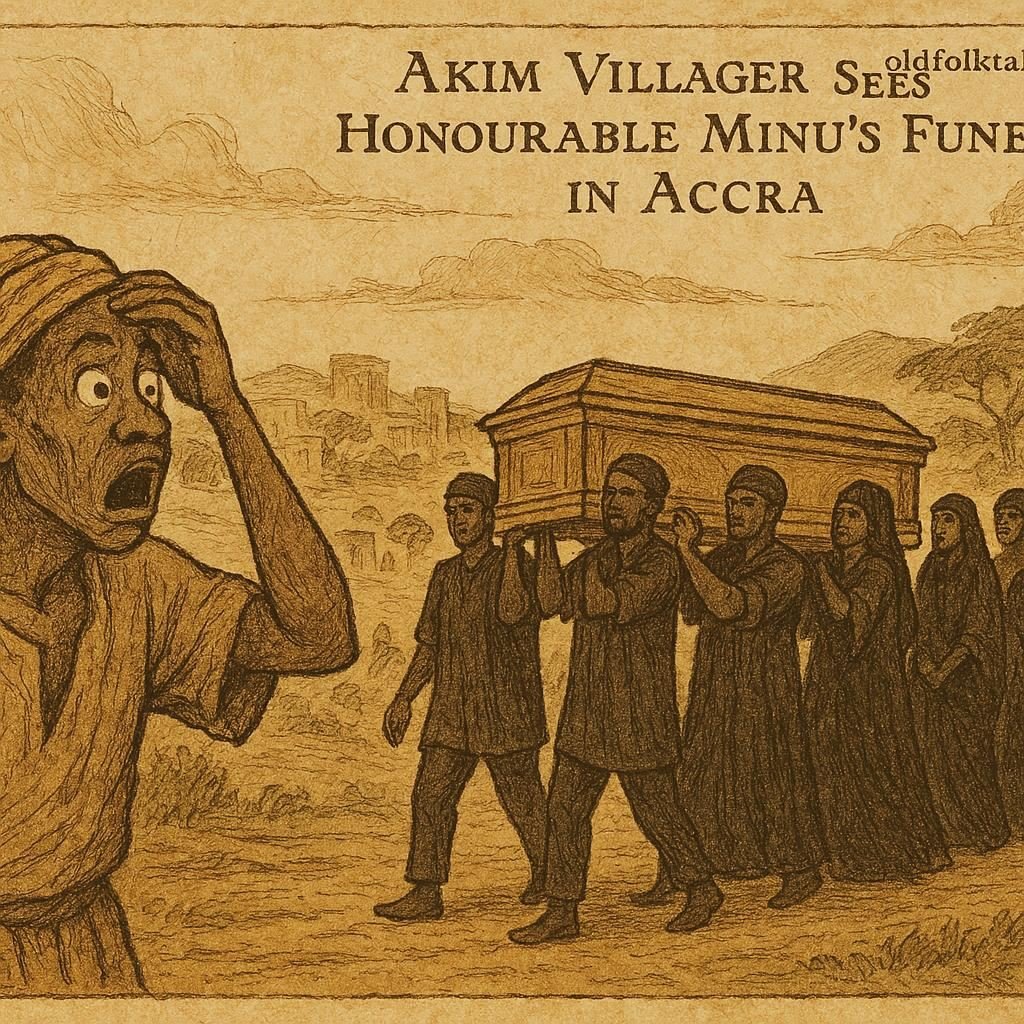
At last, the Akim-man finished his business in the town and prepared to return to his village. But as he made his way down one of Accra’s busy streets, he came upon a solemn sight. Men dressed in black carried a coffin, followed by a long procession of mourners. The crowd moved slowly, their voices hushed with grief.
Curious again, he asked a bystander in his own tongue, “Whose funeral is this? Who has died?”
The man, as always, replied: “Minū.”
The villager stopped in shock. “What? Poor Honourable Minū!” he cried. “So he has died as well? He, who owned cows without number, houses finer than kings, and ships that crossed the seas, yet even he has left it all behind and gone to the grave like a poor man!”
Shaking his head, the Akim-man turned for home. His heart was strangely light. “Better for me,” he said to himself, “to be content with my little hut and my few coins. After all, even Honourable Minū, with all his riches, could not escape death.”
And so he returned to his village, perfectly at peace with his simple life.
Moral Lesson
This tale reminds us that wealth, power, and possessions cannot protect us from the fate all humans share. Rich or poor, death comes to all. True happiness lies in contentment, not in envy of riches.
Knowledge Check
Q1: Who is the main character in the folktale “Honourable Minū”?
A poor Akim villager who misunderstands the word “Minū.”
Q2: What does “Minū” actually mean in the story?
It means “I do not understand” in the townspeople’s language.
Q3: Why did the Akim-man believe Honourable Minū was rich?
Because every time he asked who owned something grand, the reply was “Minū.”
Q4: What lesson does the folktale of Honourable Minū teach?
That wealth cannot prevent death, and true peace comes from contentment.
Q5: Where does the folktale of Honourable Minū originate?
It comes from the Akim people of Ghana.
Q6: What cultural value is highlighted in the story?
The importance of humility, contentment, and the recognition that life’s end comes to all.
Source: Ghanaian Folktale