The island of Mahé once lived under a heavy silence. The rivers had thinned to strings of dust, and the green palms that once danced in the wind now stood with drooping fronds. Goats wandered through the cracked fields searching for dry leaves, and even the fishermen no longer sang as they pulled in their empty nets. The drought had lasted so long that people began to whisper that the mountain spirits had fallen into an eternal sleep.
In a small hut at the edge of the forest lived a poor boy named Tabo. He had nothing but a tattered drum made from an old breadfruit trunk and goatskin his father had stretched long ago. Though his belly often ached from hunger, Tabo found comfort in rhythm. He played his drum every evening, letting the sound echo into the stillness. The elders scolded him, saying the drum wasted his strength when food was scarce, but he believed the drum carried something greater than sound. It carried hope.
Continue your journey: Read more East African folktales
One night, as Tabo played beside the dying fire, his grandmother whispered an ancient tale. “When the island thirsts,” she said, “the drums of faith can awaken the spirits who guard the rains beneath the mountains. But only a heart pure of greed can call them forth.” Her eyes clouded with memory, and her voice faded into the chirp of crickets.
Tabo looked toward the mountains. They rose like sleeping giants against the silver moonlight. The idea that rain spirits lay beneath their roots stirred something deep within him. “If I could wake them,” he murmured, “our people would not suffer anymore.”
The next morning, Tabo climbed toward the highest ridge, carrying his worn drum. The air was still and heavy, and dust clung to his feet. Along the way, he met villagers who laughed at him. “Do you think your tiny drum can bring rain?” they mocked. But Tabo kept walking. He believed his grandmother’s words more than their doubts.
By noon, he reached a rocky clearing overlooking the valley. The sea shimmered far below, dull and silent. Tabo placed his drum on the ground and bowed his head. “Spirits of the mountain,” he said softly, “if you still live beneath this earth, hear my rhythm. It comes from a heart that loves this island.”
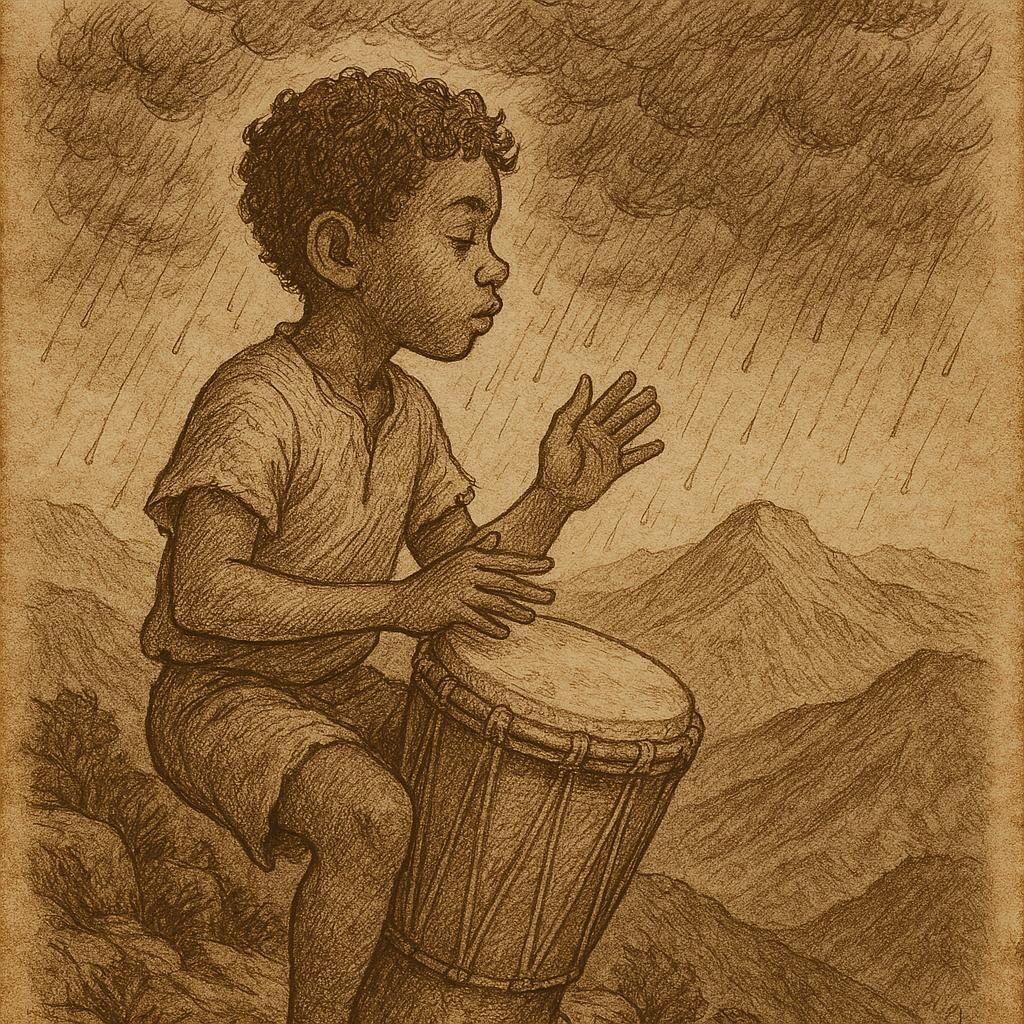
He began to play. The beats were gentle at first, soft as a whisper through dry grass. Then they grew deeper, echoing between the stones like thunder in a faraway sky. The ground trembled slightly. The leaves of the few surviving trees shivered though no wind stirred.
Encouraged, Tabo drummed harder. Sweat ran down his face, and his hands burned from the friction, but he would not stop. The rhythm rose like a heartbeat, steady and strong. Then, a deep rumble answered from beneath the earth. The mountain itself seemed to sigh.
Suddenly, a bright streak of lightning split the clouds that had long been silent. Thunder roared across the island. The first drop of rain fell on Tabo’s cheek. He laughed aloud and struck the drum once more, louder than before. The sky opened. Rain poured in silver sheets, running down the rocks, washing the dust from the earth. Rivers that had vanished sprang back to life, singing through the valleys.
Down below, the villagers ran outside, raising their faces to the rain. “The boy did it!” someone cried. “The drummer woke the spirits!”
For three days and nights, the rain fell. The fields turned green again, and the trees lifted their branches like arms of thanksgiving. When the sky finally cleared, a rainbow stretched across the mountains like a crown.
The elders searched for Tabo to honour him, but he had vanished. Only his drum remained in the clearing, resting on the wet earth. Some said the spirits took him to live among them as their messenger. Others believed he simply walked away, content that his rhythm had brought life back to the island.
Years later, travellers passing through Mahé said that when drought threatened again, a faint drumming could be heard deep in the hills at night, steady, patient, and filled with love. And always, soon after, the rain returned.
Moral Lesson
The Drummer Who Summoned Rain teaches that faith and selflessness have power beyond material strength. Tabo’s courage and pure heart reminded his people that nature listens to those who act with love and purpose. The story shows that even the smallest rhythm, when played with hope, can awaken life itself.
Knowledge Check
Who is the main character in The Drummer Who Summoned Rain and what was his special gift?
The main character is Tabo, a poor boy whose gift was his ability to play the drum with deep faith and emotion.Why did the people of Mahé suffer in the story?
They suffered because of a long and harsh drought that dried their fields, rivers, and seas.What did Tabo’s grandmother tell him about the mountain spirits?
She said that when the island thirsts, the drums of faith can awaken the rain spirits sleeping beneath the mountains.How did Tabo awaken the rain spirits?
By drumming with pure faith and love, his rhythm echoed through the mountains and awakened the spirits to bring rain.What did the villagers learn from Tabo’s act of courage?
They learned that true power comes from faith and selflessness, not from wealth or mockery.What message does the rain symbolize in the story?
The rain symbolizes renewal, gratitude, and the reward of unwavering belief.
Source: Mountain folklore of Mahé Island. Transcribed by Philippe M. Doffay in Creole Myths and Sacred Rains (1937).