Long ago, in the land of the Fon people of Benin, there lived three siblings, the children of Agbanukwe and Kpoli. Their names were Minona, Aovi, and Legba. Together, they formed a small funeral band, known for their drumming and songs, which carried both sorrow and power.
One day, a great man died in the distant land of Adjaminako, and the three siblings traveled to play their music at the funeral. Yet each sibling bore a dark past, each had killed their own spouse. Minona had slain her husband by tearing open his stomach. Aovi had taken his wife’s life by cutting off her head. Legba, youngest of the three, had killed his wife with a single blow from his cane. Despite their grim histories, they came together as musicians, their drums echoing the finality of death.
At the funeral, their performance was praised, and they were showered with gifts, especially cowries, the shells that served as currency. Among those present was King Metonofi, who carried deep shame. He had given his eldest daughter in marriage to the King of Adja, but the king was impotent and could not lie with her. Out of disgrace, he passed her on to his eldest son.
In those days, everyone sought guidance from Fa, the divine spirit of destiny, but Fa’s voice was always revealed through his servant Legba. The son of the King of Adja came to Fa, asking for medicine that would restore his manhood. Fa, compassionate, told Legba to give him the sacred white powder, the powder that brought strength and potency. But Legba, mischievous and cunning, gave him the red powder instead, the one that caused impotence.
When the funeral ended, the siblings departed, carrying their wealth of cowries. At a crossroads, they sat to divide their gifts. No matter how they split them, one cowry remained.
Minona, as the eldest, claimed it was hers by right. Aovi, second-born, argued that it belonged to him. Legba, the youngest, insisted he deserved it, for the older ones had eaten long before he was born. Their quarrel grew fierce, and finally, they asked a passing woman, an old wood-seller carrying a calabash on her head, to settle the dispute.
She tried to divide the shells but, like the siblings, could never find a way to make the piles equal. At last, she declared, “In my country, when three divide and one is left, it goes to the eldest.” She gave the extra cowry to Minona.
This enraged Aovi, who cut off her head, and Minona, who tore open her belly. Legba dragged her body into the bush and defiled it. Such was the cruelty of the siblings.
Later, another woman passed by. This time, she declared, “In my country, the extra belongs to the youngest, for the elders have eaten before him.” She handed it to Legba. Once again, Minona and Aovi killed her savagely, and once again, Legba dragged the corpse into the bush.
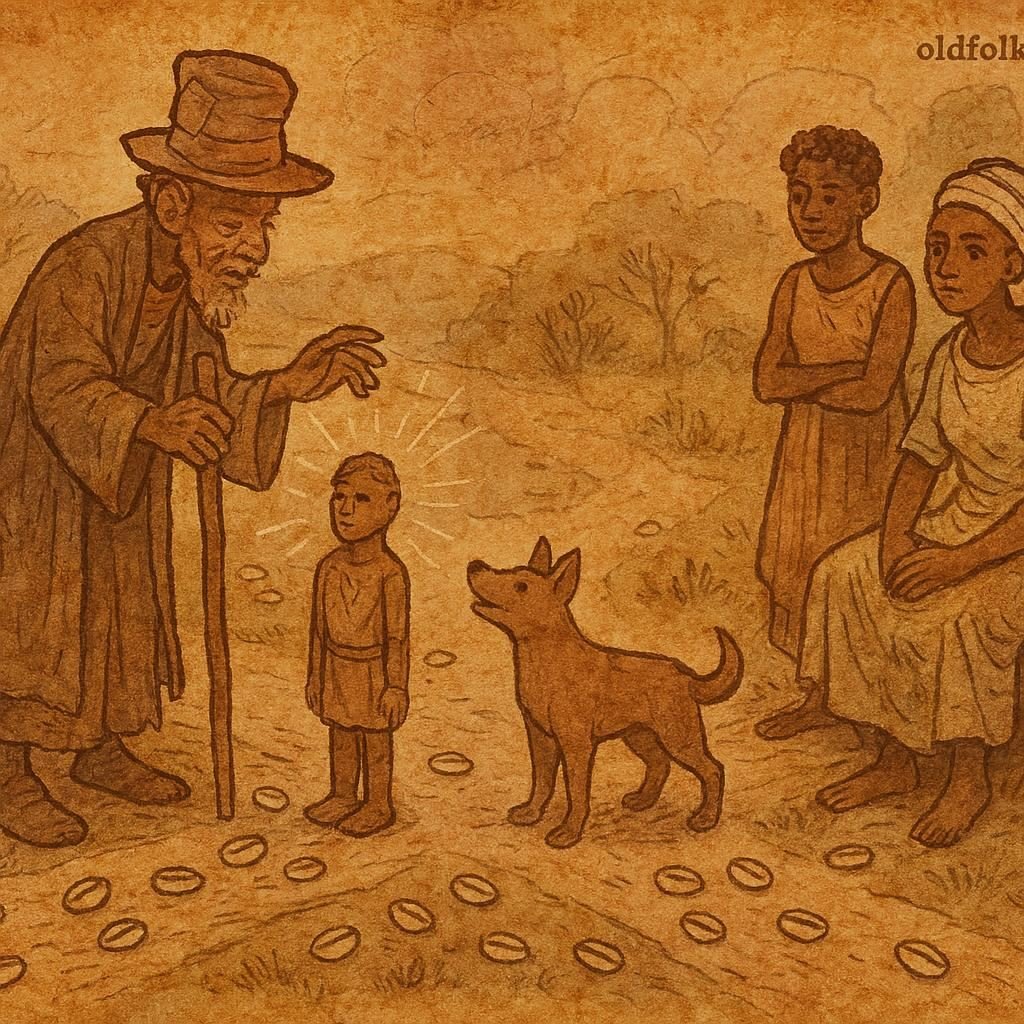
By now, Legba had grown weary of the quarrel. From Fa’s sacred sack, he took a carved figure, breathed life into it, and turned it into a dog. He whispered instructions to the creature and sent it toward his siblings.
When the dog arrived, they asked him to divide the cowries. Like before, one was always left. The dog scratched a hole in the earth and buried the final shell. “In my country,” he explained, “when three divide and one remains, it belongs to the ancestors.”
Hearing this, all three siblings were satisfied. They blessed the dog. Minona declared, “You shall lead all the vodun spirits I command.” Aovi added, “You shall guide the gods.” Legba proclaimed, “You shall lead all men, never letting them lose their way.” Thus, the dog became honored among spirits and people.
When the siblings returned home, the trick Legba had played with the red powder was revealed. The son of the King of Adja was now impotent, and so too were the men who sought Fa’s counsel. Metonofi, desperate to restore honor, announced that whoever could deflower his daughter would win half his kingdom.
Many men tried, but none succeeded, for Legba secretly gave them all the red powder. Finally, Legba himself entered the challenge. Before witnesses, he proved his virility by lying with the king’s daughter. Music thundered outside as his drums proclaimed his power. Emerging, naked and triumphant, he mocked the other men with exaggerated movements, leaving no doubt of his victory.
Metonofi rejoiced and gave his daughter to Legba as wife. More importantly, he proclaimed that Legba would be the guardian of men, women, and even the gods. Minona was sent to dwell among women, Aovi to live among the gods, but Legba could move freely everywhere. From that day forward, he became the ever-present trickster and guardian, standing between the world of men and the divine.
Moral of the Story
This tale shows that cunning, boldness, and wisdom can grant power, but it also reminds us that actions, whether selfish or just, shape destiny. Respect for the dog in Beninese tradition is rooted in its symbolic role as a mediator between men, gods, and ancestors.
Knowledge Check
Q1: Who were the siblings in this Beninese folktale?
A1: Minona, Aovi, and Legba, children of Agbanukwe and Kpoli.
Q2: What symbolic role does the dog play in the story?
A2: The dog acts as mediator, honoring ancestors by burying the extra cowry, earning respect in Vodun.
Q3: Why did Legba give out the red powder instead of white?
A3: Legba, the trickster, deliberately gave the impotence powder, showing his cunning nature.
Q4: How did Legba prove his power before King Metonofi?
A4: He deflowered the king’s daughter publicly, proving potency where all others had failed.
Q5: What does this folktale reveal about Beninese culture?
A5: It highlights beliefs in destiny (Fa), the role of trickster figures, and respect for dogs as sacred.
Q6: Why is the dog respected in Vodun tradition according to this tale?
A6: Because it settled disputes fairly, guided men and gods, and symbolized ancestral connection.
Source: Beninese Folktale