In a certain town where family bonds should have meant everything, two brothers lived lives as different as day and night. The elder was named Swarmi, a man of wealth and status who enjoyed the comforts of marriage, servants, and abundant food. The younger was called Buite, and he lived a life of loneliness and scorn.
Buite had no wife to prepare his meals, no servants to attend to his needs, and no family to share his burdens. Each day, he wandered into the bush alone to gather palm-kernels, which he ate raw or roasted over a small fire. This was his sustenance, bitter and meager though it was.
What made Buite’s suffering worse was the cruelty of his own brother. Swarmi never invited Buite to join him at meals, never included him in family celebrations or festivities. When laughter and music filled Swarmi’s compound, Buite sat alone in the shadows, invisible and unwanted. The rejection burned in his heart like a slow fire, and finally, he could bear it no longer.
If you liked this story, see our Central African folktales collection
One morning, without a word to anyone, Buite gathered his few possessions and walked away from the town. He walked through grasslands and forests, over hills and through streams, until nightfall found him standing at the edge of a deep, fertile valley.
The valley stretched before him like a green cathedral, thick with palm-trees that rose tall and majestic toward the sky. Their fronds whispered secrets in the wind, and beneath them grew dense rushes and vegetation that thrived in the damp, shadowy earth. Far down at the bottom, where sunlight barely penetrated, Buite decided to make his home.
With his own hands, he built a humble shed little more than a roof supported by sticks, rising barely a foot above the ground. It was a pitiful dwelling, damp and dark, but it was his. He spread his mat on the ground, lit a small fire, and prepared to live out his days in solitude.
Exhausted from his journey and heavy with the weight of rejection, Buite lay down to sleep that first night. As he slept, a dream came to him, vivid and clear as waking life.
In the dream, a beautiful girl appeared before him. Her voice was gentle as she called his name. “Buite, rise and follow me.” He stood and followed her through thick jungle and tangled woods until they reached the banks of a flowing river. The water sparkled in moonlight, mysterious and inviting.
“Tap on the ground three times,” she instructed him.
He did so, and to his amazement, a canoe materialized before his eyes.
“Now tap the canoe three times.”
When he obeyed, paddles appeared inside the vessel, ready for use.
“Go and fish,” the girl said, her eyes serious and intent. “Bring me food that I might cook it for you. But you must cut the heads off the fish, I cannot bear to see them.”
In his dream, Buite went fishing, cut the heads from his catch, and returned to find the beautiful girl waiting for him, ready to prepare his meal. Then he woke, his heart pounding, and could not sleep again that night.
When morning light filtered through the palm fronds, Buite rose with purpose. He traveled through the jungle and woods, following the path from his dream, until he stood at the riverbank. With trembling fingers, he tapped the ground three times.
A canoe appeared.
He tapped the canoe three times.
Paddles materialized.
His heart racing with wonder, he fished and carefully cut the heads from each fish. Then he made his way back to his wretched hovel, hardly daring to hope.
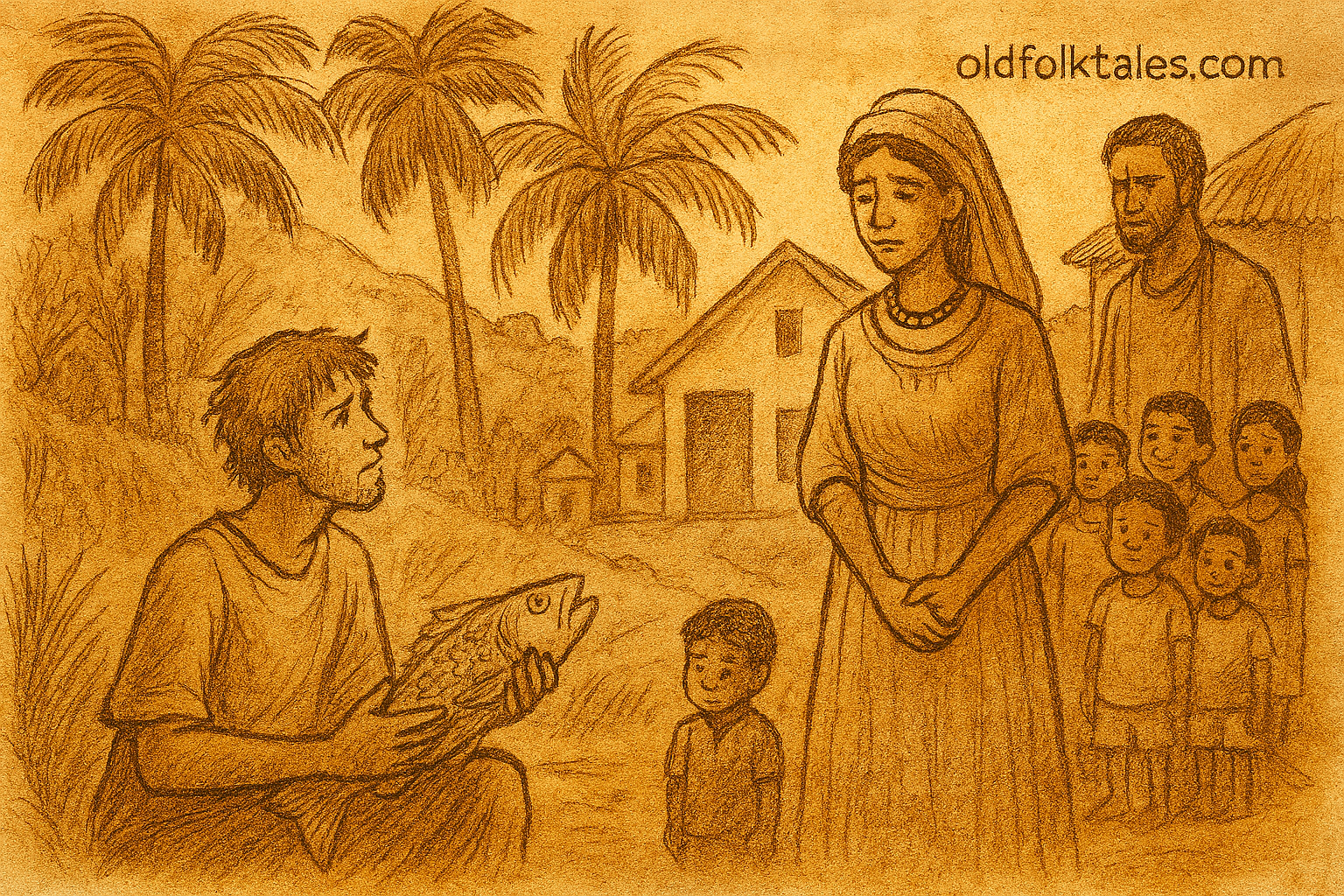
But when he arrived at the spot where his miserable shed had stood, he stopped in his tracks, overwhelmed. The hovel had vanished. In its place stood a large, beautiful house with fine furnishings, proper out-houses, and all the comforts he had never known. And there, coming forward to greet him as naturally as if she had done so every day of their lives, was the beautiful girl from his dream.
Behind her stood nine small servants, ready to attend to her every need.
“I have come to comfort you,” she said softly.
Buite’s heart filled with love and gratitude. His loneliness evaporated like morning mist.
Each day, Buite went fishing, and each day his wife sent one of her little servants to carry the fish home. He always remembered to cut off the heads, honoring her one condition. His life transformed into something he had never imagined possible.
People who passed through the valley marveled at Buite’s hospitality and wealth. Word spread throughout the region, and eventually reached his brother Swarmi. Unable to believe that despised Buite could have achieved such prosperity, Swarmi decided he must see for himself.
But something was shifting in Buite’s heart. Day after day, the task of cutting off the fish heads grew tedious. It seemed such a small, pointless rule. One day, impatience got the better of him, and he handed the fish to one of the servant boys without removing the heads.
The boy cried out in protest. “Master, please! My mother does not like to see a fish’s head!”
Buite’s pride flared. “Is it for you, a mere servant, to talk in that way to your master?”
The frightened boy hurried toward home with the fish. But guilt seized Buite, and he ran after the boy, catching him just before he reached the house. He quickly cut off the heads, and disaster was averted.
This scene repeated itself eight times with eight different servants. Each time, Buite’s impatience grew. Each time, he scolded the protesting boy. Each time, he repented and ran to fix his mistake before his wife could see.
The ninth time, Buite took the youngest servant, a boy called Parrot, fishing with him. Once again, he gave the complete fish to the boy without removing the heads.
Parrot cried out desperately, tears streaming down his face. “Please, master, please! My mother cannot see the fish heads!”
But Buite’s pride had hardened into arrogance. His imperious manner frightened little Parrot, who ran for home as fast as his legs could carry him, the whole fish clutched in his trembling hands.
Too late, Buite felt the familiar pang of regret. He chased after Parrot, running with all his strength, his breath coming in ragged gasps. He ran and ran and ran, but he could not catch the swift child.
The Vanishing
Parrot burst through the door of the house and showed the fish to his mother. The woman’s face transformed with sorrow and resignation.
In an instant, the house began to fade. The beautiful furnishings dissolved into air. The out-houses vanished like smoke. The nine servants disappeared one by one. And finally, the lovely wife herself faded away, her eyes full of sadness as she looked at Buite one last time.
When Buite arrived, gasping and desperate, he found nothing. No house, no servants, no wife only the familiar damp ground where his wretched hovel had once stood.
And there, at that precise moment, his brother Swarmi appeared, having arrived to witness Buite’s supposed prosperity. Instead, he found his younger brother standing alone in an empty valley, weeping bitterly.
Swarmi looked at Buite with even greater contempt than before and walked away, leaving him once more in solitude and despair.
The Moral Lesson
This folktale teaches us that blessing, especially those that come from magical or spiritual sources, often carry conditions that must be respected absolutely. Buite’s downfall came not from a single act of disobedience, but from a gradual erosion of respect for the boundaries set by his wife. His growing impatience and pride led him to test the limits repeatedly until he finally went too far. The story reminds us that when we receive unexpected gifts or blessings, we must honor the terms that come with them, no matter how trivial they may seem. Arrogance and the belief that rules don’t apply to us can destroy everything we’ve been given. True wisdom lies in gratitude, humility, and faithful adherence to our promises even when no one is watching.
Knowledge Check
Q1: Why did Buite leave his brother Swarmi’s town in this African folktale?
A: Buite left because his brother Swarmi treated him with cruelty and contempt. Despite being family, Swarmi never invited Buite to share meals or participate in family festivities, leaving him despised and alone. Unable to bear this rejection any longer, Buite decided to live alone in the bush rather than endure his brother’s mistreatment.
Q2: How did Buite’s magical wife first appear to him?
A: The wife first appeared to Buite in a dream while he slept in his wretched hovel in the valley. She called him to follow her through the jungle to a river, where she instructed him to tap the ground and canoe to make them appear, and told him to fish but always cut off the fish heads. When he followed these instructions in real life, his hovel transformed into a beautiful house, and she appeared with nine servants.
Q3: What was the one rule Buite’s wife required him to follow?
A: Buite’s wife required him to always cut the heads off the fish before bringing them home. She told him clearly that she could not bear to see fish heads. This was the sacred condition of her presence and their prosperity, and breaking this rule would have serious consequences.
Q4: Why did Buite repeatedly fail to cut off the fish heads?
A: Buite grew tired and impatient with the daily task of cutting off fish heads. He began to see the rule as tedious and pointless, and his pride made him believe he was above being questioned by his wife’s servants. This growing arrogance led him to test the boundaries repeatedly, until he finally broke the rule completely with the youngest servant, Parrot.
Q5: What happened when Parrot showed the whole fish to Buite’s wife?
A: The moment the wife saw the fish heads, everything vanished instantly. The beautiful house dissolved, the furnishings disappeared, the out-houses faded away, all nine servants vanished, and finally the wife herself disappeared. Buite was left with nothing but the empty ground where his original hovel had stood, having lost everything through his disobedience.
Q6: What does the vanishing wife symbolize in this African folktale?
A: The vanishing wife symbolizes the fragile nature of blessings that come with conditions, particularly those from spiritual or magical sources. She represents the gifts that can be given to us when we are humble and obedient, but which disappear when we become arrogant and disrespectful. Her departure teaches that prosperity requires maintaining the virtues humility, gratitude, obedience that attracted the blessing in the first place.
Source: Central African folktale (Kongo people tradition)