In the heart of the Gabonese forest, where the trees towered and the air was filled with the scent of damp earth and the calls of wild animals, lived Leopard, fierce and proud, and Rat, small but clever. Despite their differences in size and strength, they formed an unusual friendship. They hunted together, shared food, and traveled side by side through the thick undergrowth. Other animals marveled at their companionship, for it was rare to see such contrast in allies. Yet the forest often teaches that even the closest of friends may hide dangerous intentions.
One bright morning, Leopard and Rat set out on a hunt. The forest was alive with motion and sound. Parrots screeched in the treetops, monkeys swung from branch to branch, and the hum of insects filled the air. With Leopard’s strength and Rat’s quick eyes, they captured more than enough prey for the day. As they feasted, Leopard’s mind began to change. He watched Rat nibbling at the meat and thought, “Why should I share my food with this small creature? I am Leopard, the strongest in this forest. Rat is weak and clever only in tricks. If I had him for myself, I would never go hungry.” That night, although he smiled at Rat by the fire, Leopard’s heart was heavy with greed, and he devised a plan.
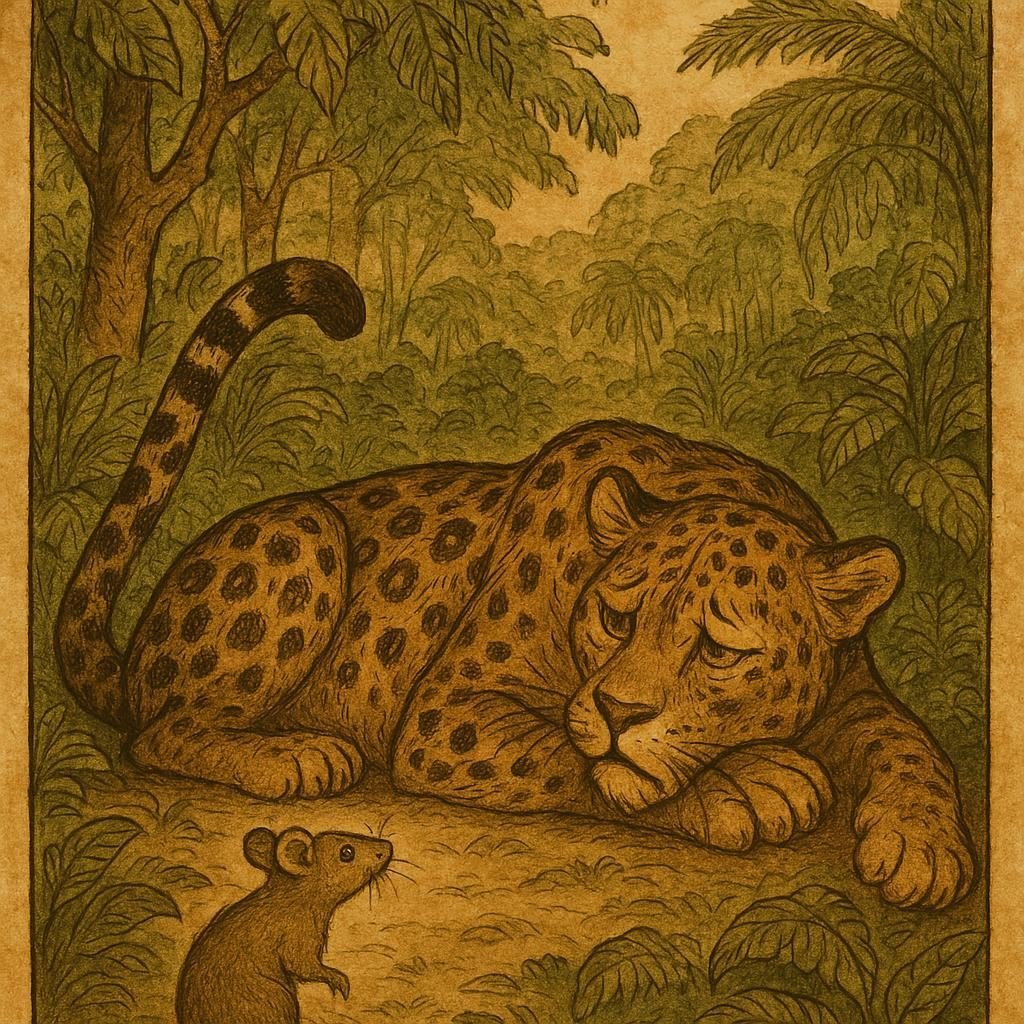
The next morning, Leopard lay in a clearing and groaned loudly. His ears drooped, his eyes half closed, and he breathed heavily as if his strength had left him. “Oh, my dear friend,” he whispered, “I am gravely ill. My strength has abandoned me. The forest spins before my eyes, and I fear I may soon leave this world. Come closer and sit by me, for I do not wish to die alone.” Rat twitched his whiskers, suspicious of Leopard’s strange behavior. He had noticed the glint of greed in Leopard’s eyes in the past. Carefully, he stepped closer, keeping a watchful eye on every movement.
READ THIS:Why Monkey Mocked Leopard
Rat observed that Leopard’s tail twitched slightly. Sick animals do not move their tails, he thought. Instead of approaching blindly, Rat devised a cautious plan. “Friend,” he said softly, “let me bring you water from the stream. It may ease your pain.” He took small steps back toward the cover of the trees and then darted swiftly into the underbrush. Leopard sprang to his feet, revealing that he had been pretending all along. He roared in anger, “Come back, Rat! You cannot escape me!” But Rat had already vanished into the forest, leaving only the rustle of leaves behind.
Leopard prowled the clearing, furious and frustrated, but he could not find Rat. The clever little creature had outsmarted the mighty hunter. Rat watched from the shadows, knowing that his caution and wisdom had saved him. He had learned a valuable lesson: even friends can betray trust when greed overcomes loyalty. The forest seemed quieter that day, as if the trees themselves had paused to witness the lesson.
From that day forward, Rat remained careful in choosing his companions. He continued to live cleverly, aware that strength alone does not guarantee loyalty. Leopard, in turn, learned that deceit could not always capture the clever or the vigilant. The forest continued its endless rhythm, teaching all creatures that cunning and prudence often outweigh sheer power.
Moral Lesson: This tale teaches that even close friends may harbor hidden intentions, and trust must be earned carefully. Wisdom and vigilance can protect one from betrayal, and prudence often saves those who are alert from the danger posed by greed or deception. True friendship is built on honesty and respect, not on blind trust.
Knowledge Check:
What are the main characters in the story?
Answer: Leopard, who is strong and proud, and Rat, who is small and clever.Why did Leopard pretend to be sick?
Answer: Leopard pretended to be sick to trick Rat so he could catch and eat him out of greed.How did Rat realize that Leopard was pretending?
Answer: Rat noticed Leopard’s tail moving and other signs that a truly sick animal would not show, which revealed the trick.What strategy did Rat use to escape?
Answer: Rat pretended to fetch water but used the opportunity to retreat carefully into the forest, avoiding Leopard’s trap.What is the main lesson of the folktale?
Answer: Even close friends can betray trust, so one must be cautious, wise, and vigilant.Where does this folktale originate?
Answer: This story is from the Mpongwe people of Gabon in Central Africa.
Cultural Origin: Mpongwe people, Gabon
Source: Robert H. Nassau, Where Animals Talk: West African Folklore Tales (Mpongwe Tribe, Gabon)