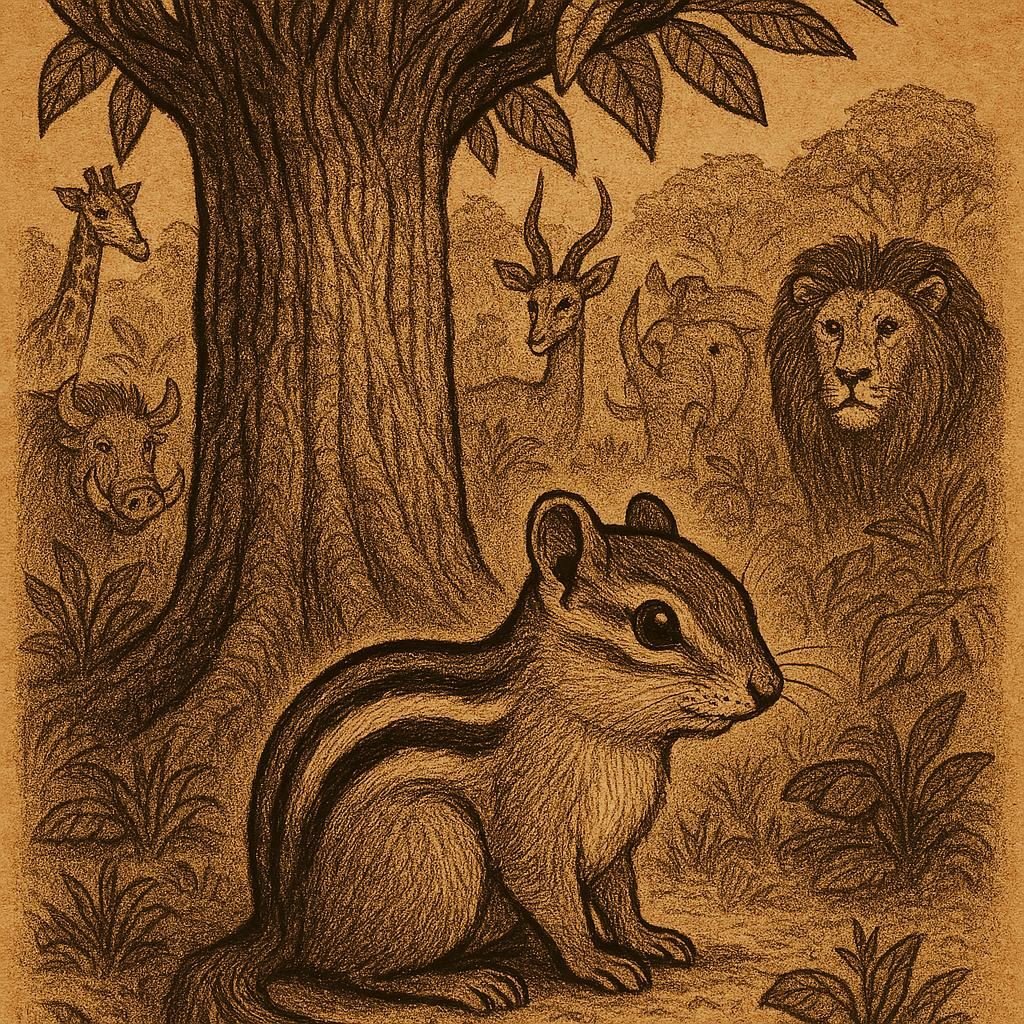
A very long time ago, the Chipmunk looked exactly like the Squirrel. He had no markings on his back and no stripes to set him apart. His fur was smooth and plain, and he blended easily with the rest of the forest animals. This story explains how the Chipmunk came to carry the stripes that remain on him until today.
The forest was alive with movement and sound. Tall trees stood shoulder to shoulder, vines dangled from every branch, and paths that once allowed the animals to walk freely had become narrow and blocked. It had rained heavily for many months. Bushes had grown thick and thorny, and tall grasses stretched across every opening. Life in the jungle was becoming difficult.
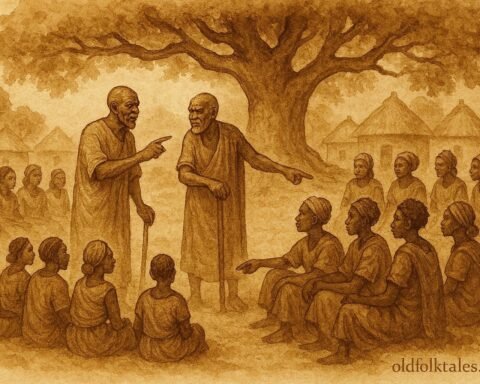
The animals grew restless and gathered for a great meeting. They sat together in the heart of the jungle and debated what to do about the problem. After long discussions, they agreed that the paths had to be cleared. Without this work, it would be impossible for them to move about, to hunt, or even to visit one another. But who would pay for such hard labor?
READ THIS:The Tale of Kweku Ananse and the Baboon’s Bananas
At last they decided that every animal who walked on the ground would contribute money to hire workers who would clear the paths. Since the birds soared freely in the sky, they would not be asked to contribute. The decision seemed fair, and most of the animals, though reluctant, agreed to pay.
The Chipmunk, however, was not pleased. Though he was tiny, his stubbornness was enormous. He stood before the gathering and boldly declared, “I will pay no tax. I refuse to give a single cowrie. If paying means that I must never touch the ground again, then so be it. I will live in the trees for the rest of my life.”
The other animals murmured in disbelief. They were sure the Chipmunk would not last long. “Let him be,” said one. “He will soon grow tired and come down. Then he will have no choice but to pay.”
But the days passed and the Chipmunk did not return to the ground. Instead, he leaped joyfully from branch to branch, hopping from one tree to another, eating fruits, and moving about in the canopy. Even the Tortoise, who was famous for cunning tricks, had paid his share, but not the Chipmunk.
Some animals began to pity him. They whispered among themselves, “Perhaps he has no money. Perhaps he is too ashamed to admit his poverty. Why else would he suffer so and limit himself to the trees?”
Their pity soon turned into kindness. They decided to help him. They placed a large gourd beneath the mighty Iroko tree, and every animal who wished could drop cowries into it. They hoped that, once the gourd was full, the Chipmunk would be able to pay his tax without shame.
News of this kindness reached the Chipmunk through a bird that flew up to the branches. When the Chipmunk heard, he laughed so hard that he almost fell from the tree. “So they have nothing better to do with their money than to pay my tax for me? How foolish they are!”
That very night, when darkness covered the jungle, the Chipmunk crept down from the trees. Quietly, he approached the Iroko tree where the collection gourd rested. Without hesitation, he snatched it up, cowries and all, and scurried away into the shadows.
At sunrise, the animals discovered the theft. Anger spread through the jungle. “The Chipmunk has stolen from us!” they shouted. They gave chase, but the Chipmunk was far too quick. Leaping from tree to tree, he easily escaped them. None could reach him.
The animals met once again in council. Their hearts were heavy, for they had shown kindness, yet the Chipmunk had betrayed them. They spoke with one voice: “The Chipmunk shall be banished from the jungle. He cannot live among us any longer.”
From that day onward, the Chipmunk no longer lived in the forest. He was forced to dwell among human beings, where he could no longer trick the animals who had once been his companions.
Many seasons later, during another great meeting in the jungle, one of the animals raised a question. “What did the Chipmunk ever do with the cowries he stole from us?”
Another replied, “He never used them for food, nor for shelter, nor for anything wise. It is said that he wasted them all to buy stripes for his back.”
The animals shook their heads in pity. And ever since that time, the Chipmunk has carried his stripes, a lasting reminder of his stubbornness, greed, and betrayal.
Moral Lesson of How the Chipmunk Got Its Stripes
The tale of the Chipmunk teaches that greed and stubbornness lead to disgrace. The animals offered kindness, yet he chose deceit and selfishness. In the end, he lost his home in the jungle and bore stripes on his back as a permanent mark of his wrongdoing. This story reminds us that those who betray the trust of others may enjoy short moments of victory but will carry the scars of their actions forever.
Knowledge Check: How the Chipmunk Got Its Stripes
Why did the animals decide to impose a tax in the story of How the Chipmunk Got Its Stripes?
Because heavy rains had overgrown the jungle paths, and they needed money to clear them.What excuse did the Chipmunk give for refusing to pay the tax?
He declared that he would never pay, even if it meant living in the trees forever.How did the other animals try to help the Chipmunk?
They set up a collection gourd under the Iroko tree so that he could have enough cowries to pay.What did the Chipmunk do with the collection gourd?
He stole it during the night and ran off with all the cowries.What punishment did the animals give the Chipmunk?
They banished him from the jungle, forcing him to live among people.According to the folktale, how did the Chipmunk get his stripes?
It was said that he wasted the stolen cowries by buying stripes for his back, which remain until this day.Cultural Origin
This folktale comes from Ghana and belongs to Akan oral storytelling traditions. It reflects themes of morality, greed, and the consequences of betrayal, showing how a trickster’s pride can leave lasting marks.