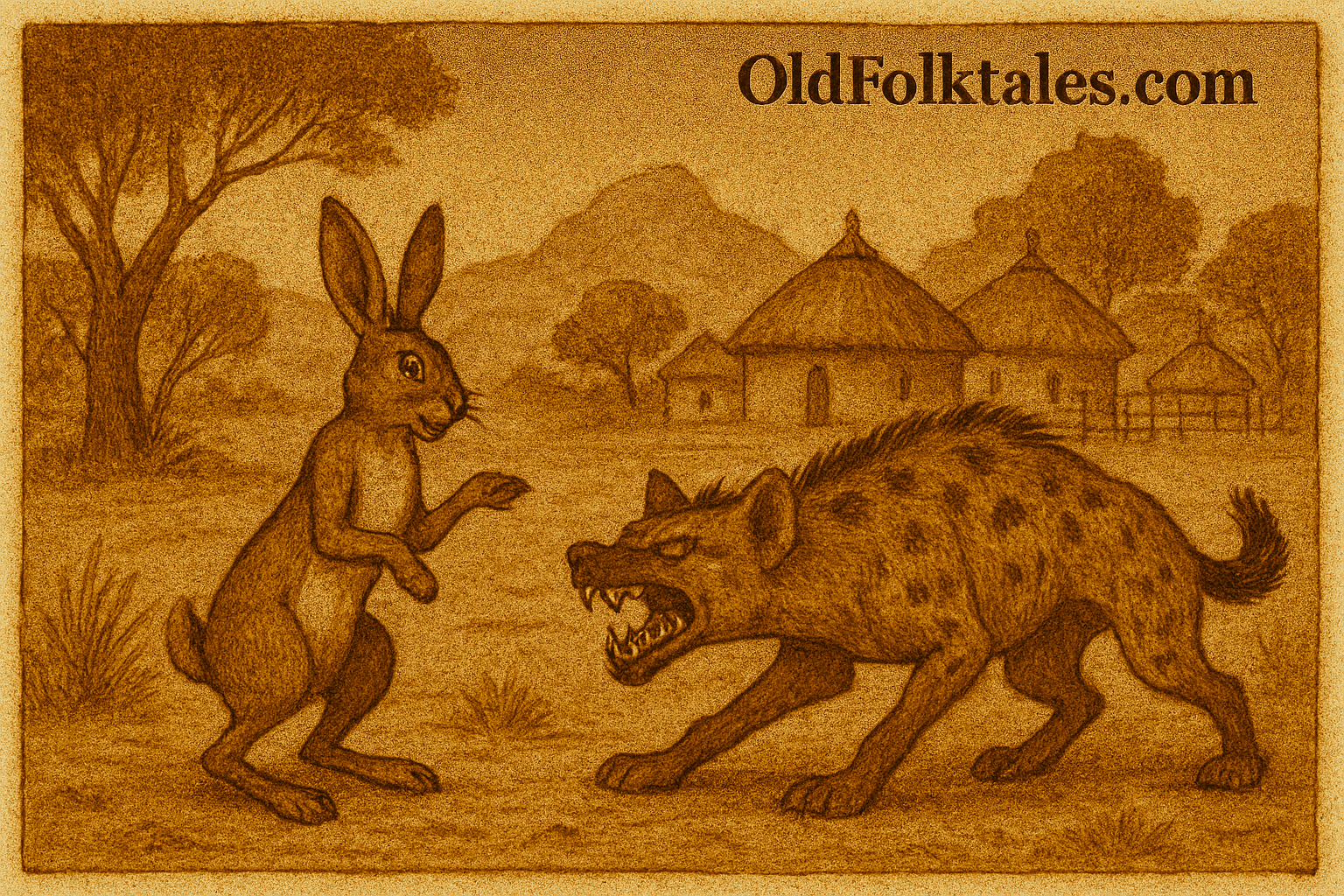
Gather round, little ones, gather like the fireflies dancing in the evening light! Let your laughter bubble up like the spring waters of our mountains, for tonight I bring you a tale of cunning and mischief that will make your bellies shake with joy. This is the story of Mmutla, the clever hare, and Phiri, the foolish hyena, a tale that has traveled from mouth to mouth since our great-great-grandmothers first stirred the cooking pots.
Motho o bohlale ha a sebetsoe ke matla A clever person is not overcome by strength, as the old ones say, and tonight you shall see how true these words ring!
Long, long ago, when the world was still learning its own songs and the animals spoke as clearly as you and I, there lived in the thornveld near the Maluti Mountains a hare named Mmutla. Now this hare was small so small he could hide behind a blade of grass but his mind was sharp as the winter wind and quick as lightning dancing across the sky.
In the same land prowled a hyena called Phiri, whose jaws could crush bones like twigs and whose laugh could be heard echoing through the valleys at midnight. Phiri was proud of his strength and his fearsome reputation, but alas, children, the ancestors had given him muscles in his body but forgotten to put any in his head!
Sebete sa bohale se feta sebete sa matla The strength of wisdom surpasses the strength of muscle, and so it was with these two creatures of the veld.
One dry season, when the rivers ran low and the grass turned brown as yesterday’s bread, both Mmutla and Phiri grew desperately thirsty. They had heard whispers on the wind of a hidden spring deep in the mountains, where crystal waters bubbled up from the earth’s heart. But the path was treacherous, winding through rocky gorges where only one animal at a time could pass.
“Ho!” called Phiri, blocking the narrow mountain path with his bulk, his yellow eyes gleaming with menace. “Little rabbit, this path belongs to the strong! Turn back, or I shall make a meal of your tender bones!”
But Mmutla, clever as the morning star, only twitched his whiskers and smiled. “Ah, mighty Phiri,” he said, his voice sweet as honey from the mountain flowers, “I would not dream of challenging your strength. But perhaps you would enjoy a game before you drink? I know of treasures hidden nearby that would make even a powerful hyena like you richer than a chief!”
Bohlale bo feta bokgoni Cleverness defeats skill, and Phiri’s greed was about to make him the perfect fool.
“Treasures?” Phiri’s ears perked up like a dog hearing his master’s whistle. “What treasures could a small rabbit know that I do not?”
Mmutla pointed with his tiny paw toward a field where the late afternoon sun made the grass shine like gold threads. “Do you see how that grass glitters, my friend? Those are not ordinary plants, they are made of pure gold! But they can only be harvested by one who is truly strong. You must run through them as fast as lightning, and whatever touches your fur will turn to gold coins!”
The foolish hyena’s eyes grew round as full moons. Without another thought, he charged into the field, running back and forth through the grass with all his might. But what Mmutla had not mentioned was that these were the sharpest thornbushes in all the land, and soon poor Phiri emerged looking like a pincushion, covered in thorns from nose to tail!
“Where is my gold?” howled Phiri, plucking thorns from his hide.
“Ah,” said Mmutla, trying very hard not to giggle, “perhaps you were not fast enough. But I know of an even greater treasure, the Moon’s Silver Lake, where the water itself is liquid silver! It lies just over that hill.”
Mohlanka o bohlale o qoba ntja e nang le meno .A clever jackal avoids the dog with teeth, and Mmutla was proving just how wise this saying was.
Still nursing his thorny wounds, Phiri limped after the hare to a small pond that shimmered beautifully in the moonlight. The clever Mmutla had chosen his spot well, the water reflected the full moon so perfectly it looked like molten silver.
“The silver is at the bottom,” whispered Mmutla. “But to reach it, you must dive deep and stay under until you can gather it all. Hold your breath and swim down, down, down!”
The greedy hyena plunged into the cold mountain water, diving again and again, trying to grasp the moon’s reflection with his claws. Each time he dove, the image scattered into ripples, and each time he surfaced, gasping and shivering, there was Mmutla on the bank, shaking his head sadly.
“Almost, mighty Phiri! I can see you nearly had it that time. Just one more dive should do it!”
By the time the foolish hyena realized he had been chasing moonbeams, he was exhausted, freezing, and thoroughly soaked. Meanwhile, clever Mmutla had hopped away to the hidden spring and drunk his fill of the sweet, clear water.
But Phiri was not finished. Oh no, children! His pride was wounded worse than his thorn-scratched hide, and he was determined to catch that impudent rabbit.
The next morning, Phiri waited by the spring, sure he would trap Mmutla when the hare came to drink. But clever Mmutla had anticipated this trap like a bird sensing a storm.
“Friend Hyena!” called Mmutla from high up on a rocky ledge. “I see you are guarding the spring. How wise of you! But I have discovered something terrible, this water has been poisoned by an evil sorcerer! Look how still and lifeless it appears!”
Now, the spring was naturally very calm and clear, but to Phiri’s fevered imagination, it suddenly did look suspicious.
“How can we test if it is safe?” asked the worried hyena.
“Simple,” replied the crafty hare. “You must stir it vigorously with your paw. If it bubbles and froths, the poison will rise to the surface and we can see it. But you must stir very hard, or the test will not work!”
Poor Phiri spent the entire morning churning the water with his paws, making it muddy and undrinkable, while Mmutla quietly slipped away to find another, cleaner spring elsewhere in the mountains.
When Phiri finally realized he had been fooled again, he let out such a howl of frustration that it echoed through every valley and gorge in the Maluti Mountains. To this day, children, when you hear the hyena’s cry at night, remember, it is Phiri, still calling out his embarrassment at being outwitted by a creature no bigger than his own paw!
Hlalefi e nyane e bona hole le kgolo e sa bone. The small wise one sees what the big fool cannot see.
From that day forward, the animals of the veld learned an important lesson. Whenever there was a dispute to settle or a problem to solve, they did not look to the strongest or the largest, but to the cleverest. And whenever young animals grew too proud of their size or strength, the elders would tell them the story of how little Mmutla made mighty Phiri dance to his tune.
The hare continued to live happily in his burrow, drinking from sweet springs and nibbling tender grass, while the hyena wandered the thornveld, still searching for golden grass and silver lakes that existed only in his own greedy imagination.
And so it was that wit triumphed over strength, cleverness over cruelty, and wisdom over foolishness as it always has and always will, when the small and clever remember that their minds are their greatest weapons.
Bohlale ha bo na tekanyo Wisdom has no measure, for it can make the smallest mouse mighty and the mightiest beast into a fool.
The Wisdom of the Ancestors
Thus do the old stories teach us, children of the mountains, that true strength does not lie in the power of our muscles or the sharpness of our teeth, but in the quickness of our thoughts and the kindness of our hearts. The hare who defeated the hyena shows us that when we face challenges greater than ourselves, we need not despair—for cleverness can open doors that force cannot break, and wisdom can solve problems that strength cannot overcome.
But let us remember also that Mmutla’s tricks were not born from cruelty but from necessity. He did not seek to harm Phiri out of spite, but only to protect himself and find the water he needed to survive. True cleverness, like the clear mountain stream, flows always toward good purposes to help the helpless, to protect the innocent, and to bring justice where there was none.
When we find ourselves small in a world of giants, let us remember that size is not destiny. The ancestors gave each creature different gifts to some they gave strong jaws, to others swift legs, and to still others sharp minds that can see solutions where others see only problems. The wise child learns to use whatever gifts they have been given, not to boast or to harm others, but to make their way safely through life’s many challenges.
So when you face your own hyenas whether they be bullies in the schoolyard or problems that seem too big to solve—remember little Mmutla. Think first, act wisely, and never let anyone convince you that loudness is stronger than logic, or that muscles are mightier than minds.
Knowledge Check
What character traits make Mmutla the hare successful against Phiri the hyena?
Mmutla succeeds through cleverness, quick thinking, and strategic planning. Unlike the physically powerful hyena, the hare uses his intelligence to anticipate problems, create elaborate deceptions, and turn his opponent’s greed and pride against him, proving that wit can triumph over brute strength.
How does this Sotho trickster tale teach children about problem-solving?
The story demonstrates that when facing larger challenges or stronger opponents, creative thinking and strategic planning can be more effective than direct confrontation. It encourages children to use their intelligence and observation skills rather than relying solely on physical strength or aggression.
What role do the Sotho proverbs play in “How the Hare Fooled the Hyena”?
The embedded Sotho proverbs like “Motho o bohlale ha a sebetsoe ke matla” (A clever person is not overcome by strength) reinforce the story’s moral lessons while connecting listeners to traditional wisdom. These sayings serve as cultural anchors that validate the tale’s teachings through ancestral knowledge.
What are the three main tricks Mmutla uses to outwit Phiri?
First, Mmutla tricks Phiri into running through thornbushes by claiming they’re golden grass. Second, he convinces the hyena to dive repeatedly for the moon’s reflection, claiming it’s liquid silver. Third, he manipulates Phiri into muddying the clean spring water under the pretense of testing for poison.
How does this African animal story reflect traditional Sotho storytelling techniques?
The tale uses repetitive patterns (three tricks), incorporates local geography (Maluti Mountains), includes call-and-response elements, features animals with human characteristics, and employs rhythmic, lyrical language typical of oral tradition. It also serves multiple purposes: entertainment, moral instruction, and cultural preservation.
Moral lessons
The story teaches that victims of bullying can use intelligence and creativity to protect themselves without resorting to violence. It shows how understanding an opponent’s weaknesses (in this case, Phiri’s greed and pride) can help smaller, weaker individuals defend themselves while also demonstrating that true strength comes from wisdom rather than intimidation.