Listen, children of the desert wind, listen well to this tale of long ago, when the world was young and the spirits walked freely between the red earth and the star-scattered sky. Listen to how the clever Mantis brought both light and shadow to our people, and why we must always remember the balance of all things.
In those ancient days, when the baobab trees were saplings and the Kalahari sands were still learning their endless dance, there was no moonlight to guide the night hunters or comfort the sleeping children. The sun blazed fierce and proud during the day, casting sharp shadows on the red earth, but when evening came thak! darkness fell like a heavy kaross over the world.
Old Mantis, that cunning one with his swiveling eyes and praying hands, Old Mantis saw how his people stumbled in the darkness. He saw how the mothers could not gather the sweet tsamma melons by night, how the hunters lost their way returning from the hunt, how the children whimpered when the black hours came. And Old Mantis, that scheming one, that clever-clever one, he said to himself: “Hai! This will not do. This will not do at all.”
Now listen carefully, for this is where the magic begins. Far, far above the thorny camel-thorn trees, beyond even where the secretary birds build their highest nests, the Moon Maiden danced in her celestial kraal. She was beautiful, that one, beautiful as the first rain after the long drought, with silver light flowing from her like water from a desert spring. But selfish eh! so selfish she was! She kept all her precious moonlight locked away in a great calabash, sharing it with no one below.
The ancestral spirits, those wise ones who had walked before, they had tried many times to convince the Moon Maiden. “Share your light,” they whispered on the wind. “Share it with the earth children below.” But the Moon Maiden, she danced and she laughed and she said, “No, no, no! My light is too precious, too beautiful to waste on the earth dwellers.”
Old Mantis heard these whispers for Mantis, that cunning one, he knows all the languages of the wind. He tilted his triangular head this way and that way, listening, listening. Then he called to his friend Jackal.
“Jackal, my swift-footed brother,” called Mantis, “I need your clever nose and your silver tongue.”
Jackal came trotting across the red earth, his pointed ears pricked forward. “What mischief are you planning now, Old Mantis? Your schemes always mean trouble for someone.”
“No trouble, no trouble,” said Mantis, though his swiveling eyes gleamed with mischief. “Just a little borrowing, a little sharing of what should belong to all.”
Now they made a plan, these two tricksters. Jackal would climb the World Tree, that mighty tree whose roots drink from the underground rivers and whose branches touch the sky-country. He would charm the Moon Maiden with his silver tongue and his handsome coat, while Mantis ah, clever Mantis! he would hide and wait for his moment.
Up, up, up climbed Jackal, past the weaver birds’ nests, past the python’s coiling place, past even where the clouds gather their rain-wisdom. The Moon Maiden saw him coming, this handsome visitor with his bushy tail and knowing eyes.
“Beautiful Moon Maiden,” called Jackal in his sweetest voice, “I have come to court you with songs of the earth below. Let me sing you the song of the springbok’s morning dance, the song of the gemsbok’s evening march across the red dunes.”
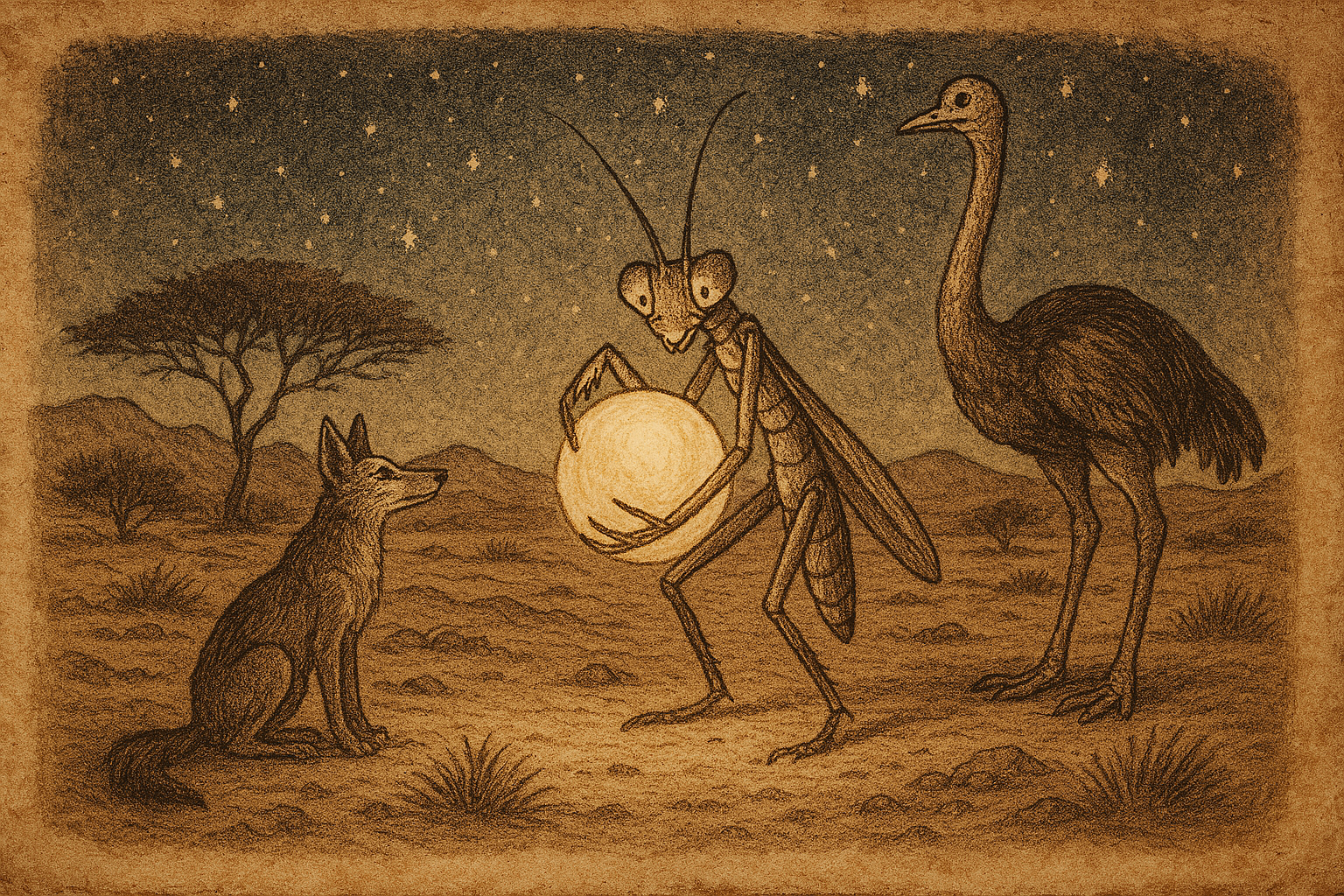
The Moon Maiden, lonely in her high kraal, was charmed by this silver-tongued visitor. She set down her precious calabash and listened to Jackal’s earth-songs. And while she listened quick as lightning, quiet as shadow Old Mantis crept forward on his stick-thin legs.
But here, children, here is where even the cleverest plans can twist like the desert wind. As Mantis reached for the calabash, Ostrich came running thump, thump, thump across the sky-plains. Big-eyed Ostrich, that curious one who sees everything but understands little.
“Thief! Thief!” cried Ostrich in her loud, foolish voice. “The earth-crawler steals the moon-treasure!”
The Moon Maiden whirled around, her silver light flashing angry-bright. She saw Mantis there with his grasping hands near her precious calabash. In her rage, she kicked the calabash high into the sky-country, and it shattered—CRASH! into a thousand thousand pieces.
The light scattered like silver seeds across the dark sky. Some pieces fell to earth and became the glowing eyes of the night creatures the genets and the bush babies, the jackals and the lions. Other pieces stayed in the sky and became the stars, each one a fragment of the Moon Maiden’s hoarded light.
But the largest piece, the most beautiful piece, it began to dance across the night sky, waxing fat like a rain-filled water hole, then growing thin like a drought-starved stream, then disappearing altogether before beginning the dance again.
The Moon Maiden wept silver tears. “See what your greed has done,” she cried to Mantis. “My beautiful light is broken forever!”
But Old Mantis, that wise fool, he looked up at the scattered star-light and the dancing moon-piece, and he smiled his knowing smile. “Not broken, Moon Maiden. Shared. Now the night hunters can find their way home. Now the mothers can gather food in the gentle light. Now the children need not fear the darkness.”
The ancestral spirits, watching from their spirit-places, they nodded their ancient heads. This was how it should be—not hoarded by one, but shared among all. Even the Moon Maiden, after her tears dried, came to see the beauty in the scattered light, the wisdom in the sharing.
But there was a price for this trickery, children of the desert. The Moon Maiden, in her anger and her sorrow, she cursed Old Mantis: “Since you would steal and scheme, you shall be no bigger than a twig, and the wind shall blow you where it will. And when you grow old, you shall shed your skin and begin again, always remembering this night.”
And so it is, even today. The mantis remains small, blown by the desert winds, shedding his skin to begin anew. But every night, when we see the moon dancing across the star-scattered sky, we remember his gift to us—the gift of shared light, the gift of gentle night-time radiance.
The Jackal, for his part in the scheme, was given the gift of the silver tongue forever, but also the curse of never being fully trusted. And Ostrich? Poor, foolish Ostrich who spoiled the careful plan—she was condemned to run forever across the earth, too heavy with her secrets to fly, her big eyes always watching but never understanding the full truth of what she sees.
The Wisdom of the Moonlight Tale
This ancient story teaches us that hoarding gifts meant for all creates imbalance in the natural world. The Moon Maiden’s selfishness brought darkness, while Mantis’s trickery, though born from compassion, carried consequences that echo through generations. True wisdom lies in understanding that we are all connected—the earth dwellers, the sky dancers, and the spirit walkers. When we respect the balance of giving and receiving, when we share rather than hoard, when we remember that every action ripples through the web of existence, we honor the ancient covenant between all living things. The moon’s monthly dance reminds us that everything in nature follows cycles of fullness and emptiness, teaching us patience, humility, and the sacred rhythm of renewal that sustains all life in the vast Kalahari and beyond.
Knowledge Check: Understanding San Folklore
Q1: What are the main characteristics of San oral storytelling traditions? A1: San oral storytelling features rhythmic patterns, repetitive phrases, vivid desert imagery, and moral teachings. Stories incorporate trickster figures, ancestral spirits, and Kalahari animals, using call-and-response elements and onomatopoeia to engage listeners. These tales preserve cultural wisdom, explain natural phenomena, and teach ethical behavior within the community.
Q2: Who is the Mantis in San mythology and what role does he play? A2: In San mythology, Mantis (often called Kaggen) is a primary trickster figure and creator deity. He represents both wisdom and foolishness, often solving problems through cunning schemes that have unintended consequences. Mantis stories teach about the complexity of leadership, the importance of community welfare, and the balance between cleverness and responsibility.
Q3: How do San folktales explain natural phenomena like the moon and stars? A3: San folktales use storytelling to explain natural phenomena through magical narratives involving animal characters and spirits. These origin stories, like “How the Mantis Stole the Moonlight,” provide cultural explanations for celestial events, seasonal changes, and animal behaviors, connecting the San people to their environment through spiritual and practical understanding.
Q4: What animals commonly appear in San folklore and what do they represent? A4: San folklore features Kalahari animals like Jackal (cunning and eloquence), Ostrich (foolishness and curiosity), Springbok (grace and alertness), and Gemsbok (endurance and nobility). These animals embody human traits and teach moral lessons, representing the deep connection between the San people and their desert environment.
Q5: What moral lessons do San folktales typically convey to their audience? A5: San folktales convey lessons about respecting nature’s balance, sharing resources fairly, understanding consequences of actions, and maintaining community harmony. They emphasize values like generosity over greed, wisdom over cleverness, and the interconnectedness of all living things in the harsh but sacred Kalahari environment.
Q6: How do San stories reflect the relationship between humans and the natural world? A6: San stories demonstrate a deep spiritual connection between humans and nature, where animals, plants, and natural forces are sentient beings with their own agency. These tales emphasize reciprocity, respect for all life forms, and understanding that human actions affect the entire natural world, reflecting the San people’s hunter-gatherer worldview and environmental ethics.