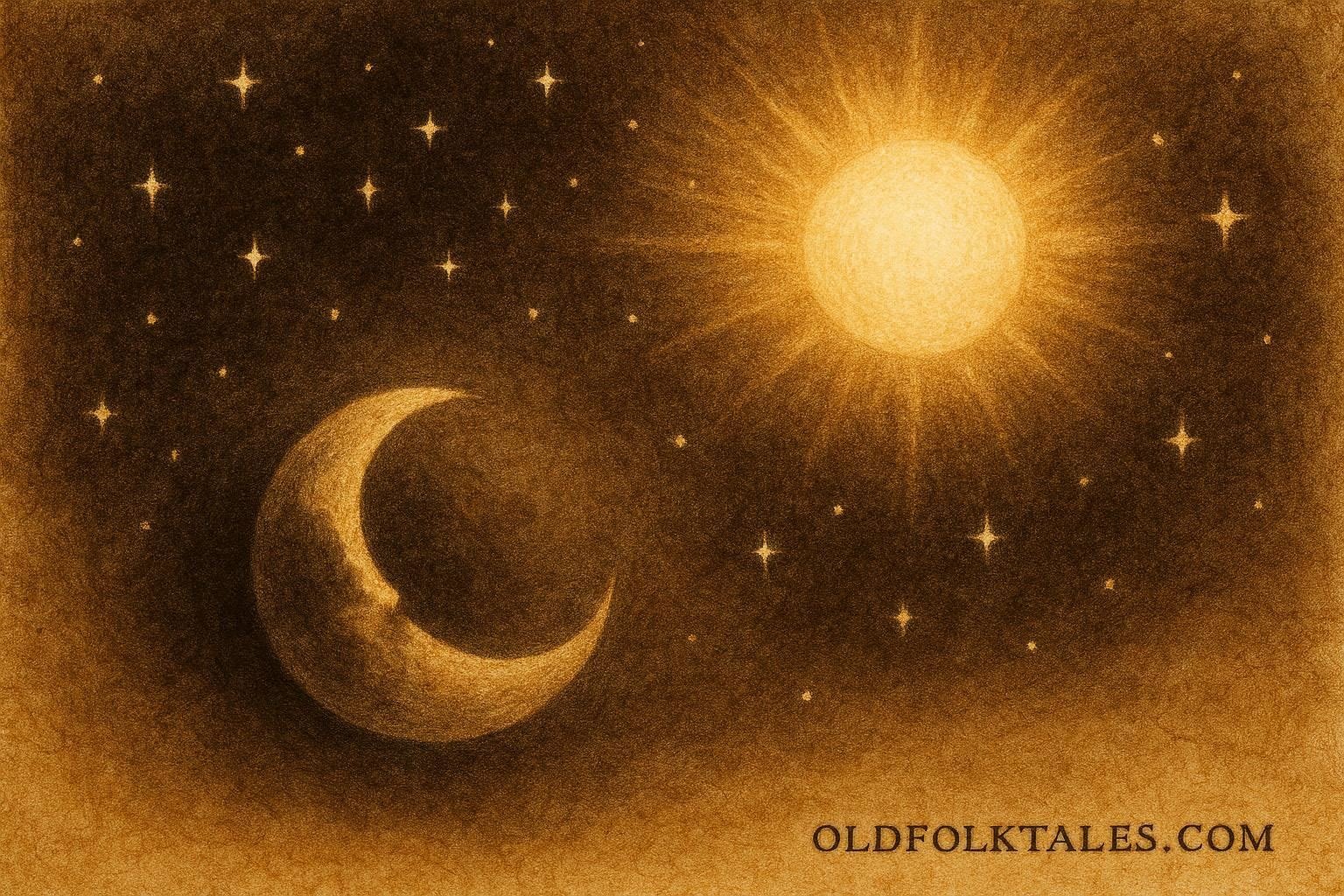
Long before the world settled into its familiar rhythm of day and night, the sky was a place of constant light.
In those early times, the Moon did not wait for darkness to rise. It did not linger in silence or appear only when the world grew still. Instead, it shared the sky freely with the Sun and the countless stars. Together, they filled the heavens with brilliance, casting their glow upon the earth at all hours.
Explore the wisdom and wonder of North African folktales
The rivers shimmered endlessly. The forests never knew true darkness. The people below lived beneath a sky that never dimmed, where light was constant and shadows were rare.
And among all the celestial beings, the Moon was perhaps the most gentle.
Its light was not as fierce as the Sun’s, nor as scattered as the stars’. It was soft, steady, and comforting. It bathed the earth in a glow that soothed rather than dazzled. Where the Sun burned bright and commanding, the Moon offered calm.
But the Moon was also different.
Its surface was not smooth like the Sun’s blazing face, nor was it as sharp and precise as the twinkling stars. It bore marks, shadows, dim patches, and uneven shapes that gave it a distinct appearance.
At first, these differences meant little.
But over time, the Sun began to notice.
The Sun, radiant and proud, shone with a brilliance that dominated the sky. It saw itself as the center of all light, the source from which all warmth and life flowed. And when it looked upon the Moon, it did not see gentleness. It saw imperfection.
One day, as they shared the sky, the Sun spoke.
“Why do you shine beside me,” it asked, its voice bright but edged with something sharper, “when your light is uneven and your face marked with shadows?”
The Moon was taken aback.
“I shine as I am,” it replied softly. “My light may not be like yours, but it still reaches the earth.”
The Sun gave a low, dismissive laugh.
“Reaches, perhaps,” it said. “But it does not compare.”
The stars, scattered across the sky, began to whisper among themselves. They, too, had noticed the Moon’s differences. Unlike them, it did not sparkle with clarity. Its glow was broad, its edges soft, its surface marked.
And so, one by one, their whispers grew louder.
“Look at the Moon,” some said.
“See how it carries shadows upon itself.”
“It is not like us.”
“It is flawed.”
Their words spread across the sky, echoing in the vastness above.
The Moon listened.
At first, it tried to ignore them. It continued to rise, to shine, to fulfill its place in the sky. But the words did not fade. They lingered, returning again and again, each time settling deeper within.
It began to notice what it had never questioned before.
The uneven patches.
The dimmer glow.
The marks that set it apart.
And slowly, the Moon’s confidence began to fade.
One day, unable to bear the weight of the whispers any longer, the Moon withdrew.
Without announcement, without explanation, it slipped away from the sky.
Where once it had shone beside the Sun, there was now only empty space.
The stars continued to sparkle. The Sun continued to blaze. But something was missing.
Below, the people noticed.
The sky, though still bright, felt different. The balance had shifted. The gentle glow that softened the world was gone, replaced by a light that was constant and unyielding.
The rivers no longer shimmered with quiet beauty. The forests lost their calm, shadowed depth. Even the air seemed restless.
But the Sun did not notice at first.
It continued to shine, proud and unwavering, filling the sky with its brilliance.
Only after some time did it begin to feel the change.
Without the Moon, the sky felt harsher. The balance between light and rest had been disturbed. The world below grew weary beneath the unbroken brightness.
And the stars, too, began to feel the absence.
Their twinkling, once complemented by the Moon’s steady glow, now seemed scattered and incomplete.
Still, none spoke of it.
Meanwhile, the Moon had hidden itself far from the gaze of the others.
It lingered in the quiet edges of the sky, where light did not reach as strongly. There, it remained, reflecting on the words it had heard.
It replayed them again and again.
Flawed. Uneven. Not enough.
The more it thought, the more it withdrew into itself.
For the first time, it questioned its place in the sky.
“Perhaps they are right,” the Moon thought. “Perhaps I do not belong among them.”
And so, it chose to remain hidden.
Time passed.
Below, the world began to change in ways that could not be ignored.
Without the Moon’s gentle presence, there was no rhythm to rest. The constant light of the Sun left no room for stillness. The people grew tired. The animals wandered without pause. The natural balance that once guided life began to unravel.
The Sun, at last, could no longer overlook what had happened.
It searched the sky for the Moon, but found nothing.
The stars, too, looked, their light flickering with unease.
“Where has the Moon gone?” they wondered.
At first, no one answered.
Then, slowly, the truth began to settle among them.
Their words had driven it away.
The Sun, though proud, was not without awareness.
It began to understand that its words, spoken in passing, had carried weight. What it had dismissed as truth had become a wound.
The stars, too, fell silent, their whispers now replaced with regret.
But the Moon did not return.
It was only after a long time that the Moon began to emerge again.
Not in the full brightness it once embraced.
Not beside the Sun.
Instead, it chose the quiet hours.
When the Sun lowered itself beyond the horizon, when the sky softened and darkness began to settle, the Moon would rise, slowly, carefully.
At first, it appeared only as a faint glow, barely noticeable.
But night after night, it grew more visible.
Its light, though still marked with shadows, spread gently across the earth.
And something remarkable happened.
In the absence of the Sun’s overwhelming brightness, the Moon’s light was no longer overshadowed.
It became the guide of the night.
The rivers shimmered once more, not with harsh brilliance, but with a calm, silvery glow. The forests regained their depth, their mystery. The people found rest beneath its quiet presence.
The stars, once critical, now shone alongside it in harmony.
And the Sun, watching from beyond the horizon, understood what it had failed to see before.
The Moon had never needed to compete.
Its light had its own purpose.
From that time onward, the sky found its balance.
The Sun ruled the day, bringing warmth and energy.
The Moon ruled the night, offering calm and reflection.
And though the Moon still carried its marks, it no longer tried to hide them completely.
It simply chose when and how to shine.
Not out of fear alone, but out of understanding.
Keep reading: Discover more Central African folktales
Moral Lesson
Words have power. What we say can shape how others see themselves. True beauty lies not in perfection, but in embracing one’s unique light and finding the right space to shine.
Knowledge Check
- What is the main lesson of “How the Moon Learned to Hide” folktale?
The story teaches self-acceptance and highlights how words can deeply affect identity and confidence. - Why did the Moon stop appearing during the day?
The Moon withdrew after being mocked by the Sun and stars for its imperfections. - What role does the Sun play in the story?
The Sun represents pride and harsh judgment, whose words contribute to the Moon’s withdrawal. - How did the world change when the Moon disappeared?
The balance of nature was disrupted, leading to constant brightness and loss of rest. - Why does the Moon appear at night in this folktale?
The Moon chooses to shine in the quiet of night, where its gentle light is appreciated. - What cultural themes are reflected in this Gabonese folktale?
Themes include identity, emotional resilience, self-worth, and the importance of balance in nature.
Source: Collected in African sky mythology anthologies (1992)
Cultural Origin: Bantu-speaking communities in Gabon