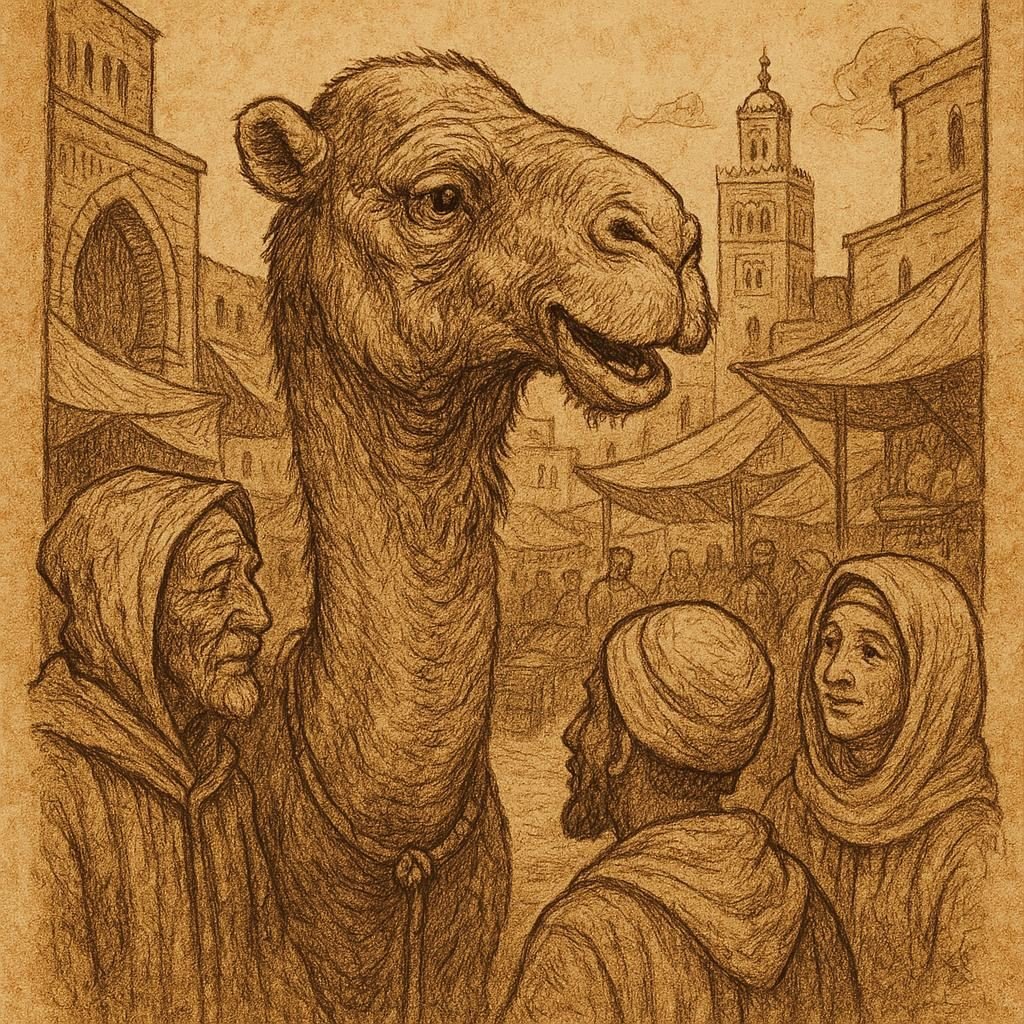
In the bustling city of Marrakech, where merchants filled the markets and storytellers shared tales in the square, there lived a poor merchant who owned a single camel. This camel was not like the others that carried goods across the desert. It was clever, watchful, and most surprising of all, it could speak. The merchant guarded this secret closely, for he feared others might use the camel’s gift for their own gain.
Each morning, the merchant led his camel through the streets, its tall body swaying and its great eyes glancing at the world with quiet wisdom. The people admired the animal’s strength, unaware of its extraordinary gift. Only when they were alone in the quiet of the night would the camel lower its head and whisper to the merchant.
“Master,” the camel would say, “do not trust every smiling face you meet. Men who seem friendly may carry hidden daggers in their words.”
The merchant listened carefully. Often the camel’s warnings saved him from deceitful bargains and false friends.
The Greedy Neighbor
Not far from the merchant’s home lived a neighbor known for his greed. He watched with envy as the merchant’s trade prospered. “It must be that camel,” the neighbor muttered. “There is something about it that brings him fortune.” His curiosity grew until one night, he crept near the merchant’s stable and listened.
To his astonishment, he heard the camel speaking. “Beware of the man with restless eyes,” it warned the merchant, “for he will seek to steal what is not his.”
The neighbor’s heart pounded. “A talking camel,” he whispered to himself. “If I can take it, I will be richer than any man in Marrakech.”
READ THIS: The Blacksmith and the Ifrit
The Theft
The very next day, the greedy neighbor accused the merchant of owing him money. He brought false witnesses to the qadi, the judge of the city. With their lies, he demanded that the merchant pay him back or forfeit his camel as payment.
Though the merchant protested, the judge, persuaded by the neighbor’s false words, ordered that the camel be given to him. With a heavy heart, the merchant handed over his faithful companion.
The camel turned its great eyes toward its master and whispered, “Do not despair. Truth walks slowly, but it always arrives.”
The Camel Speaks in Court
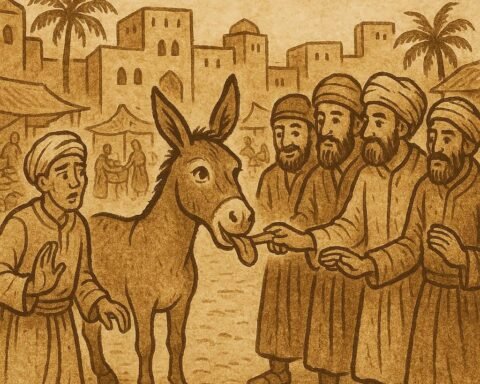
The neighbor, proud of his new possession, led the camel through the city. He boasted to everyone he met, “Look at my fine beast! It will bring me endless fortune.” Yet when he tried to command the camel to work, the animal refused. It sat stubbornly in the dust, turning its head away.
Angry, the neighbor dragged the camel before the qadi once more. “This animal is useless,” he complained. “It does not obey me. I demand justice.”
The qadi studied the camel, then said, “If what you say is true, then let us test the matter. Speak, O camel, if you can.”
The crowd gasped, for the judge’s words were bold. To their amazement, the camel raised its head and spoke clearly for all to hear.
“This man is a liar,” the camel declared. “I belong to the merchant who has cared for me faithfully. This thief tricked the court with false words to take me away.”
The square fell silent. Then whispers spread through the crowd. The qadi’s eyes widened, for never before had he witnessed such a thing.
Justice Restored
The qadi turned to the greedy neighbor. “You have shamed this court with lies,” he said sternly. “You shall be punished for your deceit.”
He ordered that the camel be returned to its rightful master and that the neighbor be fined for his dishonesty.
The merchant embraced his camel’s neck, tears shining in his eyes. “You have spoken truth and saved us both,” he whispered.
The camel bowed its head and replied, “Justice may stumble, but it will always stand tall in the end.”
From that day, the tale of the talking camel spread through Marrakech and beyond. Merchants, travelers, and storytellers carried the story across deserts and seas, reminding all who heard it that truth, no matter how delayed, can never be silenced.
Moral Lesson of The Talking Camel of Marrakech
The story teaches that greed and lies may succeed for a time, but wisdom and truth always prevail. The camel’s words remind us that justice, though delayed, cannot be hidden forever. Those who deceive will eventually be exposed, while honesty and loyalty endure.
Knowledge Check
What lesson does The Talking Camel of Marrakech teach about greed and deceit?
It shows that greed and lies may win temporarily but justice and truth will always triumph in the end.Why did the greedy neighbor want to steal the camel?
Because he overheard the camel speaking and believed owning it would bring him wealth and fortune.How did the neighbor trick the qadi into giving him the camel?
He accused the merchant falsely of owing him money and brought false witnesses to support his lie.What role did the camel play in restoring justice in The Talking Camel of Marrakech?
The camel spoke openly in court, exposing the neighbor’s lies and proving its loyalty to the merchant.What does the camel’s message about truth and justice symbolize in Moroccan folktales?
It symbolizes the enduring belief that truth may be delayed but will always come to light, reflecting cultural values of honesty and fairness.Who collected and published The Talking Camel of Marrakech?
The story was collected by Jilali El Koudia in Moroccan Folktales (1985).Source: Moroccan folktale collected by Jilali El Koudia in Moroccan Folktales (1985).