
Long, long ago, in the time when the world was young and the boundaries between mortals and gods were not yet firmly drawn, all the stories that people told around their evening fires belonged to Nyankupon, the supreme chief of all the gods. These were grand tales of divine power and celestial wisdom, stories that spoke of creation, of mighty deeds in the heavens, and of the great mysteries that governed the world.
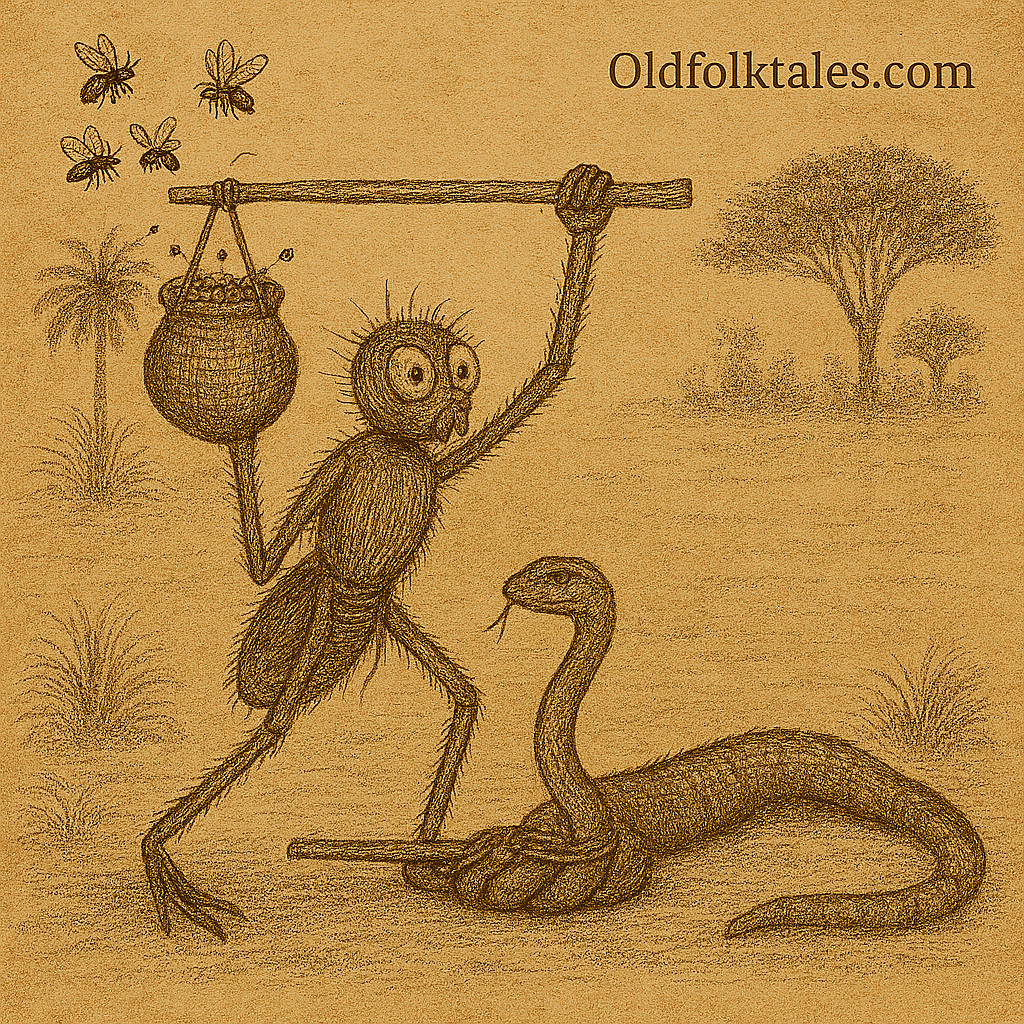
In this ancient time, there lived a spider of extraordinary cunning and boundless ambition. This was no ordinary spider, but Anansi himself, a creature blessed with intelligence, wit, and an ego that seemed to grow larger with each passing day. Anansi possessed a silver tongue and a mind that could weave schemes as intricate as the webs he spun, but he also carried within his heart a deep well of conceit that would ultimately drive him to attempt the impossible.
As Anansi listened to the storytellers in villages across the land, spinning their magnificent tales of Nyankupon’s glory and wisdom, a burning jealousy began to consume him. Why, he wondered, should all the stories belong to the god of the heavens? Was he, Anansi, not clever enough, entertaining enough, worthy enough to have tales told in his honor? The more he pondered this question, the more convinced he became that the stories should rightfully be about him.
This obsession grew until it became unbearable. Finally, Anansi made a decision that would either elevate him to legendary status or destroy him entirely. He would approach Nyankupon himself and request that all future tales be told about Anansi rather than about the chief of the gods.
The journey to Nyankupon’s celestial dwelling was not one undertaken lightly. As Anansi climbed higher and higher, from the earthly realm toward the divine kingdom, the air grew thinner and more charged with otherworldly power. When he finally stood before the magnificent throne of Nyankupon, the god’s presence was so overwhelming that even the confident spider felt his eight legs tremble slightly.
“Great Nyankupon,” Anansi began, summoning all his courage and charm, “I come before you with a humble request. The stories that mortals tell around their fires bring them joy and wisdom. I believe these tales would be even more delightful if they were told about me, your faithful servant Anansi, rather than dwelling always upon your divine majesty.”
Nyankupon regarded the small spider with eyes that seemed to hold the depth of eternity. A smile played at the corners of the god’s mouth, for he recognized both Anansi’s cleverness and his vanity. After a long moment of contemplation, Nyankupon spoke.
“Very well, clever Anansi. I will grant your request, but not without a price. If you can complete three seemingly impossible tasks, I will allow all tales to become Anansi stories. But if you fail, you must never again speak of this matter.” The god’s voice resonated with the power of thunder and the finality of fate.
Anansi’s eyes glittered with excitement and determination. “Name your conditions, great one. I accept whatever challenge you set before me.”
Nyankupon’s expression grew serious. “First, you must bring me a jar filled with live bees. Second, you must capture a boa-constrictor and deliver it to me. Third, you must bring me a living tiger. Complete these three tasks, and all the stories in the world shall bear your name.”
Without hesitation, Anansi agreed to the seemingly impossible conditions. As he descended from the heavenly realm back to earth, his mind was already spinning with elaborate plans and clever schemes.
For his first challenge, Anansi selected a large earthen vessel and set out toward a meadow where he knew a vast colony of bees made their home. As he approached the buzzing swarm, he began an elaborate performance, speaking loudly to himself in a voice designed to attract attention.
“They will not be able to fill this jar,” he declared, gesturing toward the vessel. Then, changing his tone completely, he argued with himself: “Yes, they certainly will be able to fill it!” Back and forth he went, his voice growing more animated with each exchange: “No, no, they could never fit!” “Of course they can fit!” “Impossible!” “Absolutely possible!”
As Anansi had anticipated, the bees’ curiosity was aroused by this strange debate. They swarmed around him, buzzing with indignation. Their leader, a particularly large and proud bee, demanded an explanation.
“What are you arguing about, Mr. Anansi? What is this foolish debate you’re having with yourself?”
Anansi assumed an expression of great earnestness and slight embarrassment. “Oh, my friends, I apologize for disturbing your peaceful work. Nyankupon and I have been having a great dispute about your abilities. He claims that you bees are too large and numerous to all fit inside this simple jar. I have defended your intelligence and your ability to organize yourselves efficiently. I insisted that you could easily all fit inside if you chose to do so.”
The bees buzzed with outrage at this perceived insult to their capabilities. “Of course we can fit in that jar!” they declared in unison. “We’ll show Nyankupon just how wrong he is!”
Without further ado, the entire swarm poured into the earthen vessel, packing themselves efficiently to prove their point. The moment the last bee had entered, Anansi quickly sealed the jar with a tight-fitting lid and sent it directly to Nyankupon’s celestial palace.
One task completed, two remaining.
The next day, Anansi selected a long, straight stick and ventured into the dense forest where he knew a massive boa-constrictor made its home. When he reached the serpent’s territory, he once again began his theatrical performance.
“He will be exactly as long as this stick,” Anansi mused aloud, holding up the measuring rod. “No, no, he cannot possibly be that long.” “Yes, he will be precisely this length.” “No, much shorter, I’m certain.” “I disagree exactly this long.”
The great boa-constrictor, disturbed by this peculiar monologue echoing through his peaceful domain, slithered out from his hiding place among the roots of an ancient tree.
“What is all this chattering about, Anansi?” the serpent asked, his voice carrying the weight of annoyance. “What are you measuring, and why do you keep contradicting yourself?”
Anansi bowed respectfully to the magnificent creature. “Forgive me, great snake. The people in Nyankupon’s town have been debating your impressive length. Some say you are not nearly as long as this measuring stick, while others including myself argue that you are precisely this length. Would you be so kind as to settle this dispute by allowing me to measure you?”
The boa-constrictor, flattered by the attention and confident in his impressive size, readily agreed. “Certainly! I am indeed a magnificent specimen. Let us end this debate once and for all.”
The great snake stretched himself out in a perfectly straight line beside the measuring stick. The moment he was fully extended, Anansi worked with lightning speed, using strong vines to tie the serpent securely to the stick from head to tail. Before the boa realized what had happened, he was bound fast and completely helpless.
“My apologies, friend,” Anansi said as he prepared to transport his captive, “but Nyankupon requires your presence.” With considerable effort, he carried the bound serpent to the god’s dwelling.
Two tasks completed, one final challenge remaining.
On the third day, Anansi prepared for his most dangerous undertaking. He took a sharp needle and strong thread, and with great care, he sewed his own eye shut. This painful sacrifice was essential to his plan. Then, with one eye sealed and his vision deliberately impaired, he made his way to the cave where a fierce tiger was known to dwell.
As he approached the tiger’s den, Anansi began to shout and sing with wild enthusiasm, his voice echoing through the forest with such joy and excitement that it could not be ignored.
The tiger, disturbed from his afternoon rest by this unusual commotion, emerged from his cave with a fearsome growl. “What is all this noise, Spider? Why are you creating such a disturbance in my peaceful territory?”
Anansi turned toward the tiger’s voice, his sewn eye clearly visible. “Oh, magnificent tiger! Can you not see my condition? I have sewn up my eye, and now I can see the most wonderful, incredible sights! The world has become so beautiful, so amazing, that I cannot contain my joy! I must sing and shout about these marvelous visions!”
The tiger’s curiosity was immediately aroused. “What kind of wonderful things do you see, Anansi? What could be so amazing that it makes you sing with such happiness?”
“Oh, the colors! The patterns! The hidden beauties that are invisible to normal sight!” Anansi exclaimed. “It is beyond description absolutely magical!”
The tiger’s eyes grew bright with desire. “Sew up my eyes too, Anansi! I want to see these surprising and wonderful sights that bring such joy!”
Without showing any hesitation, Anansi carefully sewed both of the tiger’s eyes shut with his needle and thread. The moment the great cat was rendered blind and helpless, Anansi took hold of his fur and led him, step by careful step, directly to Nyankupon’s heavenly palace.
When Nyankupon saw Anansi approaching with the captive tiger having already received the jar of bees and the bound boa-constrictor the god was genuinely amazed. The great deity had expected the clever spider to fail, but Anansi had succeeded through pure wit and cunning where strength and power would have been useless.
“Incredible!” Nyankupon declared, his voice filled with admiration and amusement. “You have completed all three impossible tasks through cleverness alone. I am impressed by your ingenuity, your determination, and your resourcefulness.”
True to his divine word, Nyankupon immediately granted Anansi his heart’s desire. From that day forward, all the old stories that had once been called Nyankupon tales would forever be known as Anansi tales. The spider had achieved his ultimate goal through wit, cunning, and an unshakeable belief in his own abilities.
Moral Lesson
This tale teaches us that intelligence, creativity, and persistence can overcome seemingly impossible obstacles. However, it also warns about the dangers of excessive pride and ambition. While Anansi’s cleverness earned him eternal fame, his success came through deception and manipulation of others’ trust. The story reminds us that true greatness comes not just from achieving our goals, but from how we achieve them. It celebrates mental agility while cautioning that cunning without wisdom can lead to hollow victories.
Knowledge Check
Q1: Who is Anansi in West African folklore, and why is he significant in storytelling traditions? A: Anansi is the spider trickster figure in West African folklore, particularly among the Akan people. He represents wisdom, cunning, and the power of intelligence over brute force. His significance lies in being the central character who claimed ownership of all folktales, making him the archetypal storyteller figure in African oral tradition.
Q2: What role does Nyankupon play in this West African creation myth about storytelling? A: Nyankupon serves as the supreme god and original owner of all stories in West African mythology. He represents divine authority and wisdom, and his willingness to transfer story ownership to Anansi demonstrates the importance of earning one’s place through skill and determination rather than birthright alone.
Q3: What do the three impossible tasks symbolize in Anansi’s quest for the stories? A: The three tasks—capturing live bees, a boa-constrictor, and a tiger—represent different types of challenges requiring wit over strength: managing collective groups (bees), handling deceptive situations (snake), and overcoming powerful opponents (tiger). They test Anansi’s ability to use intelligence to overcome natural disadvantages.
Q4: How does this folktale explain the origin of “spider tales” in African storytelling culture? A: The tale provides an origin story explaining why West African folktales are called “Anansi stories” rather than stories about gods or other figures. It establishes Anansi’s legendary status as the master of all tales through his successful completion of Nyankupon’s challenges, legitimizing his role as the central figure in oral tradition.
Q5: What cultural values does this West African folktale promote regarding intelligence and ambition? A: The story celebrates intelligence, resourcefulness, and the courage to pursue ambitious goals, reflecting West African cultural appreciation for wit and verbal cleverness. However, it also subtly warns about the ethics of achieving success through deception, promoting a complex view of ambition that values both achievement and moral consideration.
Q6: How does Anansi’s success through trickery reflect West African attitudes toward power and authority? A: Anansi’s triumph over seemingly impossible odds reflects West African cultural themes about the underdog’s ability to challenge established power structures through intelligence rather than force. It suggests that authority can be earned through cleverness and determination, even by those who seem powerless in conventional terms.

