In the rolling hills of Uganda, where acacia trees cast long shadows over golden grasslands and the morning air carries the scent of wild jasmine, two unlikely friends once lived in perfect harmony. A gentle lioness and a peaceful cow had built themselves a home together, a simple dwelling surrounded by a small garden where they could tend their vegetables and raise their young in safety.
This friendship between natural enemies was a wonder to behold, a testament to the power of understanding and mutual respect. Each had given birth to a child who would grow up knowing no prejudice, no fear of the other kind. The lioness had a cub whose golden coat gleamed like burnished copper in the sunlight, while the cow had a calf whose brown hide was marked with patches of cream that seemed painted by the gentlest of hands.
The lion cub possessed all the noble qualities one might hope to find in the offspring of the king of beasts. He was gentle in his play, thoughtful in his actions, and respectful to both mothers. His manners were impeccable, his heart kind, and his spirit generous. He seemed to understand instinctively that their unusual family required extra care and consideration to maintain the delicate balance of peace they had achieved.
The calf, however, was quite another matter entirely. From his earliest days, he displayed a troublesome disposition that caused his mother endless worry and frustration. He was willfully disobedient, refusing to heed warnings or follow the simple rules that governed their peaceful household. Where his lion friend was careful and considerate, the calf was reckless and headstrong, always pushing boundaries and testing patience.
Also read: The Frog and the Lizard
Near their home lay a source of particular contention, a well that provided fresh, sweet water for their daily needs. The well was deep and clear, its waters reflecting the sky like a mirror of liquid sapphire. But the calf seemed irresistibly drawn to this spot, not for the pure water it provided, but for the mischief he could create there. Day after day, he would splash and play at the well’s edge, stirring up the mud from the bottom until the crystal-clear water became cloudy and undrinkable.
Each instance of this misbehavior brought swift punishment from his mother, who understood the importance of keeping their water source clean and safe. Yet no amount of scolding or discipline seemed to penetrate the calf’s stubborn nature. He would accept his punishment with sullen resignation, only to repeat the same offense the very next day, as if driven by some compulsion he could not control.
On one fateful morning, when the calf once again began his destructive play at the well, his gentle friend the lion cub approached with the noble intention of preventing trouble before it could begin. Speaking with all the kindness and diplomacy his young heart could muster, the cub tried to persuade the calf to find other, harmless ways to amuse himself.
But the calf’s reaction was explosive and terrible. Rage consumed his young mind, drowning out any voice of reason or friendship. In that moment of blind fury, he turned on the very friend who had tried to help him, shoving the surprised lion cub with all his strength. The gentle creature, caught completely off guard by this sudden violence, tumbled backward into the well with a splash that seemed to echo through the calf’s soul like the sound of doom itself.
The water that had been disturbed so many times in play now closed over the head of an innocent victim. The lion cub, weighed down by shock and the depth of the water, could not struggle to the surface. In horrified silence, the calf watched as his dearest friend disappeared beneath the still water, and understood with terrible clarity that his moment of rage had destroyed everything good in his world.
Terror such as he had never known seized the calf’s heart. The magnitude of his deed crashed down upon him like a mountain falling, and he ran frantically to find his mother, his voice breaking as he confessed the terrible accident that was no accident at all, but the result of his own uncontrolled anger.
The cow listened to her son’s halting confession with growing horror, understanding immediately the catastrophe that had befallen them all. “We must flee,” she told her calf, her voice trembling with fear and grief. “When the lioness discovers what has happened, her grief will turn to rage, and that rage will demand blood. She will kill us both, and no power on earth could blame her for it.”
Mother and son began their desperate flight, seeking sanctuary with an antelope who lived nearby. This creature, proud of her sharp horns and swift hooves, initially boasted of her ability to protect them. “Am I to fear a single lioness?” she declared with false bravado. “Let her come! My horns will teach her to respect the innocent!”
But when the lioness returned to her empty home and discovered the body of her beloved cub floating in the well, her roars of grief and fury shook the very earth. The sound carried across the landscape like thunder, announcing to every creature within miles that death was on the prowl, seeking vengeance for innocence destroyed.
When these terrifying sounds reached the antelope’s ears, her courage evaporated like morning dew under a scorching sun. “You must leave immediately,” she told the cow, her voice shaking with terror. “If she finds you here, we will all perish!”
The desperate pair continued their flight, seeking refuge with a buffalo who seemed more formidable than the antelope. His massive shoulders and powerful hooves suggested strength enough to face any threat. “I will defend you,” he promised with apparent confidence. “These hooves have trampled many enemies. One lioness holds no terror for me!”
Yet when the lioness’s roars grew closer, echoing off the hills with the promise of imminent vengeance, even the mighty buffalo’s resolve crumbled. His previous boasts seemed hollow as he urged the cow and calf to continue their flight. “Quickly now,” he said, backing away from the approaching sounds. “I cannot protect you from such fury. You must find help elsewhere!”
Their final hope lay with the elephant, that giant among all land creatures, whose size and strength were legendary throughout the animal kingdom. Surely, they thought, this magnificent beast would have the power to face down even an enraged lioness. The elephant himself seemed to think so, swaying confidently as he declared his intention to protect them. “My trunk will seize her and hurl her through the air,” he boasted. “Her bones will shatter like dry twigs!”
But as the lioness’s vengeful roars grew ever nearer, even the mighty elephant began to sway nervously from foot to foot. His great trunk, which had seemed so formidable, curled up defensively against his body as fear overcame his initial confidence. “Perhaps,” he said with obvious reluctance, “you should continue searching for help. I… I have other matters to attend to.”
Exhausted by their frantic flight and abandoned by every creature they had approached for help, the cow finally collapsed by the roadside. Her strength was spent, her hope nearly gone, and the terrible sounds of pursuit grew ever closer. It seemed that their fate was sealed, that justice for the lion cub’s death would be swift and final.
It was at this moment of deepest despair that salvation appeared in the most unlikely form imaginable. Kasanke, a small red bird whose brilliant feathers caught the sunlight like tiny flames, happened to be flying overhead when she spotted the exhausted cow and heard her desperate tale of woe.
Where mighty beasts had fled in terror, this tiny creature felt only compassion and determination. She listened to the cow’s story without flinching, her bright eyes sparkling with intelligence and courage that put larger creatures to shame. “Hide yourself in those bushes,” she instructed the cow with calm authority. “I will handle this matter.”
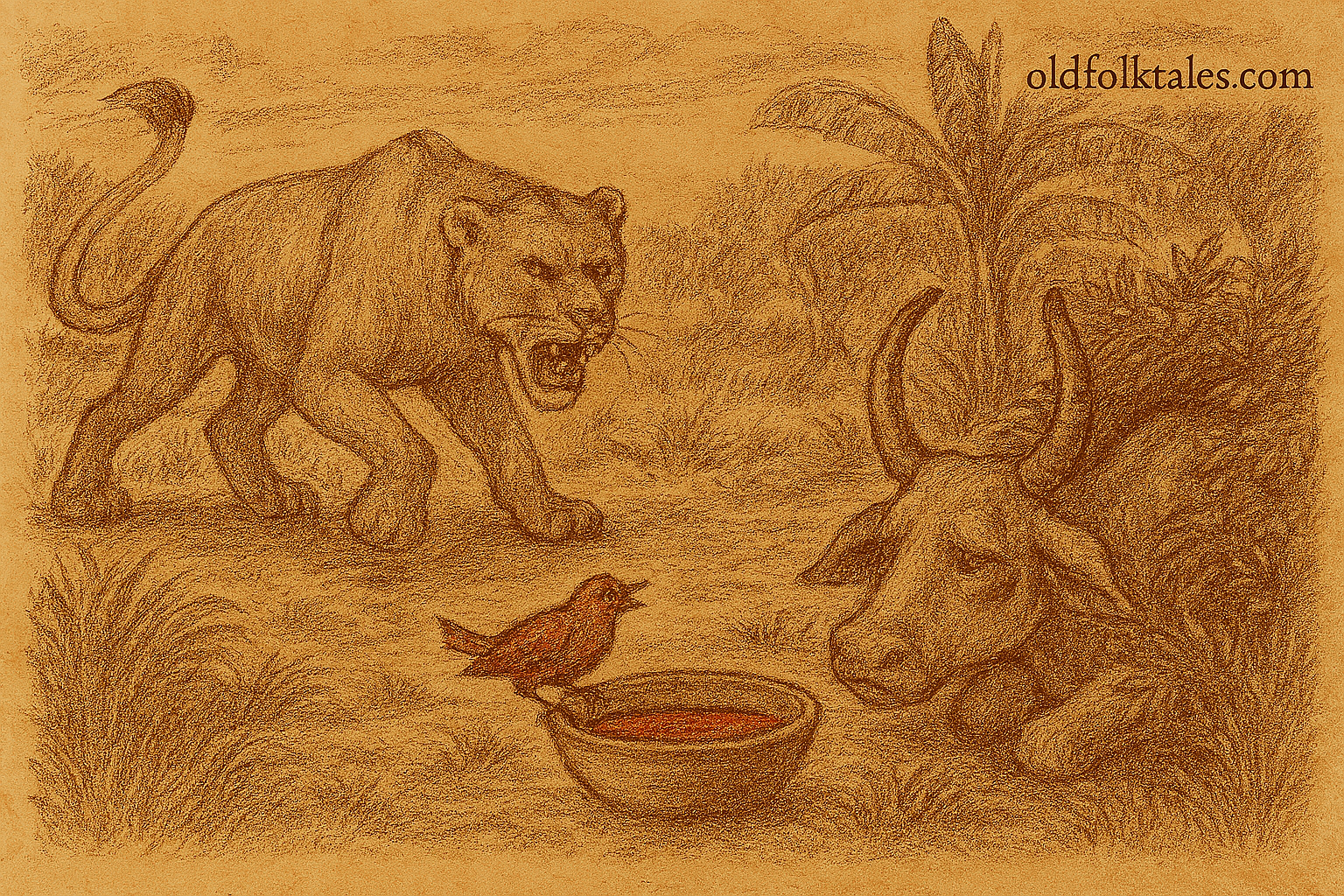
Working with swift precision, Kasanke flew to a nearby banana grove and selected a large, heart-shaped seed pod that was deep red in color. She then procured a wooden bowl and, with gentle skill, milked the cow until the vessel was full. Into this white milk, she squeezed the red juice from the seed pod until the liquid resembled blood, dark and convincing in its deception.
The lioness appeared shortly thereafter, her magnificent form trembling with rage and grief, her golden eyes blazing with the need for vengeance. Her roars had grown hoarse from her long pursuit, but her determination had not weakened by even a fraction.
“Why do you make such a terrible noise?” Kasanke asked boldly, flying directly into the path of the approaching predator.
“Impudent bird!” the lioness snarled, her claws extending reflexively. “I will add you to my feast of revenge!”
But Kasanke was already in motion, diving fearlessly toward the lioness’s head. Her small but sharp beak found its target with surgical precision, striking one golden eye and then the other. The lioness roared in pain and confusion, swinging her massive paws through the air in a futile attempt to catch her tiny tormentor.
As the lioness stumbled about, her vision impaired and her pain intense, Kasanke executed the final stroke of her clever plan. She hurled the bowl of red liquid over the great cat’s body, then dropped the heart-shaped seed pod at her feet.
“Look upon yourself!” Kasanke declared with theatrical authority. “I have killed you! Your heart has fallen from your body, and you bleed your life away! Death comes for you now!”
The lioness, her eyes streaming with tears of pain, could see only dimly through her injury. But she could feel the wetness on her fur, could see the dark shape that might indeed be her own heart lying on the ground. Terror such as she had never known seized her soul, and she fled into the wilderness, running until she reached the safety of her empty home.
When the immediate danger had passed, the cow emerged from her hiding place with profound gratitude shining in her eyes. “Kasanke,” she said solemnly, “you have shown more courage than all the great beasts combined. For this deed, I make you this promise: for all time to come, every cow shall welcome you as a friend. Every cattle kraal shall be your home, and you shall share in our bounty whenever you have need.”
And so it remains to this day throughout the land of Uganda. When evening falls and the cattle return from their grazing to be milked in the kraals, Kasanke the Little Red Bird follows them home. The cowherds, remembering the ancient debt of gratitude, always pour a small portion of milk upon the ground before filling their pails. The cows turn their great heads to watch this ritual with approval, for they remember the story passed down through countless generations the tale of the tiny bird whose courage saved their ancestor when the greatest beasts had failed her in her hour of need.
The Moral Lesson
This powerful tale teaches us that true courage has nothing to do with physical size or strength, but rather springs from compassion, quick thinking, and the willingness to act when others will not. Kasanke’s bravery contrasts sharply with the cowardice of much larger and supposedly more powerful animals, reminding us that moral courage often comes from the most unexpected sources. The story also illustrates how violent anger leads to tragedy, while wisdom and cleverness can overcome seemingly impossible odds.
Knowledge Check
Q1: What caused the tragic incident between the lion cub and the calf in this Ugandan folktale? A1: The calf’s habitual disobedience and tendency to muddy the well led to the lion cub trying to intervene peacefully. The calf’s violent reaction pushing his friend into the well in anger resulted in the lion cub’s drowning and set the entire story in motion.
Q2: Which animals promised to help the cow but failed to do so when the lioness approached? A2: Three animals promised help but fled when they heard the lioness’s roars: the antelope (who boasted of her horns), the buffalo (who claimed his hooves could trample enemies), and the elephant (who said his trunk could hurl the lioness away).
Q3: How did Kasanke the Little Red Bird defeat the much larger and more powerful lioness? A3: Kasanke used cleverness rather than strength she pecked the lioness’s eyes to impair her vision, then threw red-colored milk over her and dropped a heart-shaped seed pod nearby, convincing the lioness that she was mortally wounded.
Q4: What reward did the cow promise Kasanke for saving her life? A4: The cow promised that forever after, all cows would welcome Kasanke as a friend, every cattle kraal would be her home, and she could share in their bounty whenever needed a promise still honored in Uganda today.
Q5: What does the character of Kasanke represent in Ugandan folklore and culture? A5: Kasanke represents the triumph of courage, intelligence, and compassion over brute force and size. She embodies the African storytelling tradition that small creatures can achieve great things through wisdom and bravery, challenging assumptions about power and strength.
Q6: How does this story explain a real cultural practice in Uganda? A6: The tale explains why Ugandan cowherds traditionally pour milk on the ground before filling their pails when the cattle come home in the evening it’s an offering to honor Kasanke the Little Red Bird and remember her courageous deed that saved the cow ancestor.
Source: Ugandan folktale, traditional oral literature of the Baganda people, Uganda