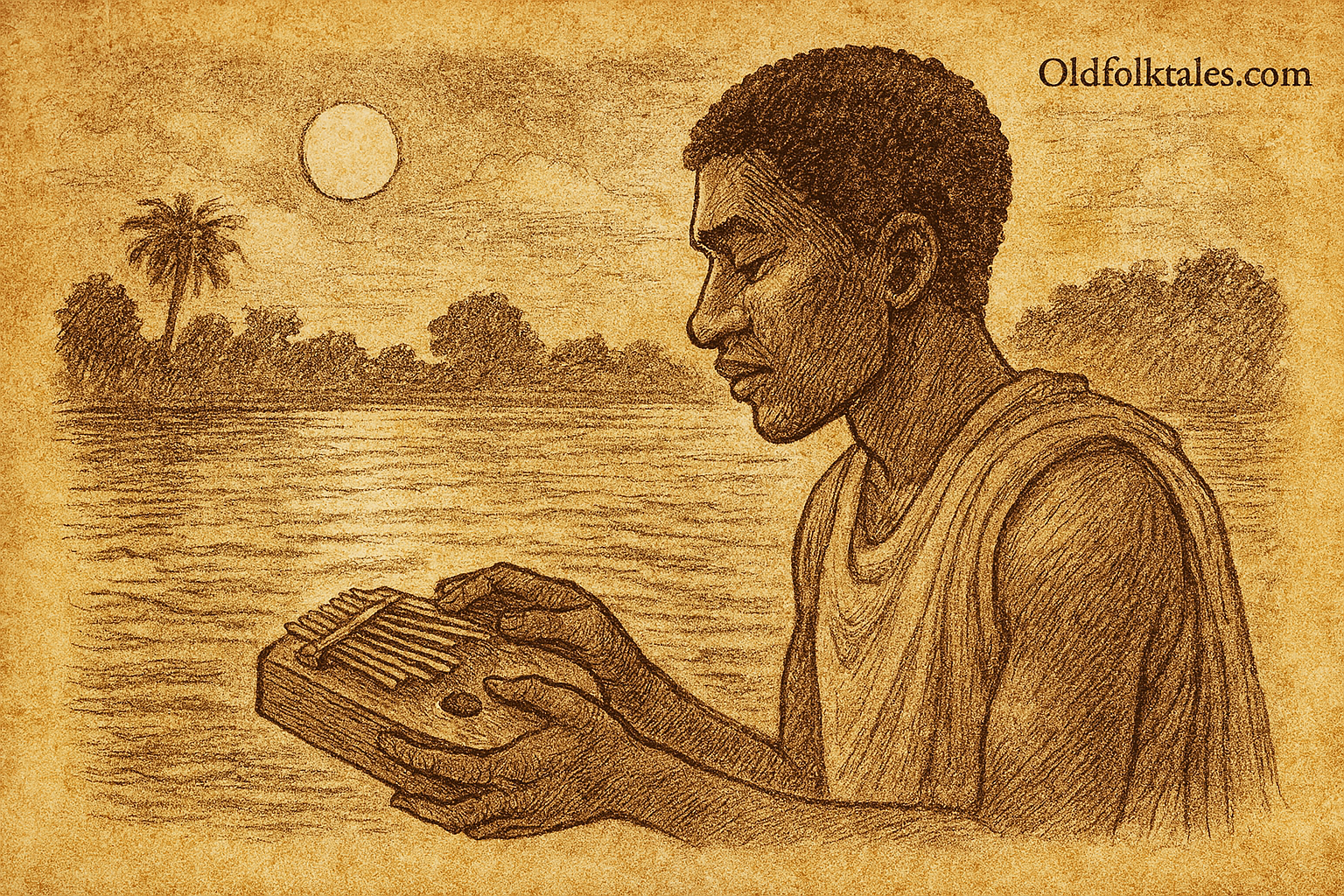
In the days when the Luapula River flowed wide and wild through the heart of Zambia, there lived a young musician named Luyando in the bustling town of Mwense. His fingers danced across the metal keys of his kalimba, a thumb piano lovingly carved from rich mukwa wood and wherever he played, joy followed like a shadow follows the sun.
Chiefs and wealthy traders sent for him constantly, summoning him to their grand feasts and celebrations. Luyando would arrive with his precious instrument, and soon the air would fill with its silvery notes. People couldn’t help themselves, they sang, they clapped, they danced until their feet were sore and their hearts were light.
After each performance, his hosts would offer him food and a handful of small coins. “Eat well, musician!” they’d say, gesturing to the leftovers. It wasn’t much, but it was enough for Luyando to live on.
Love this story? Discover our full Southern African folktales collection
His friends often worried about him. “How can you survive on so little?” they’d ask, shaking their heads.
But Luyando would simply smile. “It is enough for me,” he’d reply with genuine contentment. “How many men are blessed enough to make music every day, to see people smile and dance, and to live among friends who care?”
He loved Mwense with all his heart. The town was a crossroads of cultures and commerce, where traders arrived by canoe from the great lakes, Bangweulu to the south and Mweru to the north. Their boats groaned under the weight of fresh fish, precious salt, cassava roots, gleaming copper bracelets, and cloth dyed in colors as bright as parrot feathers. At the bustling market, Luyando heard languages from across Zambia and beyond, from the dense forests of Congo to the distant coast of Tanzania. And at sunset, when he crossed the old wooden bridge, he would pause to watch the golden light paint the Luapula River in shades of amber and fire.
“Is there any place more beautiful than this?” he would whisper to himself.
Yet despite his contentment, Luyando’s heart carried a quiet loneliness. The young women who danced to his music often smiled at him with warm eyes, and more than once, he felt his heart stir. But these were daughters of chiefs and prosperous merchants, while he was merely a poor musician who lived on scraps and small coins. The distance between them felt as wide as the river itself.
The Promise to the River
One peaceful evening, Luyando wandered beyond the town to his favorite spot on the riverbank. He sat on a smooth stone, cradling his kalimba in his lap, watching the moonlight scatter across the rippling water like scattered diamonds.
“My beloved Luapula River,” he sighed to the flowing waters, “you accept everyone equally rich or poor, it is all the same to you. If only you were a woman! I would marry you this very night and never leave your side.”
He began to play, first a soft, sorrowful melody that spoke of longing, then a peaceful tune that breathed contentment, and finally a lively song that made the very air dance. The notes floated across the water like fireflies in the darkness.
Suddenly, the river began to swell. Waves slapped violently against the bank, and Luyando scrambled to his feet. “Leza protect me!” he cried, invoking the supreme deity.
From the depths rose a mighty figure, taller than three men, crowned with shells and strings of ancient beads, his hair streaming behind him like river weeds, his chest gleaming like burnished copper in the moonlight.
“Musician!” the figure thundered, his voice like distant drums. “I am the Guardian of the Waters. From my palace far below, I heard your music, and it pleased me greatly. My daughter, Princess Mulonga, has also been listening. She loves your songs above all things.”
Luyando fell to his knees, trembling. “Thank you, great Spirit.”
“I must soon return to my palace beneath the waves,” the Spirit continued. “I wish you to play at my feast. Will you come?”
“Gladly, mighty one,” stammered Luyando, “but how will I find your home?”
The Spirit laughed, a sound like rushing waterfalls. “Under the water, of course! But you need not wait for your reward.”
At that moment, a great fish leaped from the river and landed at Luyando’s feet. Its scales gleamed gold in the moonlight. As the musician watched in wonder, the fish stiffened and transformed into solid gold.
“Music is worth more than all the riches in the world,” declared the Spirit. “If the world were truly fair, you would never go hungry again.” With a tremendous splash that soaked Luyando to the skin, the Spirit vanished back into the river.
Journey to the Underwater Palace
The next morning, Luyando sold the golden fish in the market for a fortune. With his newfound wealth, he purchased passage on a trader’s canoe heading north toward Lake Mweru. The journey was smooth at first, with strong winds filling their sail and the paddlers singing work songs in rhythm.
But when they reached the deepest part of the river, where the water turned dark as midnight, the canoe suddenly shuddered and stopped dead. The wind still blew strong, but they couldn’t move an inch forward. The paddlers cried out in terror.
“It is the River Spirit!” shouted the captain, his eyes wide with fear. “He holds us fast in his grip!”
“Do not be afraid,” Luyando called out calmly. “I know whom he seeks.” Clutching his precious kalimba tight against his chest, he took a deep breath and leaped into the water.
Down, down, down he sank through the cool depths until his feet touched the riverbed. Before him rose an magnificent palace constructed of gleaming pearl and smooth river stones, its towering gates fashioned from red and white coral. He walked through the entrance and found himself in a vast hall that glittered with otherworldly light.
The River Spirit sat upon a throne of mother-of-pearl beside his elegant Queen. Around them gathered the strangest wedding guests Luyando had ever seen—giant catfish as long as canoes, silver tilapia that shimmered like coins, ancient crocodiles with knowing eyes, playful otters, wise river turtles, scuttling crabs, and beautiful water maidens whose bodies seemed to flow like liquid.
“You have arrived just in time!” boomed the Spirit. “Play, musician, and let our feast begin!”
The Dance That Shook the River
Luyando struck the first notes on his kalimba, and suddenly the water itself seemed to sing. The fish leaped in graceful arcs, the turtles spun like dancers, the maidens swayed with movements as fluid as waves. Even the mighty River Spirit himself rushed to the floor, stamping his feet and turning in wild circles, his arms flung wide in ecstasy.
“Faster!” he cried, laughing with pure joy. “Play faster!”
Luyando’s thumbs flew across the keys, playing music faster and more furiously than ever before. The river above began to shake. The palace walls quivered. On the surface, the Luapula River tossed boats like children’s toys and smashed waves against the shore with terrifying force.
The Queen leaned close to Luyando and whispered urgently in his ear: “End your song, musician! The world above is drowning.”
Alarmed, Luyando deliberately snapped one of his kalimba’s strings. “Forgive me, great Spirit,” he called out, “but my kalimba has broken.”
The Spirit stopped dancing, still laughing breathlessly. “What a shame! I could have danced forever! But you are a fine man, Luyando, and you have brought me great pleasure. I will reward you with the greatest gift—I shall give you a wife, one of my own daughters. You will stay here with us always, making music in my palace.”
Luyando bowed low, his mind racing. “Great one, I am deeply honored. But my home is above, with my people.”
“Nonsense!” roared the Spirit, though his tone was not unkind. “You will wed my daughter, Princess Mulonga, and that is final.”
The princess stepped forward from behind her father’s throne. Her eyes shone like starlight on water, and her smile was tender and full of hope. “Dearest Luyando,” she said softly, “I have loved your music for so long. At last, we can be together.”
“You are as beautiful as the river itself,” Luyando replied, and he meant it. His heart was torn between longing and fear.
But the Queen whispered once more in his ear, her voice barely audible: “If you embrace her even once, you will never return to your world. The choice is yours.”
The Impossible Choice
That night, Luyando lay beside Princess Mulonga on a bed woven from the softest river reeds. She was everything he had ever dreamed of lovely, gentle, kind, everything his lonely heart had longed for. But each time he reached out to hold her, he heard the Queen’s warning echo in his mind: never return again. His arms remained stiffly at his sides.
“Why do you not embrace me, my husband?” Mulonga asked softly, her voice filled with hurt and confusion.
“It is… it is our custom,” Luyando said quickly, the lie bitter on his tongue. “We do not touch on the first night of marriage.”
“Then you never will touch me,” she said sadly, understanding the truth in his hesitation. She turned away from him, and a single tear rolled down her cheek.
When Luyando woke, he felt warm sunlight on his face and heard familiar birdsong. He opened his eyes to find himself back on the riverbank where his adventure had begun. His kalimba rested in his lap, its broken string now mysteriously repaired. Behind him, he could see the roofs of Mwense rising in the morning light.
“My home,” he whispered, and tears ran down his face, joyful for his return, sorrowful for what he had lost.
A Life Well Lived
The years that followed were kind to Luyando. With the wealth he had gained from the golden fish, he bought his own canoes and traded goods up and down the river. In time, he became a respected merchant. He married a good woman from the town, raised strong children who filled his house with laughter, and often played his kalimba at their family feasts.
But on quiet evenings, he would still walk to his favorite spot by the Luapula River. There he would sit and play for the flowing waters, his music drifting across the ripples. And sometimes just sometimes, he thought he saw a maiden’s face in the water, listening to his songs. Or perhaps it was only the moonlight dancing on the waves.
The Moral of the Story
This timeless tale teaches us that true belonging cannot be found by abandoning who we are or where we come from. Luyando faced an impossible choice between love and home, between extraordinary beauty and familiar ground. His decision reminds us that the greatest riches lie not in gold or even romantic love, but in remaining true to ourselves and honoring the communities that shaped us. Sometimes the hardest wisdom is knowing that we cannot have everything we desire and that choosing our authentic path, though painful, is the only way to live with integrity.
Knowledge Check
Q1: Who is Luyando and what makes him special in his community?
Luyando is a poor but talented musician from Mwense, Zambia, who plays the kalimba (thumb piano) at feasts for chiefs and traders. Despite his poverty, he finds joy in bringing happiness to others through his music and feels rich in friendship and purpose.
Q2: What does the River Spirit represent in Zambian folklore?
The River Spirit represents the supernatural guardian of the Luapula River, embodying the power and mystery of natural waters. In African traditions, such spirits are believed to control rivers and lakes, protecting them while also possessing the ability to bless or curse humans who interact with their domains.
Q3: Why does Luyando refuse to embrace Princess Mulonga?
The Queen warns Luyando that if he embraces Princess Mulonga even once, he will never be able to return to his human world above the water. Luyando must choose between romantic love with the princess and his home, community, and identity in Mwense.
Q4: What is the significance of the kalimba in this story?
The kalimba is both Luyando’s livelihood and his spiritual connection to the supernatural world. His music is so beautiful that it attracts the River Spirit’s attention and nearly causes destruction when played too energetically in the underwater palace. It represents the power of art to bridge the human and spirit worlds.
Q5: What does this folktale teach about home and belonging?
The story teaches that our deepest roots and sense of belonging are tied to our community and cultural identity. Even when offered extraordinary wealth and love, Luyando cannot abandon his home without losing himself. True contentment comes from staying connected to where and who we come from.
Q6: How does this story reflect traditional Zambian values?
The tale reflects Zambian values of community over individual gain, respect for nature and spiritual forces, contentment despite material poverty, and the importance of music and storytelling in cultural life. It also shows reverence for the Luapula River, which has been central to trade and life in the region for centuries.
Source: Zambian folktale from the Luapula River region