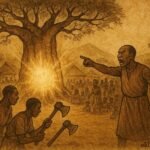
Long ago, in a village in Africa, there lived two men who were the closest of friends. They were inseparable, always seen together whether in the fields, at the market, or at the village gatherings. So close was their bond that they gave each other special names, to be used only between themselves.
One called himself Maku Mawu, meaning “I will die God’s death.”
The other was named Maku Fia, meaning “I will die the King’s death.”
At first, only the two friends used these names. But as time passed, the villagers began to notice. Amused by the unusual titles, they adopted them as well, until soon the whole community referred to the pair by their nicknames instead of their real ones.
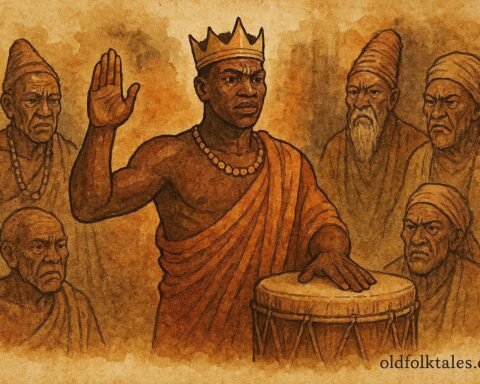
Eventually, word of these strange names reached the ears of the King. Curious, and perhaps a little suspicious, he summoned both men to his court. When they arrived, he questioned them about their unusual choices.
The King was pleased with Maku Fia, whose name honored royal authority. But he frowned upon Maku Mawu, whose name suggested a destiny ruled only by God, not by kings. Annoyed, the King began to plot against him.
The Gift of Yam and Stone
After their audience, the King invited both friends to attend a grand feast in three days’ time. Before they left, he handed each a gift: to Maku Mawu, he gave a heavy yam; to Maku Fia, he gave only a small round stone.
Maku Fia felt insulted.
“What use is this stone?” he grumbled. “If only it were a yam, I could at least cook it for dinner.”
Hearing this, Maku Mawu, ever generous, said,
“Then let us exchange. I am tired of carrying this heavy yam.”
So they swapped. Maku Fia happily cooked and ate the yam, while Maku Mawu broke open his stone. To his surprise, hidden inside was a collection of glittering ornaments, including a ring the King had secretly placed there.
Realizing the King’s plan, Maku Mawu decided to keep the discovery a secret.
The King’s Trap
Not long after, the King sent a decree: Maku Mawu must bring the ring to court, and if he failed, he would lose his head. The King believed this was his chance to destroy the man whose name displeased him.
To protect himself, Maku Mawu hid the ring. He dug a small hole in the wall of his home, placed the ring inside, and carefully sealed it over with plaster.
But the King was cunning. He summoned Maku Mawu’s wife in secret and promised her wealth if she could bring him the ring. Not knowing the danger, she questioned her husband. Trusting her, Maku Mawu revealed the hiding place. When he was away, she found the ring, delivered it to the King, and received her reward unaware she had signed her husband’s death sentence.
The Ring is Lost
On the day of judgment, the King prepared for the public trial. He placed the ring inside one of his palace dishes for safekeeping. But when servants carried the dishes to the nearby pool to wash, the ring slipped out unnoticed and sank to the bottom.
When the King stood before the assembly, he called upon Maku Mawu to present the ring. Calmly, the man knelt and said,
“The ring is lost, and I am ready to die. Only grant me a few hours to set my house in order.”
Though reluctant, the King allowed him four hours.
The Fish and the Miracle
Maku Mawu returned home, prepared his affairs, and thought, “Since I must die, I will eat one last meal.” He took his fishing net and went to the very pool where the palace dishes had been washed.
Casting his net, he caught a large fish. As he cleaned it, his eyes widened in amazement inside the fish lay the missing ring.
With great joy, he rushed to the palace, shouting,
“I have found the ring! I have found the ring!”
The people rejoiced. “He named himself rightly Maku Mawu ‘I will die God’s death,’ for only the death chosen by God can claim him!”
Shamed and powerless, the King had no excuse to harm him. Maku Mawu lived, and justice was preserved.
Moral of the Story
The tale of Maku Mawu and Maku Fia teaches that destiny is not in the hands of kings or rulers, but in the hands of God. Greed, envy, and deceit cannot triumph over truth, for what is meant to be will always find its way.