In the ancient days when the kingdoms of Uganda stretched across lush hills and fertile valleys, there lived an old man named Mugisha in the land of Buganda. His life was marked by simplicity and solitude, no wife to share his evening meal, no children to carry his name forward, no cattle to mark him as a man of means. Each morning, as the sun broke over the horizon, Mugisha would rise from his simple sleeping mat and venture into the wild grasslands where elephant grass grew tall and thick.
With his weathered knife, he would cut bundle after bundle of the coarse grass, binding each one with practiced hands. When the afternoon heat grew heavy, he would hoist the bundles onto his bent back and make the long walk to the market. There, farmers and herders would purchase his grass as fodder for their livestock, paying him a modest handful of cowrie shells for his day’s labor.
Those few shells were enough for Mugisha. He bought cassava and groundnuts for his meals, occasionally patching his worn tunic when the fabric grew too threadbare. Whatever remained, he carefully placed in a clay pot that he kept hidden beneath his sleeping mat. Year after year, this pattern continued unchanged, and Mugisha wanted for nothing because he desired nothing beyond what he already possessed.
Looking for more? Explore the magic of East African folktales here
But one evening, when Mugisha reached beneath his bed to add his day’s earnings to the pot, he gasped in astonishment. The clay vessel was filled to overflowing with cowrie shells, far more wealth than he could have possibly saved through his humble work.
“What in the name of the ancestors shall I do with all this?” he wondered aloud, staring at the unexpected fortune. “I eat only what satisfies my hunger, I wear only what shields me from the sun, and I need nothing more than the life I already know.”
After much contemplation beneath the stars, an idea formed in his mind. The next morning, Mugisha sought out a well-traveled trader in the marketplace. “Tell me, friend,” he asked, “who is considered the most noble and worthy woman in all the kingdoms of our land?”
The trader stroked his beard thoughtfully. “That honor belongs to none other than Namasole, the radiant young queen of Busoga. Her palace lies eastward, perhaps four or five days’ journey from here. She is known for her wisdom and grace.”
Mugisha used a portion of his cowries to purchase an exquisite gold bracelet, its surface etched with intricate patterns. He entrusted it to the trader with instructions to deliver it to the queen with his humble respects.
When Queen Namasole received the bracelet from a poor grasscutter she had never met, she was deeply moved. “Such unexpected kindness from one who has so little must not go unanswered,” she declared to her attendants. She immediately ordered a camel to be loaded with the finest silks, fabrics of deep indigo, brilliant crimson, and shimmering gold thread, and sent them back to Mugisha.
When the camel arrived at his modest dwelling, Mugisha stared at the luxurious silks in dismay. “What use are these beautiful things to me?” he lamented. “I cannot fill my stomach with fabric, nor does a grasscutter have need of such finery.”
He returned to the trader. “Tell me now, who is the noblest and most honorable man in all the land?”
“Without question,” the trader replied, “it is Omukama Kaboyo, the powerful young king of Bunyoro. His kingdom lies to the west, and his reputation for strength and fairness is known throughout the region.”
Mugisha promptly sent all the silks to King Kaboyo. The king, equally impressed by such generosity from an unknown commoner, responded by sending twelve of his finest cattle, sleek, healthy animals with gleaming coats and strong legs.
“This grows worse and worse!” Mugisha cried when the cattle arrived, mooing and stamping outside his small hut. “What would an old grasscutter do with twelve cattle? I have no pasture where they might graze, no wife to milk them each morning, no children to tend them throughout the day.” Without hesitation, he sent the entire herd onward to Queen Namasole.
And so began an extraordinary exchange. The queen, delighted by the cattle, sent gold ornaments and precious stones to the king. The king responded with trained servants and fine pottery. Mugisha, bewildered each time a new gift arrived at his door, simply passed everything along. Cattle, gold, ivory, servants, even elephants laden with treasures, each magnificent gift flowed through Mugisha’s hands like water through a stream, never stopping, never accumulating.
Both Queen Namasole and King Kaboyo grew increasingly curious about this mysterious benefactor whose generosity seemed to know no bounds. Who was this Mugisha who gave away fortunes without seeking anything in return? Finally, unable to contain their curiosity any longer, both decided to travel and meet him personally.
The queen departed from Busoga in the east with a grand caravan of attendants and gifts. The king set out from Bunyoro in the west with his warriors and royal entourage. By a strange twist of fate, they both arrived at Mugisha’s humble dwelling on the very same morning.
Poor Mugisha, looking out and seeing dust clouds rising from both directions, felt panic seize his heart. “What terrible shame have I brought upon myself?” he whispered. “How can a simple grasscutter receive a queen and a king? They will see that I am nothing but a foolish old man living in a hut barely fit for goats!”
Before the sun had fully risen, Mugisha fled into the surrounding hills, his heart heavy with embarrassment and fear.
But he had not gone far along the winding path when two luminous figures appeared before him, the Bachwezi spirits, ancient beings of legend who glowed like captured sunlight. Their presence was both terrifying and beautiful.
“Where are you running, Mugisha?” they asked, their voices like wind through tall grass.
“I am a foolish old man,” Mugisha confessed, his head bowed. “I wanted nothing from this life, asked for nothing, yet somehow I have created this chaos. A queen and a king are coming to honor me, and I have nothing to offer them but my shame.”
The spirits smiled with ancient wisdom. “In your heart, Mugisha, you are already a king. True nobility is not measured in cattle or gold, but in the generosity of one’s spirit.”
They reached out and touched his shoulder. In that instant, his tattered clothing transformed into magnificent barkcloth robes befitting royalty. His simple grass hut shimmered and grew, becoming a splendid palace with tall walls and a grand entrance.
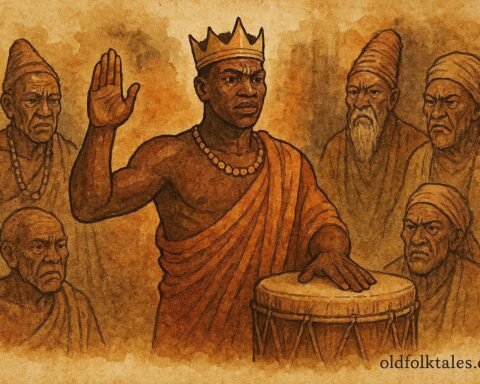
When Queen Namasole arrived from the east and King Kaboyo from the west, they found Mugisha seated on a throne of carved wood, looking every bit the noble ruler. They greeted him with the respect due to one of great status, and as the days passed in celebration, something unexpected happened. Through their shared admiration for Mugisha’s generosity, the young queen and the young king began to see each other with new eyes. Friendship blossomed into affection, and affection deepened into love.
Their marriage was celebrated in Mugisha’s palace with thundering drums, graceful dancers, and feasting that continued for many days and nights. The union brought peace and alliance between their two kingdoms, and all praised Mugisha as the wise man whose kindness had made it possible.
But when the celebrations finally ended and the last guests had departed, Mugisha quietly slipped away once more into the hills. The Bachwezi spirits found him there, sitting beneath an acacia tree, gazing at the stars.
“Why do you run away again, Mugisha?” they asked gently. “You have brought joy to many and could live as a king for all your remaining days.”
“I seek no throne, no palace, no servants,” Mugisha replied simply. “I am happiest with my knife and my grass, with my simple meals and my quiet evenings. That is where my contentment lives.”
The spirits laughed softly, a sound like bells in the wind. “Then so it shall be, wise one.” With another touch, they restored him to his humble self.
And so Mugisha returned to his simple life, cutting elephant grass each morning and selling it in the market each afternoon. He never sent another gift, never sought recognition, but he was always remembered throughout the kingdoms as the generous grasscutter whose selfless heart had united a king and queen, bringing peace and prosperity to the land.
The Moral Lesson
This folktale teaches us that true wealth lies not in accumulating possessions, but in understanding what brings genuine contentment to our hearts. Mugisha’s generosity flowed naturally from his lack of attachment to material things, and his greatness was recognized not when he owned a palace, but when he chose simplicity over status. The story reminds us that the noblest character is found in those who give freely, seek nothing in return, and remain content with who they truly are regardless of how the world might wish to honor them.
Knowledge Check
Q1: Who was Mugisha and what was his daily occupation in the kingdom of Buganda?
A: Mugisha was an elderly man with no family or possessions who worked as a grasscutter in Buganda. Each day, he cut wild elephant grass, bundled it, and sold it at the market as animal fodder, earning only a few cowrie shells for his labor.
Q2: Why did Mugisha send gifts to Queen Namasole and King Kaboyo?
A: When Mugisha unexpectedly found his savings pot overflowing with cowrie shells, he had no personal use for the wealth. Rather than keeping what he didn’t need, he chose to honor the noblest people in the land by purchasing gifts and sending them to the queen and king, demonstrating his generous and selfless nature.
Q3: What role do the Bachwezi spirits play in the story?
A: The Bachwezi spirits serve as supernatural beings who recognize and reward Mugisha’s inner nobility. They appear twice in the story first transforming him and his home into royal splendor when he felt ashamed before the arriving monarchs, and later restoring his humble life when he expressed that true happiness lay in simplicity, not status.
Q4: How did Mugisha’s generosity lead to the union of two kingdoms?
A: Through Mugisha’s continuous exchange of gifts between Queen Namasole of Busoga and King Kaboyo of Bunyoro, both monarchs became curious about the mysterious benefactor. When they traveled to meet him simultaneously, they encountered each other and, through their shared admiration for Mugisha’s character, fell in love and married, uniting their kingdoms.
Q5: What is the cultural significance of cowrie shells in this Ugandan folktale?
A: Cowrie shells were used as currency throughout many African kingdoms, including those in Uganda. In this story, they represent Mugisha’s modest earnings and later his unexpected wealth, symbolizing the material resources that he valued far less than his contentment and peace of mind.
Q6: Why did Mugisha choose to return to his simple life as a grasscutter after becoming honored as a king?
A: Mugisha understood that his happiness came from simplicity and purposeful work, not from wealth, status, or recognition. Despite being transformed into royalty and celebrated as a great man, he recognized that his true contentment lay in his humble daily routine, demonstrating that self-knowledge and authenticity are more valuable than external honors.
Source: Ugandan folktale from the kingdoms of Buganda, Busoga, and Bunyoro (Bantu cultural tradition)