In the ancient days when the earth was still young, there lived a hunter named Ndiaye in a small village on the edge of the great Senegalese forest. Ndiaye was known far and wide not only for his skill with the bow but for his respect and understanding of the forest spirits. While others saw the forest as a place of danger, Ndiaye listened to the whispers of the trees and the songs of the birds. The villagers often said, “Ndiaye speaks the language of the forest.”
One bright morning, Ndiaye awoke to a strange silence. The usual chatter of birds was gone, and the wind no longer danced through the leaves. An eerie stillness had fallen over the forest. Curious and concerned, Ndiaye took his bow and set out to discover the cause.
As he entered the dense trees, he heard faint whispers carried by the wind. “The forest mourns,” the voices seemed to say. Ndiaye stopped near an ancient baobab and spoke aloud, “Oh, spirits of the forest, what troubles you so?”
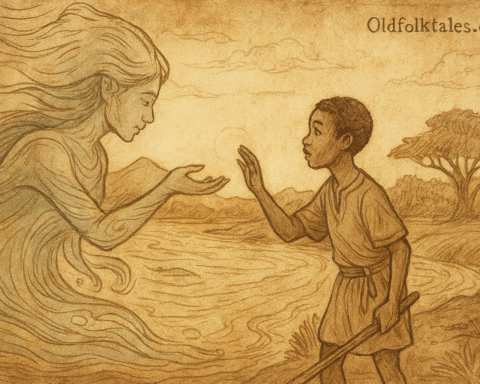
Suddenly, a gentle breeze swirled around him, and a voice emerged from the rustling leaves. “Ndiaye, the forest’s heart is fading. The river that feeds us is drying. Without water, the trees will wither, and the animals will flee. You must find the source and restore its flow.”
Ndiaye’s heart sank. He knew the river was the lifeblood of the forest. Without it, his village too would suffer. Determined, he promised, “I will find the source and bring back the water.”
The forest spirits guided him deeper into the jungle. Along the way, Ndiaye encountered many trials. A wide chasm blocked his path, filled with jagged rocks and swirling mist. Remembering the wisdom of the elders, he crafted a bridge from fallen branches and vines, careful not to harm the living plants. As he crossed, the mist whispered warnings, but Ndiaye’s steady feet carried him safely over.
Further along, a cunning serpent blocked the trail. Its scales shimmered like the river’s surface at dawn, and its eyes gleamed with ancient knowledge. “Turn back, hunter,” the serpent hissed. “No man can change the river’s fate.”
But Ndiaye stood tall, his bow at the ready. “I come not to fight but to heal. Let me pass, and you will be honored.”
The serpent narrowed its eyes but saw truth in Ndiaye’s voice. Slowly, it slithered aside, revealing a narrow path lined with glowing flowers.
At the end of this path, Ndiaye found a great stone dam blocking the river’s source. The dam was carved with strange symbols, and it pulsed with a dark energy. Ndiaye remembered stories of the forest’s ancient guardian, a spirit that could be both protector and destroyer.
Kneeling, Ndiaye prayed aloud, “Oh, great guardian, I seek only to restore balance. Please release the waters so life may flourish.”
The dam trembled, and a booming voice echoed from the stones. “Only one who proves pure of heart and wise in spirit may free the river.”
Ndiaye was given three tasks: to plant a seed in the barren soil, to share food with a hungry creature, and to tell a story that could heal a broken heart.
First, Ndiaye found a withered patch and planted a single seed from the baobab tree, whispering words of hope. Then, he came across a young gazelle, thin and weak. He offered part of his meal without hesitation. Lastly, sitting beneath the stars, Ndiaye told the tale of the moon and the firefly to a grieving mother whose child was lost.
The guardian’s voice returned, “You have shown kindness, patience, and wisdom. The river flows once more.”
With a rumble, the dam cracked, and water burst forth in a joyful torrent. The forest sighed with relief as the river rushed back to life, sparkling and singing.
Ndiaye returned to his village a hero, but humble as ever. The forest whispered its thanks, and the animals danced under the moonlight. Ndiaye knew the balance was fragile, and from that day, he became the forest’s keeper, protector of its secrets and friend to all who lived beneath the trees.
✧ Commentary
This Senegalese folktale beautifully illustrates the importance of harmony between humans and nature. Ndiaye’s journey teaches that true strength is not just physical but rooted in wisdom, patience, and respect. The forest’s voice symbolizes the spirit of the environment, reminding us that listening and kindness are essential for balance. Through this story, we see how traditional values emphasize stewardship of the land and the power of storytelling to heal and protect.
✧ Moral
Kindness, respect, and understanding are the greatest powers. When we live in harmony with nature, we create balance and peace for all.
✧ Questions & Answers
1. Q: What was happening to the forest in the story? A: The river feeding the forest was drying up, threatening all living things.
2. Q: What promise did Ndiaye make? A: He promised to find the river’s source and restore its flow.
3. Q: What challenges did Ndiaye face on his quest? A: Crossing a dangerous chasm, battling a serpent, and confronting a forest spirit guarding the water.
4. Q: What three tasks did the forest spirit ask Ndiaye to do? A: Plant a seed, share food with a hungry creature, and tell a healing story.
5. Q: What does this folktale teach about humans and nature? A: It teaches that living with respect and kindness toward nature brings balance and peace.