In the heart of the ancient African forest, where towering trees stretched their branches toward the heavens and the air hummed with the sounds of countless creatures, lived Ngiya the Gorilla. Despite his impressive size and strength, Ngiya carried a heavy burden that weighed more than his powerful frame could bear, the cruel mockery of his fellow forest dwellers.
Day after day, the other animals would gather in small groups, whispering and pointing at Ngiya as he passed. Their voices would rise in cruel laughter as they called out, “Broken-face! Here comes Broken-face!” The name stung like thorns, piercing Ngiya’s heart with each utterance. His broad chest would tighten with shame, and his dark eyes would cast downward to avoid their mocking gazes.
The constant ridicule gnawed at Ngiya’s spirit until doubt consumed his thoughts. Was his appearance truly so terrible? Were the taunts justified, or were they simply the result of jealousy and meanness? The uncertainty tormented him more than the insults themselves, for not knowing the truth left him trapped between hope and despair.
Also read: The Eagle and Leopard Hunting Contest
One morning, as golden sunlight filtered through the canopy above, Ngiya made a decision that would change everything. He sought out Ingenda, a small but notably clever monkey from the respected Monkey Tribe. Ingenda was known throughout the forest for his quick wit and nimble movements, qualities that had earned him both admiration and wariness from other creatures.
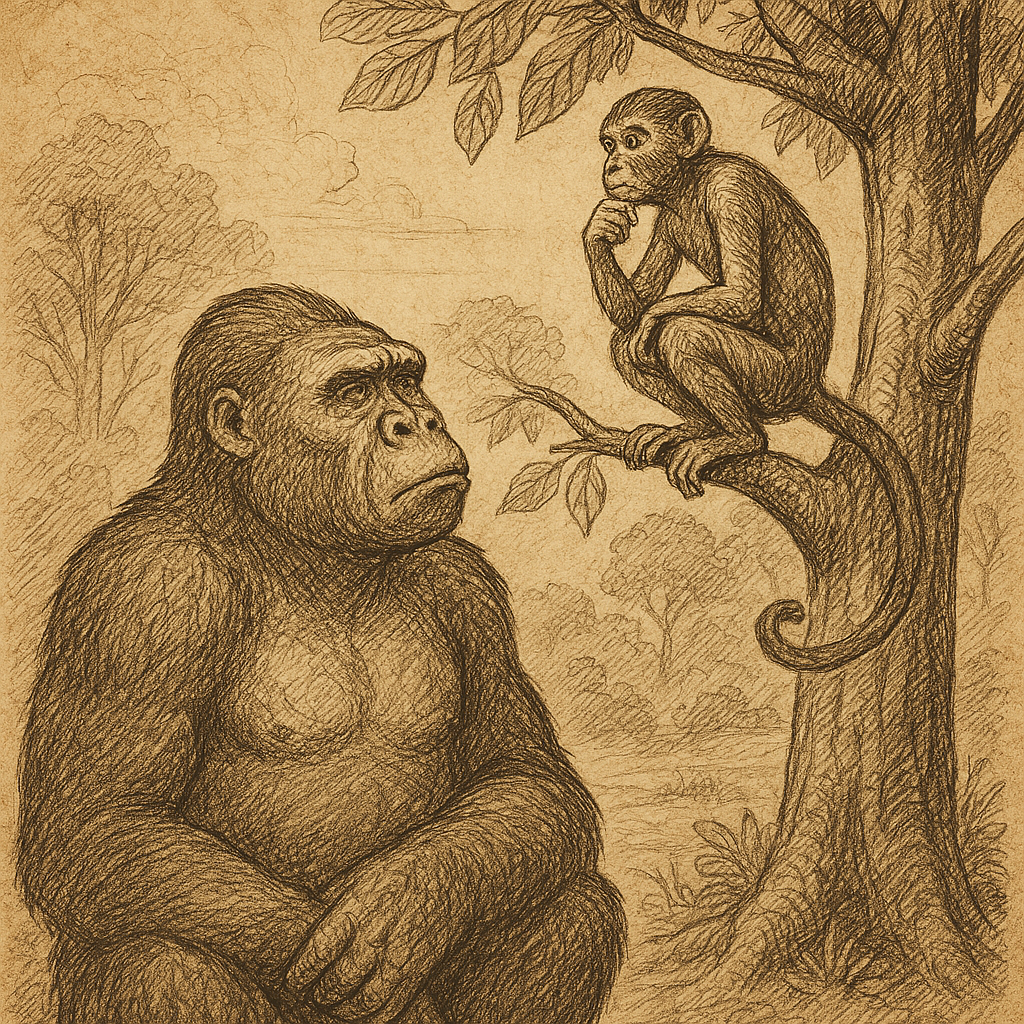
With a voice heavy with vulnerability, Ngiya approached the smaller animal. “Ingenda,” he said, his massive hands fidgeting nervously, “I must ask something of you, and I need you to be completely honest with me.” The gorilla’s eyes, usually so fierce and commanding, now pleaded with desperate hope. “Examine my face carefully and tell me, is it truly as broken and ugly as they all say?”
Ingenda felt his tiny heart race as he looked up at the towering figure before him. The small monkey found himself caught in an impossible situation, trapped between two equally dangerous paths. To refuse Ngiya’s request would surely anger the powerful gorilla, whose strength could crush him without effort. But to tell the truth, for indeed, Ngiya’s face did bear the unfortunate features that had earned him his cruel nickname, might provoke an even more dangerous rage.
Quick thinking had always been Ingenda’s greatest asset, and now his life might depend on it. His bright eyes darted around the clearing until they settled on a tall tree nearby, its branches heavy with ripe, golden fruits that swayed gently in the morning breeze.
“Of course, mighty Ngiya,” Ingenda said with a respectful bow, “I will examine your face and give you the honest answer you seek.” Then, with seemingly innocent casualness, he added, “But I must confess, I am terribly hungry this morning. My stomach growls so loudly I fear it might distract me from giving you the careful attention you deserve. Might I first gather a few fruits to quiet my hunger?”
Ngiya, eager for an answer but understanding the logic, nodded his great head in agreement. “Yes, yes, eat what you need. But be quick about it, I must know the truth.”
With the agility that made his tribe famous, Ingenda scrambled up the tree trunk, his small hands and feet finding purchase on the rough bark with practiced ease. As he climbed higher and higher, he plucked the choicest fruits, stuffing them into his cheeks and taking deliberate, slow bites.
“I must eat properly to think clearly,” Ingenda called down, his voice muffled by fruit. “Such an important question deserves my full attention and energy.” All the while, he continued his steady ascent toward the safety of the upper branches.
By the time Ingenda had consumed his second piece of fruit, he had reached the very crown of the tree, where the branches swayed gently in the wind and provided him with multiple escape routes to neighboring trees. From this lofty and secure perch, he could see Ngiya far below, growing increasingly impatient.
“Now then,” Ingenda called down, his voice carrying clearly through the forest air, “for me to examine your face properly, you must look up at me with your face turned toward the sky.”
Ngiya, trusting and desperate for an answer, tilted his massive head back and gazed upward, his face fully exposed in the morning light. From his safe vantage point high above, Ingenda could see clearly what the other animals had been mocking the unfortunate arrangement of features that had earned Ngiya his hurtful nickname.
Taking a deep breath, Ingenda made his choice. Truth, however painful, was what had been requested, and truth was what he would deliver. But he would deliver it from a place where the consequences couldn’t reach him.
“I have examined your face carefully, great Ngiya,” Ingenda called down, his voice carrying a note of genuine sadness for what he was about to confirm. “And I must tell you honestly, as you have asked it is really so. It is really so that your face bears the features they mock.”
The words hit Ngiya like a physical blow. His heart sank as the truth he had both feared and needed to hear echoed through the forest. Rage began to build in his chest not just at the confirmation of his appearance, but at having the truth delivered from such a safe distance, making him feel even more foolish and powerless.
“Come down here!” Ngiya roared, his voice shaking the leaves on nearby trees. “Come down and face me after delivering such news!”
But Ingenda, wise in the ways of survival, had no intention of descending. Instead, with the natural grace of his kind, he leaped from branch to branch, tree to tree, calling back as he disappeared into the green canopy, “The truth was what you asked for, mighty Ngiya, and the truth is what you received!”
Ngiya stood alone in the clearing, his fury burning hot but his target now beyond reach. He pounded his chest and roared his frustration to the forest, but Ingenda was already far away, safe among the treetops where no earthbound creature could follow.
Moral Lesson
This tale teaches us that while truth can be painful, it is often necessary for growth and self-acceptance. It also shows us that wisdom sometimes lies not in avoiding difficult situations, but in finding clever ways to navigate them safely. Ingenda demonstrated that honesty and self-preservation can coexist when approached with intelligence and timing.
Knowledge Check
Q1: Who are the main characters in this African folktale? A: The main characters are Ngiya the Gorilla, who is mocked by other animals for his appearance, and Ingenda, a small but clever monkey who is asked to give an honest opinion about Ngiya’s face.
Q2: What cruel nickname did the forest animals give to Ngiya the Gorilla? A: The other animals called Ngiya “Broken-face,” which caused him great emotional pain and self-doubt about his appearance.
Q3: How did Ingenda the Monkey cleverly protect himself while telling the truth? A: Ingenda climbed high into a tree under the pretense of eating fruit to satisfy his hunger, positioning himself safely out of Ngiya’s reach before delivering the honest but hurtful truth.
Q4: What does this folktale teach about the consequences of seeking uncomfortable truths? A: The story teaches that while seeking truth is important for self-understanding, we must be prepared for potentially painful answers and that the truth, though difficult, can be a starting point for personal growth.
Q5: What cultural values does this African folktale represent? A: This folktale represents values of wisdom, cleverness in dangerous situations, the importance of truth-telling, and the understanding that survival sometimes requires strategic thinking rather than direct confrontation.
Q6: What does Ingenda’s escape symbolize in the story’s moral framework? A: Ingenda’s escape symbolizes that wisdom often involves knowing when and how to deliver difficult truths safely, and that intelligent strategy can protect those who speak honestly in dangerous situations.