In the distant days when witchcraft still held sway over the land and the customs of the ancestors governed every aspect of life, there lived in separate but neighboring territories two prominent figures who would become entangled in a tale of tragic misunderstanding. This was a time when death was never accepted as natural, and every passing required careful investigation to determine its cause before burial could proceed.
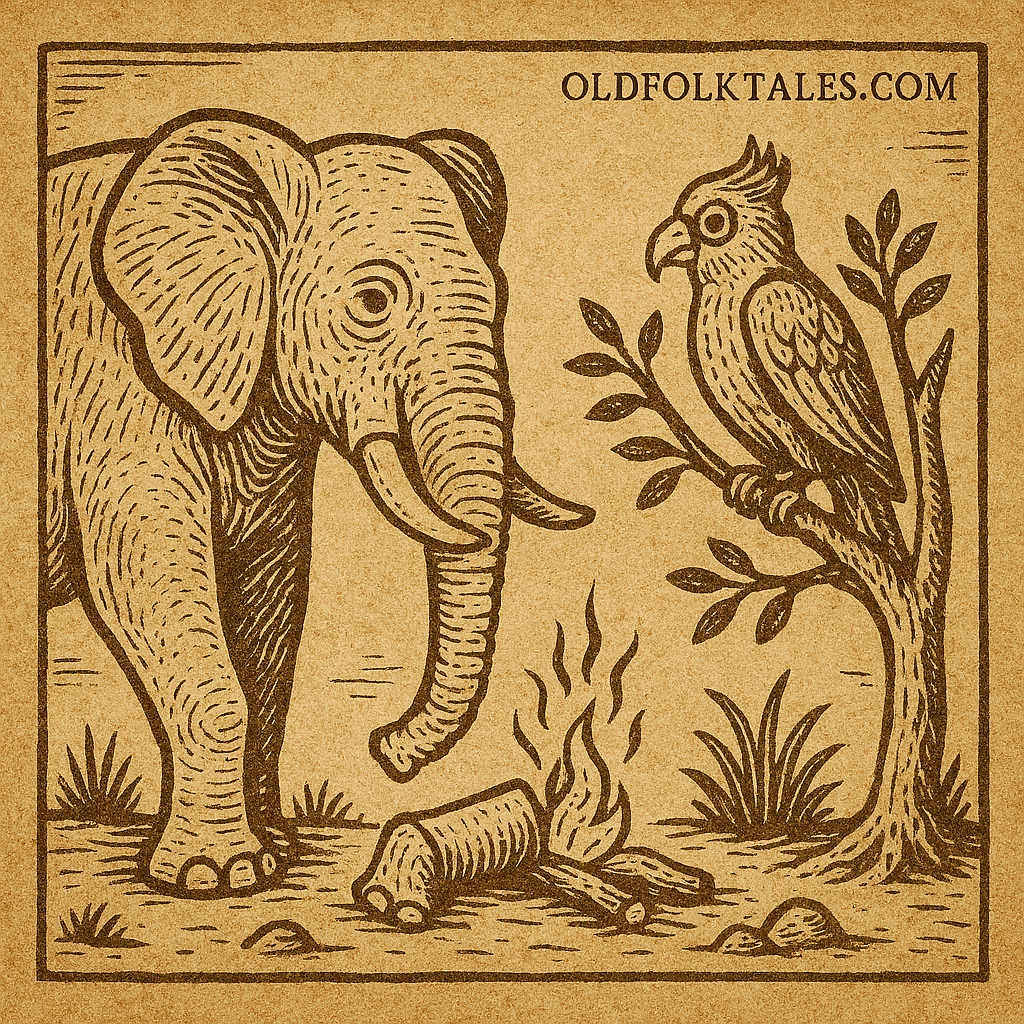
Njaku the Elephant, magnificent in his size and strength, had established his own thriving town where he ruled as the undisputed leader. His massive frame cast long shadows across the settlement, and his trumpet calls could be heard echoing across the valleys, announcing his presence to all who dwelt in the surrounding lands. His children, equally impressive in their size and power, looked up to their father with unwavering respect and were known throughout the region for their absolute obedience to his every command.
Not far away, Koho the Parrot had built his own settlement, smaller perhaps than Elephant’s grand town, but vibrant with the sounds of tropical life. Brightly colored feathers adorned the inhabitants, and their melodious calls created a symphony that drifted on the warm breezes. Parrot’s children possessed a remarkable gift that made their town the envy of many neighboring communities, they were extraordinary hunters whose skills provided their people with an abundance of fresh meat daily.
Also read: Unyunge the Shrew Mouse and Po the Lemur
Every morning, as the sun painted the sky in brilliant shades of orange and gold, Parrot’s offspring would set out with their hunting implements, moving through the forest with the grace and precision that only came from generations of practiced skill. When evening approached and they returned home, their father would call out joyfully, “Hida! Hida!” celebrating the wild meat they brought back in such abundance that no one in their town ever knew hunger.
The success and prosperity of Parrot’s hunting expeditions did not go unnoticed by their neighbors. Word of their achievements spread like ripples across water, eventually reaching the ears of Elephant, who found himself growing increasingly troubled by reports of the smaller bird’s apparent superiority in this crucial aspect of community leadership.
One day, consumed by curiosity and perhaps a growing sense of inadequacy, Elephant announced to his town, “I must undertake a journey to visit my friend Chum Koho. There are matters I wish to discuss with him personally.”
The journey to Parrot’s town was not long, but it felt interminable to Elephant as questions and doubts swirled through his mind. When he finally arrived at Parrot’s dwelling, he found his friend in a peculiar position that immediately caught his attention. Koho stood motionless, balancing on one leg while the other was bent up and hidden beneath his colorful plumage, creating an unusual and somewhat mysterious appearance.
Elephant’s massive brow furrowed with confusion and concern as he observed his friend’s strange posture. “Chum!” he called out, his voice booming across the small courtyard, “What have you done to your leg? Why do you stand in such an unusual manner?”
Parrot, perhaps caught off guard by the unexpected visit and the directness of the question, responded without thinking carefully about the implications of his words. Looking directly at his large friend with eyes that seemed to sparkle with mischief or perhaps nervousness, he replied, “My children have gone with it hunting.”
The statement hit Elephant like a physical blow. His small eyes widened in amazement as he tried to process what he had just heard. Could it truly be possible that Parrot’s legendary hunting success came from such an extraordinary sacrifice? The idea seemed both incredible and somehow fitting for someone whose children achieved such remarkable results.
“On your oath?” Elephant demanded, his voice carrying the weight of solemn ritual and the binding power of sacred promises. “Do you swear this is the truth?”
Parrot, now committed to his hastily spoken deception and perhaps enjoying the look of astonishment on his friend’s face, doubled down on his false claim. “Truly!” he declared with conviction, his head nodding emphatically. “It is exactly as I have told you.”
Elephant stood in stunned silence for several long moments, his mind racing to comprehend this revelation. Finally, he spoke again, his voice subdued and thoughtful. “I came merely to visit you, to see how you fared. But now I have learned something extraordinary. I must return home to consider what you have shared with me.”
Parrot, relieved that the conversation seemed to be ending, nodded graciously. “Yes, very good, my friend. Travel safely on your journey home.”
The return journey passed in a blur of obsessive thoughts for Elephant. His pride, already wounded by the apparent superiority of Parrot’s hunting success, now burned with a fierce intensity. How could he, the mighty Elephant, leader of his own town and possessor of such strength and size, be outdone by a small bird? The very thought was intolerable to his ego.
Upon reaching his own settlement, Elephant’s mind was made up. His voice rang out across the town with commanding authority as he addressed his children. “Arrange the nets today! Tomorrow we shall embark on a great hunt that will surpass all others!”
His children, accustomed to their father’s decisive leadership, began immediately preparing their hunting equipment with eager anticipation. They sharpened spears, checked trap mechanisms, and organized their supplies, excited by the prospect of demonstrating their own hunting prowess.
The next morning dawned bright and clear, perfect weather for their planned expedition. As his children made their final preparations, Elephant’s shame and determination reached a crescendo. The thought that Parrot, so much smaller and seemingly less capable, had achieved superior results through sacrifice gnawed at his pride like a persistent wound.
“My children,” he announced with grim determination, “take a saw, and cut off my leg. We shall hunt as Parrot’s family hunts, with the very essence of our leader supporting the expedition.”
His children stopped their preparations and stared at their father in shock. The request seemed incredible, dangerous, and completely unnecessary. Yet they had been raised from birth to show absolute obedience to their father’s commands, never questioning his wisdom or judgment.
“Father,” one of them ventured hesitantly, “are you certain this is wise? You are needed here in the town.”
“Do as I have commanded,” Elephant replied firmly. “Take the saw and cut off my leg. Carry it with you on the hunt, just as Parrot’s children do.”
With heavy hearts and trembling hands, his children obeyed. They severed their father’s leg as he had commanded, the act filling them with horror even as they complied with his wishes. Carefully, they wrapped the dismembered limb and prepared to take it with them on their hunting expedition, though none of them understood how it would help their efforts.
As soon as his children departed for the hunt, carrying his severed leg with them into the wilderness, Death arrived at Elephant’s door. The loss of blood, the shock to his system, and the severity of his self inflicted wound had created an invitation that Death could not ignore.
“I have arrived!” Death announced in a voice that echoed through the town like a funeral bell.
The people of Elephant’s settlement immediately recognized the gravity of the situation. Panic spread through the community as they realized their leader was in mortal danger. “Come quickly!” they cried out in desperation. “Njaku is not well! Our leader needs help!”
But their urgent calls fell on deaf ears. Elephant’s children were far away in the forest, beyond the reach of even the most desperate shouts. They continued their hunt, unaware that their father lay dying in his home, the victim of his own pride and misguided decision.
When the hunting party finally returned to town, expecting to share their father’s triumph and perhaps witness his vindication, they found instead a scene of mourning and confusion. Their mighty father lay still and cold, his great spirit having departed while they were away.
The people of the town gathered around the tragic scene, their voices rising in bewilderment and sorrow. “What strange manner of hunting is this?” they wondered aloud. “Since we were born, we have never heard of such a thing, that hunting should be conducted with the severed limbs of those who remain behind in the town.”
As was the custom in those days of careful investigation, representatives from neighboring towns arrived to participate in the inquiry that would determine the cause of death. When they questioned Elephant’s children about the bizarre circumstances, the young ones could only repeat what their father had told them.
“Who counseled you to undertake such a dangerous action?” the investigators asked.
“It was our father himself,” the children replied sadly. “He commanded us, saying ‘Cut!’ and so we obeyed and cut as he instructed.”
The investigation continued as the authorities sought to determine if anyone bore responsibility for Elephant’s death. Eventually, their attention turned to Parrot, whose hunting success had apparently inspired Elephant’s fatal decision.
“The blame belongs to Koho,” some declared. “His boasting must have led to this tragedy.”
Parrot was summoned to answer for his possible role in the death. When confronted with the accusations, he responded with genuine bewilderment and denial. “The fault is not mine,” he protested earnestly. “I never told him to cut off his leg. I never suggested such a thing.”
After careful consideration, the investigators could find no evidence that Parrot had directly caused or encouraged Elephant’s self destructive action. The charges against him were dismissed, and the community was left to grapple with the tragic consequences of pride, jealousy, and misunderstanding.
The burial proceeded according to the ancient customs, but the shadow of the tragedy lingered long after the ceremony concluded.
Moral Lesson
This tale serves as a powerful warning against the dangers of jealousy and pride. Elephant’s envy of Parrot’s success led him to make a fatal decision based on false information and wounded ego. The story teaches us that competition and comparison with others can blind us to reason and lead to self destruction. It also illustrates how deception, even seemingly harmless lies, can have unintended and devastating consequences for others.
Knowledge Check
Q1: Who are the main characters in this African folktale about death and deception? A: The main characters are Njaku the Elephant, who rules his own town, Koho the Parrot, whose children are successful hunters, and Death, who comes to claim Elephant after his self inflicted injury.
Q2: What lie did Parrot tell Elephant about his hunting success? A: Parrot falsely claimed that his children took his leg with them when they went hunting, implying that his physical sacrifice contributed to their remarkable hunting success and abundant meat.
Q3: What fatal decision did Elephant make based on Parrot’s deception? A: Driven by jealousy and pride, Elephant commanded his children to cut off his leg with a saw so they could take it hunting, believing this would make them as successful as Parrot’s children.
Q4: What was the ancient custom regarding death investigations in this folktale? A: In the days of witchcraft, it was customary not to bury a corpse until investigators determined who or what caused the death, a process that sometimes took several days while the body was preserved with salt and smoke.
Q5: How did the community determine responsibility for Elephant’s death? A: The people initially blamed Parrot for inspiring Elephant’s fatal decision, but after investigation, they found Parrot had never directly told Elephant to cut off his leg, so the charges were dismissed.
Q6: What does this African folktale teach about jealousy and competition? A: The story warns that jealousy and competitive pride can lead to irrational decisions and self destruction, showing how envy of others’ success can blind us to reason and cause tragic consequences.