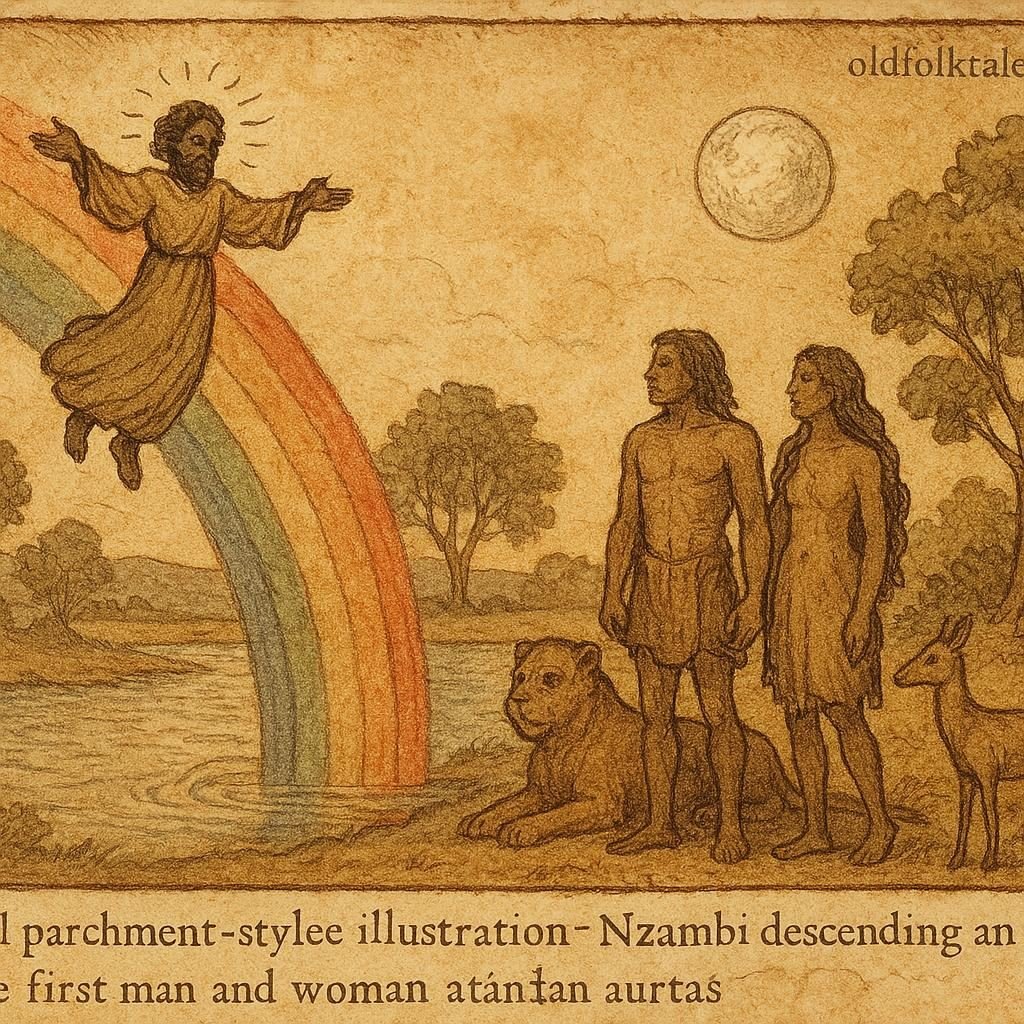
In the twilight of time, when the world was still raw and unshaped, Nzambi, the great creator, descended to earth upon the shimmering arc of a rainbow. He landed gently on the banks of the Katubang’ony, a river that flowed quietly through the Kato bushlands near the village of Mwachiamvu. Nzambi looked around and found the place beautiful, yet empty. Its stillness stirred him, and he set his mind to creating life.
First, Nzambi caused trees to sprout from the soil, their leaves unfurling in the morning sun. He filled the air with the cries of birds and the forest with the footsteps of animals. Yet his heart remained unsatisfied. Creation, though wondrous, seemed incomplete. So, as the crown of his work, Nzambi shaped the first man and the first woman. They stood upon the earth, alive with spirit and strength, gazing in awe at the world around them.
It is said that the traces of this beginning still remain, footprints carved into stone, alongside the spoor of a dog, the marks of a bush pig, and the faint etchings of mankind’s earliest hunts. These silent imprints whisper the memory of humanity’s dawn.
When Nzambi beheld the man and woman, he blessed them tenderly: “Sumbukeni, semenu ayana, Marry and have children.” They obeyed, and soon their union bore fruit. Children filled the earth, running, laughing, and living beneath the watchful sky. Nzambi rejoiced, for his own creation multiplied before him, carrying his life-force into the world.
In the beginning, they lived together as one family, walking njilu yimu, the same path. Harmony bound them, but as time passed, their numbers grew beyond what one place could hold. The land grew crowded, and disputes rose among them. Quarrels turned into fights, and kin turned against kin. Disturbed by this unrest, the elders gathered and resolved to spread out in search of new lands where peace might return.
READ: The Creation and Departure of Nyambe : A Zambian Folktale
Yet even as they scattered, the burden of strife did not ease. Battles arose among the people, and grief grew heavy. In despair, the first-born ancestor raised his voice in prayer:
“You, Nzambi, our creator, you who gave us life how shall we overcome this misery? Show us the path that pleases you, for nothing is more valuable than to fulfill your wish.”
Nzambi heard their cry, and a pang of regret struck him. He realized that in granting them endless blessings of marriage and children, he had allowed their numbers to grow without limit. He resolved to set a law upon them.
Thus, Nzambi spoke with solemn authority:
“From now on, I lay a restriction upon you. If you sleep while the moon strolls in the sky, the penalty shall be death. This death may not come that very night, but it shall come, for I will call back the Akashi, the spirit, I placed in your bodies. This law binds every one of you. Sleep not under the moonlight, or prepare to die.”
The ancestors carried Nzambi’s message back to the people. They whispered it from hearth to hearth, and the warning spread across the land. At first, they feared death greatly, yet they also resolved not to let it conquer them. The children of Nzambi became alert, their eyes wide in the night. They hunted beneath the moon and rested only when the sun was high. Night after night, they kept themselves busy, and for a long time no one died.
But fate does not spare even the most careful. Among them lived an elder, revered as one of the first men, yet his sight had dimmed with age. His eyes no longer caught the silver glow of the moon. For many nights, the younger ones guided him, warning him when the moon was bright. This protection lasted long, and he endured.
One day, however, the young people left for a distant ceremonial feast, leaving the old man alone. That night the sky was veiled with heavy clouds, swollen with rain. The moon’s glow was hidden. Believing it still to be day, the old man lay down and closed his eyes. Sleep embraced him gently and forever. He did not wake. Death had claimed its first victim.
From that day forward, the law of Nzambi was fulfilled. Death entered the world. No longer did men and women live without end. Some passed away in sleep, some in sickness, and others without cause. Thus, the order of life was sealed: birth, struggle, and finally death.
Moral Lesson
This Lozi folktale reminds us that every blessing carries responsibility. Nzambi gave humanity the gift of life and abundance, but their unchecked multiplication brought conflict and imbalance. To restore order, death was introduced as a boundary for humankind. The story teaches that disobedience, forgetfulness, and human frailty carry consequences, yet it also shows the inevitability of mortality as part of the human journey. Ultimately, it warns against pride and neglect of divine wisdom, urging people to live consciously, honouring the life they are given.
Knowledge Check
Q1: Who is Nzambi in this Lozi folktale?
A1: Nzambi is the supreme creator who shaped the world, animals, and the first humans.
Q2: What blessing did Nzambi give to the first human couple?
A2: He blessed them with the words “Sumbukeni, semenu ayana,” meaning “Marry and have children.”
Q3: Why did Nzambi impose the law about sleeping under moonlight?
A3: Because human multiplication caused strife, and Nzambi sought to limit life by introducing death.
Q4: How did people avoid death at first?
A4: They stayed awake at night, hunting under the moon and sleeping during the day.
Q5: Who was the first to die, and why?
A5: An old man with poor eyesight, who mistakenly slept when the moon was hidden by clouds.
Q6: What cultural lesson does the story teach?
A6: It explains the origin of death among humans and emphasizes the importance of obeying divine laws.
Source: Lozi folktale, Zambia.