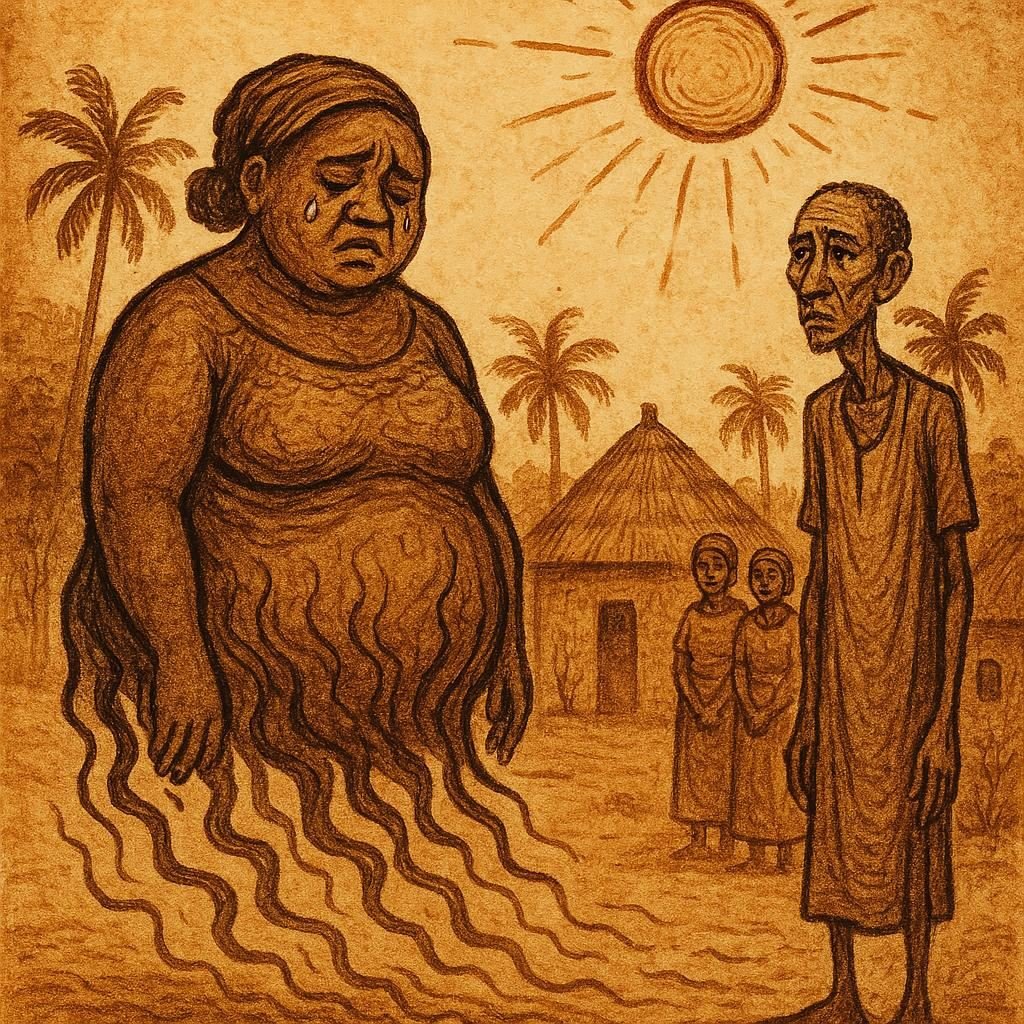
Long ago, in a quiet village surrounded by rolling fields and tall palm trees, there lived a husband and wife who could not have been more different in appearance. The man was thin, lean as a stalk of millet, with long limbs and narrow shoulders. His wife, however, was remarkably fat, so round and heavy that she was instantly noticed wherever she went.
They were devoted to one another, yet whenever they walked side by side through the village, the people whispered and chuckled behind their backs. Some were cruel enough to laugh out loud, exclaiming, “What a strange pair! Look at the skinny man with his enormous wife!” Their voices carried like sharp arrows, striking the woman’s heart with every word.
At first, she tried to ignore the taunts. She told herself that her size was simply how she was made, and that those who laughed were merely unkind. But over time, the constant mockery began to weigh heavily on her spirit. She felt shame every time she left her hut, ashamed even of the body that had once been a source of pride.
One evening, unable to bear it any longer, she turned to her husband with sorrow in her eyes.
“Husband,” she said softly, “the people mock us wherever we go. They say I am too fat, and they make me feel like a burden and a shame to you. Tell me, what should I do?”
Her husband, thin as he was, gazed at her thoughtfully. He did not laugh, nor did he scold her for her feelings. Instead, he offered advice.
“Every morning,” he said, “stand outside beneath the rising sun. Let the heat of its rays fall upon you, and remain there for some time. Do this each day, and perhaps you will become smaller.”
The woman, desperate for change and eager to silence the laughter of the people, agreed to follow his words.
The next morning, as the sun crept above the horizon, she went out and stood beneath its golden light. The warmth bathed her skin, and she stood still, letting it soak into her body. The villagers who passed by saw her there but said nothing.
The following day, she returned again, and the next day after that. Day after day, she stood beneath the blazing sun, hoping to grow thin like her husband.
And indeed, something began to happen. Slowly, her great body seemed to shrink. Her face became less round, her arms grew smaller, and her heavy frame began to fade. But instead of simply becoming thin, she continued to waste away, as though the sun’s heat was burning her very substance into the air.
Her husband watched, but said nothing. The villagers, who once mocked her, now looked on in silence as the woman diminished before their eyes.
Finally, after many mornings beneath the harsh rays of the sun, the woman melted away altogether, vanished, leaving nothing behind but silence and sorrow.
Her shame and the cruelty of others had driven her to destroy herself, and in the end, she was gone.
Moral of the Story
This tale reminds us that no one should be ashamed of who they are. Allowing the mockery or judgment of others to dictate your worth can lead to self-destruction. True strength lies in accepting oneself as one is.
Knowledge Check
Q1: What is the origin of “Of the Fat Woman Who Melted Away”?
A1: This is a West African folktale passed down through oral tradition.
Q2: Who are the main characters in the story?
A2: The main characters are the fat woman and her thin husband.
Q3: What role does the sun play in the story?
A3: The sun acts as the force that causes the woman to melt away when she stands in it daily.
Q4: What is the main lesson of the folktale?
A4: The tale teaches that one should not be ashamed of who they are, as shame can cause self-harm.
Q5: Why did the woman decide to change herself?
A5: She wanted to stop the villagers from mocking her for being fat.
Q6: How does this folktale reflect cultural values?
A6: It highlights the dangers of ridicule, societal pressure, and the importance of self-acceptance within community life.
Source: Nigerian Folktale