In the golden age when mighty caravans crossed the endless Sahara Desert carrying precious salt from ancient mines, gleaming gold from distant kingdoms, sweet dates from flourishing oases, and exotic spices that perfumed the desert air, there ruled in the magnificent city of Cyrene a powerful king whose greatest treasure was not wealth but his beloved daughter, Princess Laila.
The princess possessed a rare combination of wisdom and grace that set her apart from all other noble daughters in North Africa. Her intelligence sparkled like the morning star over the Mediterranean, her kindness flowed like cool water from a desert spring, and her beauty was celebrated from the bustling markets of Tripoli to the remote palm groves of Fezzan. Poets composed verses about her gentle nature, and travelers carried tales of her radiant smile across the vast Libyan landscape.
From three neighboring cities, ambitious princes arrived at Cyrene’s gates, each determined to claim Princess Laila’s hand in marriage. But when the princess observed these suitors during the traditional courtship ceremonies, her heart sank like a stone dropped into a deep well.
Also read: The Proud Daughter Who Married a Skull
The first prince strutted through the palace halls with insufferable arrogance, boasting loudly about his military conquests and vast territories. He spoke only of himself, never asking about others or showing interest in anything beyond his own accomplishments.
The second prince appeared slovenly and careless, with dirt beneath his fingernails and stains upon his robes. He seemed indifferent to cleanliness, proper manners, or the respect due to a royal court, treating servants rudely and showing no consideration for palace customs.
The third prince spent his days admiring his reflection in polished bronze mirrors, adjusting his clothing, and speaking endlessly about his own handsome features. He showed no curiosity about Princess Laila’s thoughts, dreams, or desires, seeing her merely as another beautiful ornament to add to his collection.
“Father,” Princess Laila pleaded privately with the king, her voice heavy with disappointment, “please do not force me to marry any of these men. None of them would make a suitable husband or a wise ruler.”
The king loved his daughter deeply and respected her judgment, but he also feared the political consequences of offending three powerful neighboring kingdoms. War could devastate his peaceful realm and bring suffering to thousands of innocent people. Seeking a solution that might satisfy everyone, he devised a clever plan.
“You are all worthy suitors from noble houses,” he announced to the three princes in his great throne room, its walls decorated with intricate mosaics depicting desert scenes. “To ensure absolute fairness in this important matter, each of you must journey into the world for exactly one year and one day. Whoever returns bearing the most wondrous and magical treasure shall win my daughter’s hand in marriage.”
The three princes departed immediately, each traveling in a different direction across the vast desert landscape, determined to find the most extraordinary prize imaginable.
After precisely one year and one day had passed, the three princes met by chance at a famous oasis well before returning together to the palace. Each was eager to display the miraculous treasure he had discovered during his long journey.
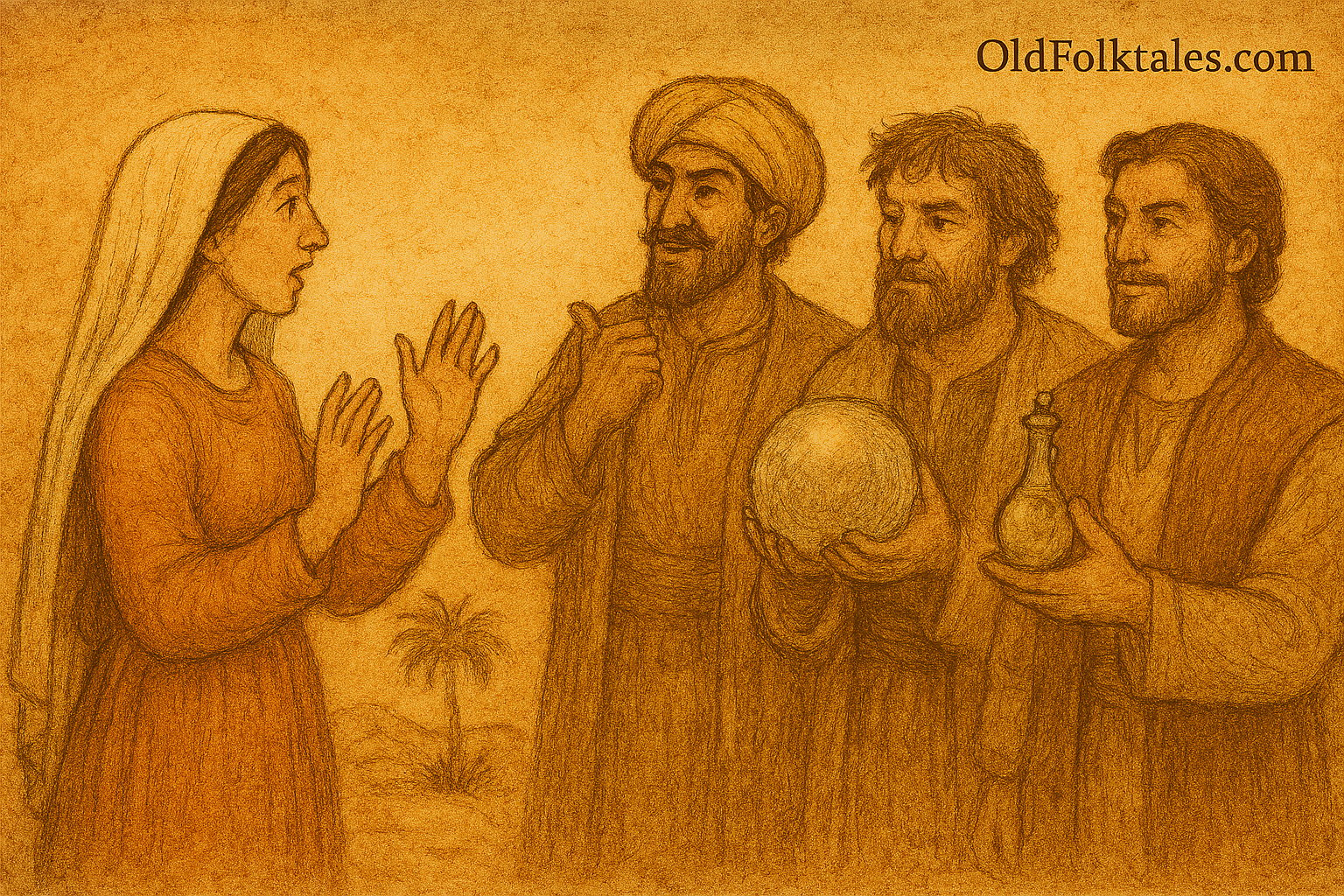
The first prince produced a magnificent desert crystal, perfectly clear and beautifully polished, that caught the sunlight like captured starfire. “This magical stone,” he declared proudly, “allows the holder to see anything happening anywhere in the world, no matter how distant.”
The second prince unfurled an exquisitely crafted camel saddle decorated with silver threads and precious stones. “This enchanted saddle,” he announced, “can carry its riders across any distance faster than the swiftest desert wind.”
The third prince revealed a small vial filled with golden olive oil that seemed to glow with inner light. “This miraculous oil of healing,” he proclaimed, “can cure any sickness and even restore youth when applied with a heart full of true love.”
As they admired each other’s remarkable treasures, the first prince decided to use his crystal to observe Princess Laila before their return. To their absolute horror, they saw her lying deathly ill upon her bed, surrounded by her grief stricken father and the kingdom’s most skilled physicians, all of whom appeared to have abandoned hope.
Without a moment’s hesitation, the three princes set aside their rivalry and worked together. They mounted the magical saddle, which instantly transported them across the desert to the palace gates. Racing through the corridors, they burst into the princess’s chamber where the third prince immediately stepped forward and touched a single drop of the healing oil to Laila’s pale lips.
At once, her eyes fluttered open like flower petals greeting the dawn. Color returned to her cheeks, strength flowed back into her limbs, and she rose from her sickbed completely restored to perfect health. The king wept tears of pure joy, calling their arrival a divine miracle.
That evening, as the palace celebrated Princess Laila’s miraculous recovery with music, dancing, and feasting, the three princes each stepped forward to claim her hand in marriage.
“Without my crystal,” declared the first prince righteously, “we would never have known she was dying.”
“Without my saddle,” insisted the second prince, “we could never have reached her in time to save her.”
“Without my healing oil,” proclaimed the third prince, “all our efforts would have been meaningless.”
The king found himself deeply troubled, for each prince spoke absolute truth. Their combined efforts had indeed saved his daughter’s life, and each treasure had played an essential role in her rescue.
To resolve this impossible dilemma, he summoned his wisest council members. Among them sat a humble wandering Sufi sage who had recently arrived from distant lands, his eyes bright with the wisdom gained through years of spiritual seeking and worldly experience.
The sage listened carefully to each prince’s claim, stroking his white beard thoughtfully. Finally, he spoke in a voice gentle yet firm:
“Your Majesty, each treasure is indeed wondrous, and each prince has demonstrated courage and nobility. But in matters of marriage, which determine the happiness of a lifetime, surely the person whose very life hangs in the balance deserves to be heard.”
He turned respectfully toward Princess Laila. “Noble daughter, the choice of whom you will marry belongs ultimately to you. Whom do you choose?”
The princess bowed her head in thoughtful silence, then lifted her gaze and spoke with quiet dignity and unwavering resolve:
“Each prince has played a part in saving my life, and for that noble deed I shall be grateful forever. But in all their arguing about who deserves to marry me, only the sage has remembered that this choice is mine to make. Therefore, father, with your blessing, I choose to marry him.”
The court gasped in astonishment, and the king protested, “But daughter, he is old and frail!”
Princess Laila smiled knowingly and approached the elderly sage. Taking the vial of healing oil from the third prince, she gently anointed the sage’s weathered hands. Instantly, his bent back straightened like a young palm tree, his white beard darkened to rich brown, and his lined face glowed with the vigor and handsomeness of youth. He stood tall and strong, his eyes sparkling with intelligence and love as he smiled gratefully at the wise princess.
The king, though astonished by this transformation, felt great relief and joy. He blessed their union and granted the three princes rich lands and trading privileges for their noble efforts. In time, each prince found a bride perfectly suited to his character and lived contentfully.
Princess Laila and the sage ruled their kingdom with wisdom, justice, and compassion, while the great caravans continued their eternal journeys across the golden Libyan sands, carrying with them the tale of the princess who chose love and wisdom over treasure and pride.
Moral lesson
This Libyan tale teaches us that true love cannot be won through material possessions or competitions, but grows from mutual respect, shared wisdom, and the recognition that each person deserves the freedom to choose their own destiny. The greatest treasure is not what we can possess, but the wisdom to value others’ choices and the courage to follow our hearts.
Knowledge Check
Q1: Who is Princess Laila in this Libyan folktale from Cyrene? A: Princess Laila is the wise and beautiful daughter of a king who rules the city of Cyrene. She is celebrated throughout Libya for her intelligence, grace, and beauty, and ultimately chooses to marry a Sufi sage rather than any of her three princely suitors.
Q2: What are the three magical treasures in this North African legend? A: The three magical treasures are a desert crystal that allows the holder to see anything happening anywhere in the world, a magic camel saddle that can transport riders faster than wind, and healing olive oil that can cure any sickness and restore youth when applied with true love.
Q3: How do the three princes work together to save Princess Laila? A: When the first prince uses his crystal to see that Princess Laila is dying, all three princes immediately cooperate: they use the second prince’s magic saddle to travel instantly to the palace, then the third prince applies his healing oil to cure her illness.
Q4: What cultural elements from Libya and the Sahara appear in this folktale? A: The story features Libyan cities (Cyrene, Tripoli, Fezzan), Sahara Desert settings, traditional caravan trade routes, desert oases, olive oil (important to Mediterranean Libya), camel transportation, and Sufi spiritual traditions common in North Africa.
Q5: What role does the Sufi sage play in Princess Laila’s decision? A: The Sufi sage serves as the voice of wisdom who reminds everyone that Princess Laila should have the right to choose her own husband. His respectful recognition of her agency contrasts with the princes’ focus on their own achievements, leading to her choosing him.
Q6: What moral lessons about choice and wisdom does this Libyan tale teach? A: The folktale teaches that true love cannot be won through competitions or material wealth, that everyone deserves the freedom to choose their own destiny, and that wisdom and respect for others are more valuable than pride, vanity, or possessions.