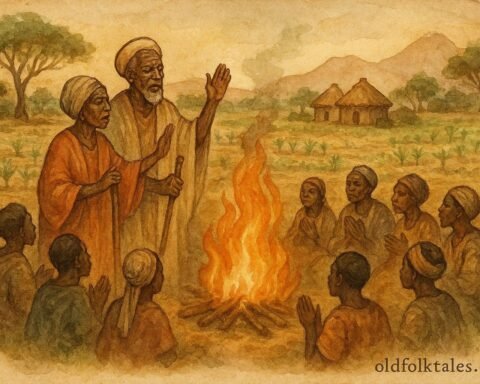
Listen, children of the desert wind, listen well to this song story of the first waters. Gather close, close, close to the fire’s heart, for this is the tale of how the rivers were born and why we must honor every precious drop. Listen to the voice of! Khwa-Ka, the Rainmaker woman, whose song still echoes in every thunder cloud, every morning dew, every sweet sip of water that touches our lips.
Tap, tap, clap, clap go the rhythm sticks. Tap, tap, clap, clap like the first raindrops on thirsty earth.
In the beginning times, when the world was young and dry, dry, dry, there was no flowing water in all the vast Kalahari. No rivers sang their gurgling songs. No streams danced down from the distant mountains. The only water that blessed the red earth came from the deep places ,the hidden springs that the ancestors had shown our people, the secret water-eyes that winked up from beneath the sand.
The people knew every water hole, every hidden seep, every place where the elephant paths led to the precious, life-giving pools. But the water was still, still, still. It did not flow. It did not run laughing across the land to greet other waters. Each pool sat alone, like a solitary star in the vast sky of sand.
In those dry-season days lived a woman named !Khwa-Ka—ah, such a woman! Her voice was sweet as the honey from the wild bees, strong as the wind that shapes the dunes. !Khwa-Ka was the song-keeper of her people, the one who knew all the old melodies, all the sacred rhythms that called to the rain spirits dwelling in the high cloud-country.
Rain, rain, come to us, went her morning song. Water, water, bless the earth, Cloud spirits, dance above us, Bring the gift of life’s rebirth.
Every day, !Khwa-Ka would climb to the highest dune, the red sand mountain that touched the belly of the sky. There she would sing her water-calling songs, her voice floating up, up, up to where the cloud-spirits dwelled. The people below would hear her voice carried on the desert wind, and their hearts would lift with hope.
But the rains came only in their season, brief and precious. The rest of the year, the earth cracked like old leather, and the people wandered far, far, far between the water holes, carrying their precious liquid in ostrich eggs, measuring each drop like liquid sunlight.
One terrible year ,ai, such a year! the drought stretched longer than the memory of the oldest grandmother. The regular rains forgot to come. The secret springs drank deeper into the earth. Even the baobab trees, those ancient water-storers, began to shrivel and crack.
The people grew desperate. Children cried for water. The elders shook their heads with worry. Animals gathered at the few remaining water holes, and the peaceful sharing of the water became tense and fearful.
!Khwa-Ka climbed her singing dune every dawn, every noon, every sunset, calling to the cloud-spirits with increasing desperation. But the sky remained blue, blue, blue ,beautiful but merciless as a lion’s eye.
Water spirits, hear my plea, she sang, Children thirst, elders weep, Even the patient earth cries out, Wake the waters from their sleep.
One night, as !Khwa-Ka lay on her sleeping kaross looking up at the star-scattered sky, the ancestors came to her in a dream. They were beautiful, these old ones, shimmering like heat mirages, their voices like the whisper of wind through grass.
“Daughter of our blood,” they said, “your voice is strong, but your song reaches only the sky. The waters below also need to hear your calling. Sing not just to the clouds above, but to the sleeping waters beneath. Wake them. Call them. Teach them to move and flow and join together like the voices in a great song.”
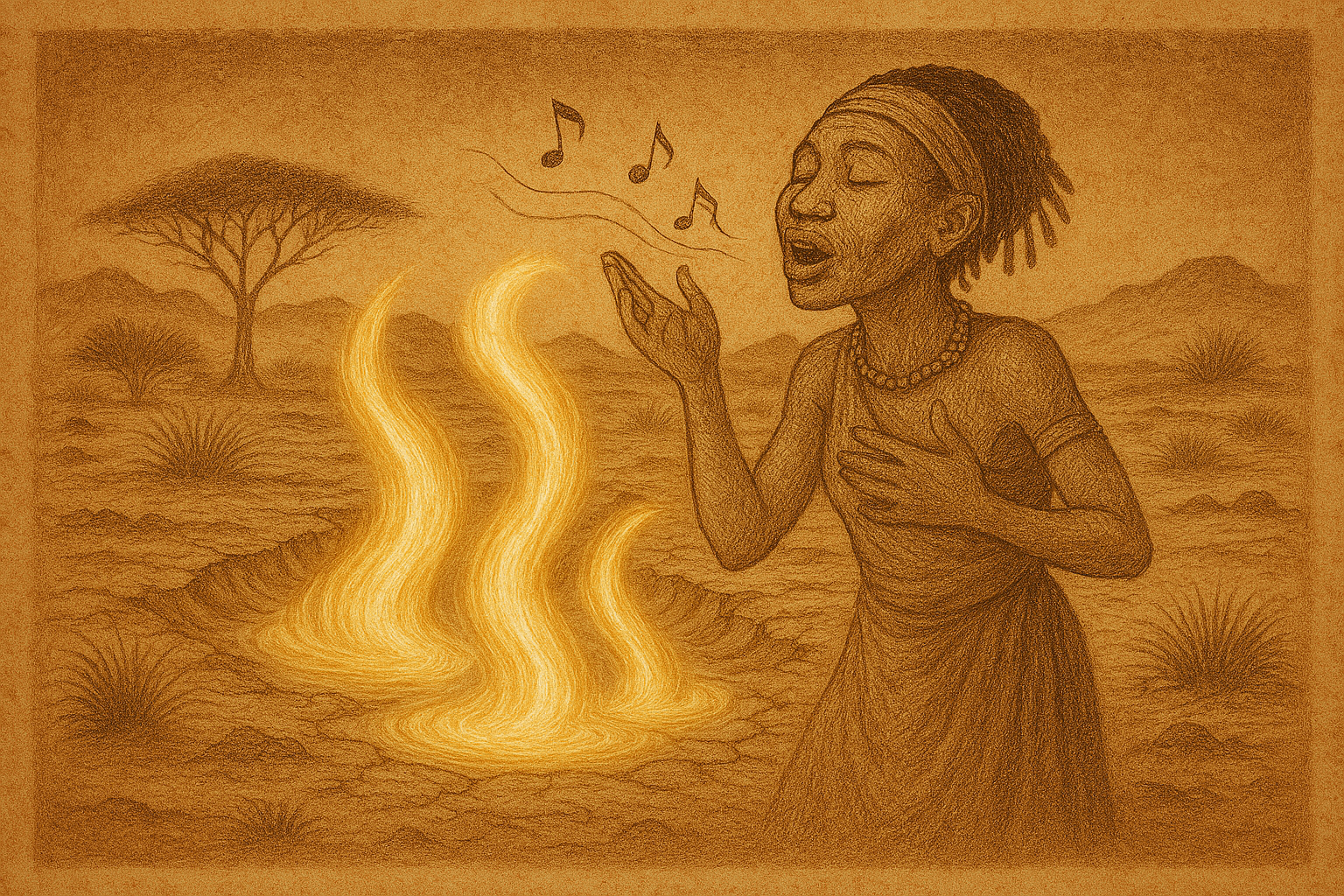
!Khwa-Ka woke with the dream-wisdom bright in her heart. As the sun painted the eastern sky with its first golden brushstrokes, she began to sing but this time, she pressed her ear to the earth and sang downward, into the deep places where the ancient waters slept.
Deep waters, hear my calling, she sang into the sand, Join your voices, flow together, Cross the thirsty, waiting land, Bind the desert like a tether.
Something stirred beneath her feet. A trembling, a movement, as if the earth itself was listening. !Khwa-Ka sang louder, her voice growing strong with the power of her people’s need.
Flow, flow, across the red earth, Sing, sing, your liquid song, Bring life to waiting roots and seeds, Carry the blessing all along.
The ground began to shake not with the anger of earthquakes, but with the joy of awakening waters. Far below, the sleeping springs heard !Khwa-Ka’s song and began to move, to dance, to reach toward each other like long-separated friends.
Gurgle, bubble, splash and flow, Run like children at their play, From pool to pool, from stone to stone, Dancing waters, come away!
Then marvel of marvels! water began to seep up around !Khwa-Ka’s feet. Not just a spring, but moving water, flowing water, water that sang its own liquid song as it moved across the red earth.
Other springs heard the call. From every hidden water-place in the great Kalahari, the ancient pools began to overflow, sending ribbons of precious water across the sand. These ribbons found each other, joined together, grew stronger and deeper.
See how the waters dance! sang !Khwa-Ka, her voice now joined by the gurgling melody of flowing streams. See how they seek each other! Like voices joining in a song, Like children finding their mother!
The people came running from their shelters, their eyes wide with wonder and joy. Children splashed in the new-born streams. Elders knelt to drink and give thanks. Animals approached cautiously, then with growing confidence as they realized these flowing waters were a gift for all.
But !Khwa-Ka was not finished with her song-magic. Standing now in the midst of the flowing waters, she sang the greatest verse of all the song that would ensure the rivers would always remember their way.
Remember this path, sweet waters, Remember this song of flow, When the rains come in their season, Follow the ways that you now know.
When drought comes to test us, Sleep deep but do not forget, The channels you carve in the earth-heart Are promises you must yet keep.
And so it was. The rivers learned their pathways, carved their channels deep into the red earth. When the seasonal rains came, they followed these ancient roads, filling them with dancing, singing water. When the dry times returned, the rivers slept but did not disappear entirely they left pools, seeps, the promise of return.
!Khwa-Ka became known as the River-Mother, the one whose voice had taught the waters to sing together. Her descendants inherited her gift, becoming the water-singers of their people, the ones who knew the songs that called the rains and blessed the springs.
But the greatest gift was not !Khwa-Ka’s alone it belonged to all. The rivers she had awakened became the highways of life, the silver threads that connected distant places, the singing paths that brought news from far-off lands and carried the seeds of distant trees to new homes.
Even today, when the San people find a flowing stream, they remember !Khwa-Ka’s song. They cup the water in their hands like liquid starlight, and they whisper their thanks to the River-Mother who taught the sleeping waters how to dance.
The Sacred Trust of Water
This ancient song-story teaches us that water is not merely a resource to be consumed, but a sacred trust connecting all life across time and space. !Khwa-Ka’s wisdom reminds us that water responds to reverence, that our relationship with this precious element must be one of respect, gratitude, and careful stewardship. Just as the rivers learned to flow together in harmony, we must understand that every drop we waste affects the greater community of life. Water carries memory of droughts survived, of abundance shared, of the delicate balance that sustains existence in the desert’s heart. When we honor water through conservation, protection of watersheds, and mindful use, we continue !Khwa-Ka’s sacred song, ensuring that future generations will hear the life-giving music of flowing streams. The rivers that flow today carry within them the echo of that first song, reminding us that water is not just a physical necessity but a spiritual gift that binds all living things in the eternal dance of survival and renewal.
Knowledge Check: Understanding San Water Stories and Traditions
Q1: What role do water stories play in San Bushmen culture and survival? A1: Water stories in San culture serve as both practical survival guides and spiritual teachings about resource management. These tales encode knowledge about water sources, seasonal patterns, and conservation ethics while emphasizing water’s sacred nature. They help communities maintain respectful relationships with scarce desert water resources through storytelling traditions.
Q2: How do San rainmaker traditions reflect their relationship with the environment? A2: San rainmaker traditions demonstrate deep environmental understanding through songs, dances, and ceremonies that honor natural water cycles. These practices show the San belief that humans can communicate with natural forces through respectful rituals, reflecting their intimate knowledge of weather patterns, seasonal changes, and desert ecology.
Q3: What are the key elements of traditional San water ceremonies and songs? A3: Traditional San water ceremonies feature rhythmic chanting, clapping, and call-and-response singing that mimics rainfall sounds. These rituals include prayers to ancestral spirits, offerings at water sources, and communal performances that strengthen social bonds while honoring water’s life-giving properties in the harsh Kalahari environment.
Q4: How do San folktales teach water conservation and environmental stewardship? A4: San folktales embed practical water conservation lessons within entertaining narratives, teaching communities to value every drop, protect water sources, and share resources equitably. Stories like “Rainmaker’s Song” emphasize that water is a community treasure requiring collective responsibility and spiritual respect for sustainable management.
Q5: What significance do rivers and flowing water hold in San cosmology? A5: In San cosmology, rivers represent life-giving connections between the physical and spiritual worlds, carrying messages from ancestors and linking distant communities. Flowing water symbolizes continuity, renewal, and the sacred circulation of life force that sustains all desert creatures through drought and abundance cycles.
Q6: How do San water stories preserve ecological knowledge for desert survival? A6: San water stories function as environmental encyclopedias, preserving crucial knowledge about seasonal water availability, animal behavior around water sources, weather prediction techniques, and sustainable resource management. These oral traditions ensure that essential survival information passes accurately between generations in nomadic hunter-gatherer communities.