Long ago, when animals and spirits still walked close with humankind, there lived a bird called Vulture. Though a bird, Vulture was raised by Sewanla, a creature much like an antelope. At birth, Vulture carried strange gifts: a rope fit for climbing palm trees and an axe sharp enough to cut wood. His caretaker in infancy was a being named Tetelidja, who watched over him with vigilance.
Sewanla himself lived in a time of deep tradition. In those days, when a man died, the people could not bury him unless they first obtained the tail of a Tetelidja. Misfortune came to Sewanla when his father passed away. His elder brother reminded him:
“Before we can bury our father, you must bring back the tail of a Tetelidja.”
But such a task was no small thing. The Tetelidja lived far away, so distant that the journey stretched from Allada to Abomey. Determined to honor his father, Sewanla set out with only three cooked eggs to sustain him.
Sewanla and the Old Woman of the Bush
On his long road, Sewanla came upon a crumbling hut deep in the bush. An old woman, bent with age and mystery, lived there. She peered at him with sharp, knowing eyes and asked:
“What do you seek, traveler, that you come so far into the wilderness?”
Sewanla bowed respectfully. “I seek the tail of a Tetelidja.”
As a gift, he offered her one of his precious eggs. She ate it quickly, smacking her lips. “If you have more,” she demanded, “give them to me, and in return you will find what you seek.”
Trusting her words, Sewanla gave her all three. Satisfied, the old woman revealed the secret:
“The Tetelidja sleep here. They are away feeding, but they will soon return. Hide behind this tree. When night falls and they lie down, seize one and cut off its tail.”
Night descended, heavy and silent. The Tetelidja returned one by one, their voices echoing as they sniffed the air.
“There is a man here. I smell him!” one said suspiciously.
“Silence!” the old woman snapped. “No one is here.”
At her word, they curled up and slept. At midnight, Sewanla crept forth, trembling but resolute. He found the largest Tetelidja, raised his axe, and with one swift blow, cut off its tail. Before the creature could wake, he fled, running into the darkness with his prize.
The Tail That Spoke
By dawn, the Tetelidja stirred. The largest of them reached behind and found his tail missing. His fury roared through the bush.
“I told you a man was here!” he thundered. “Now my tail is gone.”
Then he called out in ritual command: “Whether my tail lies in the hands of a man, a bird, or a beast, let it answer me!”
To Sewanla’s horror, the severed tail replied in a clear voice: “Here I am.”
Terrified, Sewanla clutched the talking tail and ran even faster. Behind him, the Tetelidja gave chase, their feet pounding the earth. Again the largest cried, “Let me hear my tail’s voice, wherever it may be!”
The tail called out once more: “I am still in this man’s hand.”
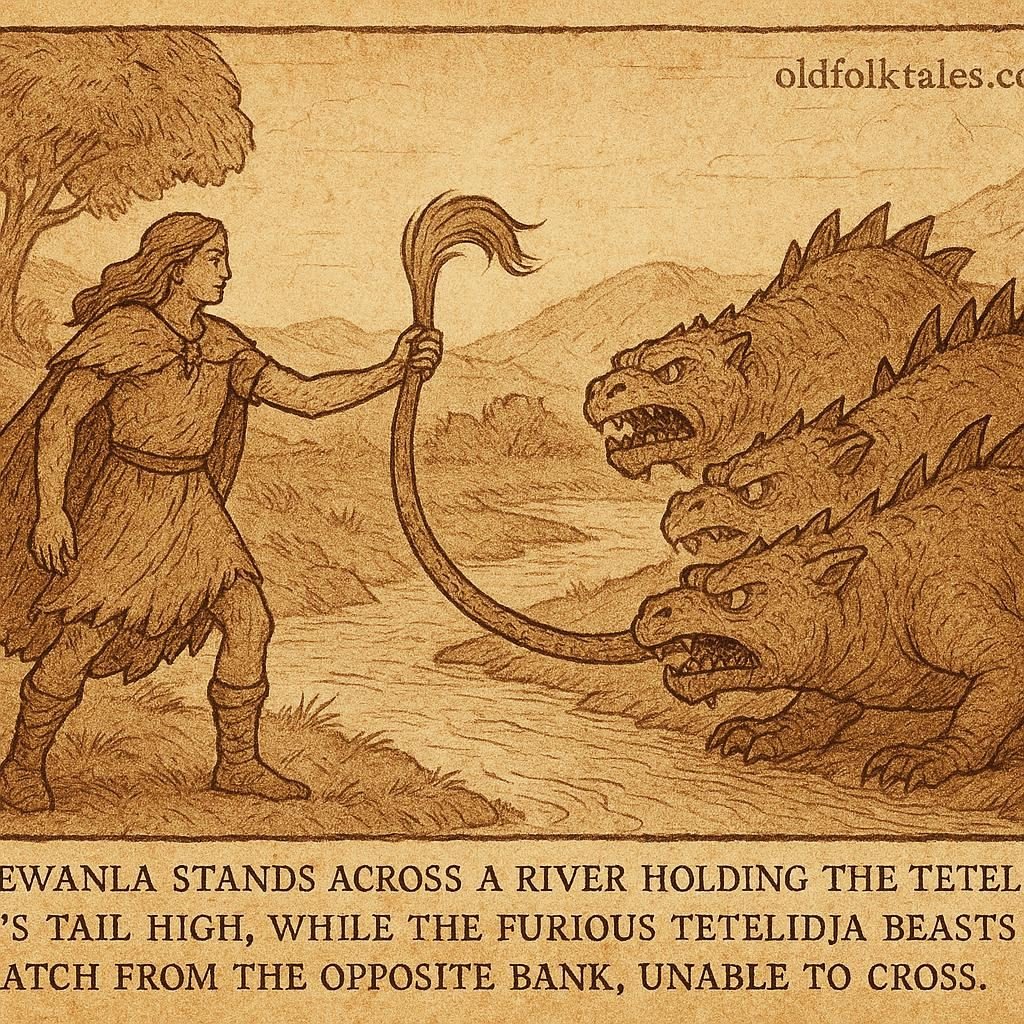
Sewanla’s heart pounded. He ran until he reached a wide river, only six kilometers from home. But the water barred his path. Desperate, he changed himself into stone, and changed the tail into stone as well.
When the Tetelidja arrived, they saw nothing. They never entered water, and so they prowled helplessly along the bank. One of them scoffed, “If I had the man, I would throw this very stone at him.” He picked up Sewanla’s stony form and hurled it across the river.
The moment it landed on the far shore, Sewanla and the tail returned to flesh. He stood, waving the tail in triumph. Furious but powerless, the Tetelidja turned back. Sewanla carried the tail home, and his father’s burial was at last completed.
Betrayal by the King and the Ascent to the Sky
Yet Sewanla’s trials did not end there. The king of the land, jealous and scheming, called him. “Go,” the king commanded, “and climb my palm tree to fetch me nuts.”
But his true intention was murder. When Sewanla climbed, the king’s men stacked straw and oil at the base and set it aflame. The tree blazed below him, cutting off escape.
In his desperation, Sewanla borrowed the climbing rope that Vulture owned. Instead of descending, he climbed higher, upward into the sky. There he transformed, no longer a hunted man but a god. He became Hevioso, the Thunder-God.
He gathered his brothers to himself. To one he declared: “You will follow me always. If I do harm, you will do harm beside me.” From that day, thunder rolled in pairs. The male force was Hevioso, fierce and swift. The female, Bade, counseled caution, urging mercy before wrath. Together they ruled the storm.
As for the others, some changed into vultures, cursed to wander endlessly in flight, stealing food and never finding true rest.
Moral of the Story
This tale from Dahomey teaches that perseverance and courage in the face of impossible trials can lead to transformation and greatness. Yet it also warns that greed, betrayal, and envy, whether from kings or creatures, cannot extinguish destiny.
Knowledge Check
1. Who raised Vulture in the story?
Vulture was raised by Sewanla, an animal similar to an antelope.
2. Why did Sewanla seek the tail of a Tetelidja?
Because his father had died, and tradition required a Tetelidja’s tail before burial.
3. How did the old woman help Sewanla?
She directed him to hide and cut off a tail when the Tetelidja slept.
4. What made the tail extraordinary?
It spoke aloud whenever its owner called for it.
5. How did Sewanla escape the king’s attempt to kill him?
He used Vulture’s climbing rope to ascend into the sky, where he transformed into Hevioso, the Thunder-God.
6. What cultural belief does the story explain?
It explains the origin of thunder and vultures in Dahomey tradition.
Source: Beninese Folktale