The Ape, the Snake, and the Lion

A young hunter learns that wild beasts can be more honorable than men when kindness is met with betrayal.
October 8, 2025
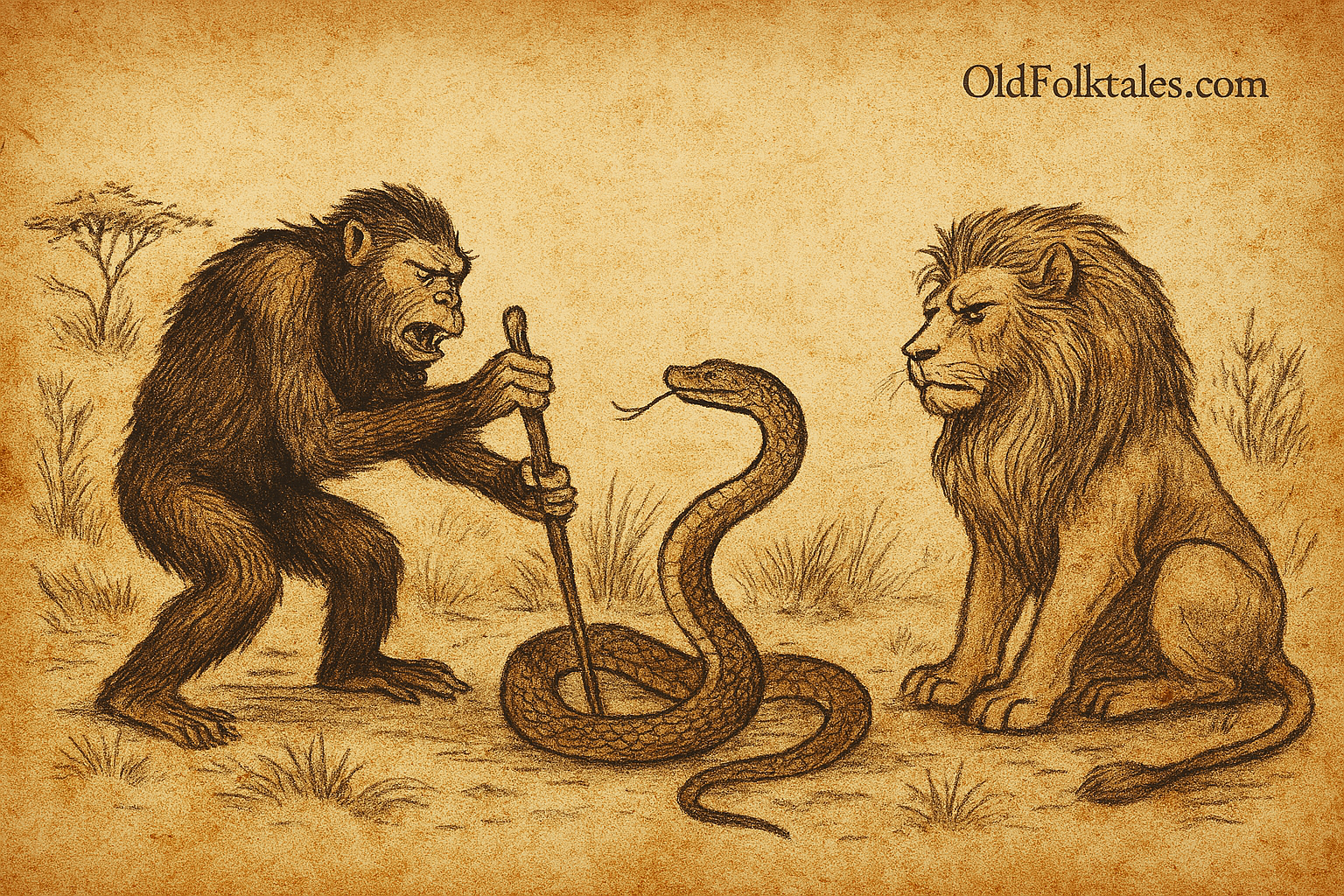
Parchment-style illustration of Zanzibar ape, snake, and lion gathered in dry savanna, inspired by traditional folktale themes.
The Ape, the Snake, and the Lion

Long, long ago, in the cocoa-growing village of Kobolè, not far from the great Taï Forest, there lived a widow and her only son. The scent of roasted plantains and palm oil often floated through the village, but in their small clay hut, there was little to eat. The woman’s husband had died when the boy was still an infant, leaving her to labor from sunrise to sunset, pounding cassava, carrying firewood, and weeding other people’s farms just to survive. Yet hunger remained their constant visitor.

When the boy grew old enough to understand their suffering, he asked, “Mother, why do we always go to sleep hungry? What work did Father do before he died?” Her eyes softened with memory. “Your father was a hunter, my son. He set traps in the forest, and we ate what he caught.”

The boy’s name was Koffi Gnahoré, and when he heard this, he smiled. “Ehh, that’s not work, that’s joy. I too will set traps and fill our calabashes with meat.”

The next morning, Koffi Gnahoré rose before the roosters crowed. He walked into the deep Taï Forest where the air smelled of rain and wild cocoa. On the first day, he cut strong branches from the iroko trees. On the second, he shaped them into clever traps. On the third, he twisted raffia fibers into ropes. On the fourth and fifth, he placed his traps along the paths where bush fowl, antelope, and porcupine passed.

When he returned to check them on the sixth day, his traps were full. There was more game than he and his mother could ever eat. He carried the extra to the market in Man, where the traders bought his meat for good money. That evening, his mother cooked rice and stew with palm oil. For the first time in years, they ate until their bellies were round and their hearts light. From that day, their home never lacked food. But as the elders say, “Good fortune is like morning mist, it vanishes when the sun grows strong.”

After many moons, Koffi found his traps empty day after day. Then one morning, he discovered an ape caught in one. As he raised his spear, the creature cried out in a human voice, “Koffi Gnahoré, son of Kobolè, spare me. I am Gbâ, the ape. Free me today from the trap, and one day, I will save you from the burning sun.” Koffi’s heart softened, and he cut the rope. The ape leapt into the trees and said, “For your kindness, I give you this. Beware of men, for their tongues are sweet but their hearts may be bitter.”

The next day, Koffi found a python struggling in another trap. “I am Naga, the python,” it said. “Let me go, hunter. Save me from death today, and I shall save you from danger tomorrow.” Koffi hesitated, then freed the great serpent. It slithered into the forest with the same warning. “Do not trust a man too easily.”

On the third day, he found an old leopard snarling in a snare. The beast’s eyes glowed like fire. “Do not fear,” it said. “I am Gbôhi, the leopard of the hills. Release me, and I will repay you when you need it most.” Koffi freed the leopard, who also said, “Be kind, but be wise. Some men repay goodness with harm.”

On the fourth day, Koffi found a traveler caught in one of his traps. He quickly freed him. The man grabbed his hands and said, “Ah, my savior. You have saved my life. I will never forget this kindness.” Koffi smiled, thinking he had made a friend. But as the elders say, the snake that bit you once hides in the same grass again.

Soon, hunger returned. Koffi said to his mother, “Make me seven cassava cakes. I will go hunting deep in the forest.” She baked the cakes with trembling hands, and he set off. For days he walked, but saw no game. He ate the cakes one by one until only one remained. Weary and lost, he sank to the ground beneath a great silk-cotton tree.

Just then, he heard a voice from above. “Koffi Gnahoré.” It was Gbâ the ape, swinging down with bunches of bananas and a calabash of water. “I repay your kindness today,” the ape said. Later, Gbôhi the leopard appeared, carrying fresh meat and a burning stick for fire. “Eat, my friend. I repay your mercy with mine.” Finally, at a river crossing, Naga the python rose from the water. “You are entering a strange town, Koffi. Give me your little bag.” When Koffi handed it over, the python hissed softly, and when he returned it, it was full of gold bracelets and silver ornaments. “Use them wisely,” Naga said, and disappeared into the river.

Koffi entered the great town of Kong, and who should he meet first but the man he had freed. “Ah, my friend,” the man said, smiling wide. “Come and rest in my house.” That night, while Koffi slept, the man crept to the chief’s palace and whispered lies. “A stranger sleeps in my house with a bag full of gold given by evil spirits. He is not a man, Chief, he is a python who walks in human skin.”

At dawn, the chief’s guards dragged Koffi before the people. The crowd shouted for his death. But before the executioner’s spear could strike, a great hiss echoed through the air. Naga the python rose from the village well, coiled around the lying man’s legs, and would not release him. The crowd gasped. The chief ordered silence. Koffi told the whole story, of the ape, the leopard, the python, and the ungrateful man.

The chief nodded slowly. “Men can be wicked, but not all. The one who turns kindness into betrayal digs his own grave.” He banished the lying man from the village and gave Koffi gifts and honor.

And so the people of Kobolè learned that gratitude does not live in words but in deeds. The animals, thought to be lesser, kept their promises. The man, thought to be wise, broke his. The griots say, “When you pour water for another, your hands will never stay dry.” And the people answer, “Ehh-heh.”

True kindness asks for nothing in return. He who betrays goodness betrays himself. For gratitude shines brighter than gold, and treachery always reveals its fangs.

The Wisdom of the Tale

This tale from Côte d’Ivoire teaches a truth both bitter and bright. It shows that kindness should come from the heart, not from hope of reward. It reminds us that wisdom and loyalty are not the gifts of one race or one kind, for even animals may hold more honor than men. Koffi Gnahoré’s courage and compassion brought him friendship and protection, while the ungrateful man’s deceit brought him shame. The chief’s judgment reveals the balance of the world, for though evil exists, so too does justice. True character is tested not in comfort but in trial, not in promises but in action. The story warns that those who betray kindness betray themselves, for lies and treachery cannot hide forever. Gratitude is the golden thread that binds hearts together, and he who breaks it will find himself alone when the storm comes.

Knowledge Check

1. What made Koffi Gnahoré become a hunter?
He and his mother were very poor and often hungry. After learning that his late father had been a hunter, Koffi decided to hunt to feed them.

2. What advice did the three animals give Koffi?
They told him to be kind but warned that men are often ungrateful and may repay kindness with harm.

3. How did the animals help Koffi in the forest?
The ape brought him food and water, the leopard gave him meat and fire, and the python filled his bag with gold and silver.

4. What lie did the rescued man tell about Koffi?
He told the chief that Koffi was a spirit or snake in human form who used magic to get his gold.

5. How was Koffi proven innocent?
The python appeared and wrapped around the lying man’s legs, showing everyone who was truly guilty.

6. What lesson does the story teach?
True gratitude comes from the heart, and those who repay kindness with evil will be exposed.

Source: Adapted from a traditional Ivorian folktale, based on a retelling from Fairytalez.com.

author avatar
Aimiton Precious

Banner

Go toTop