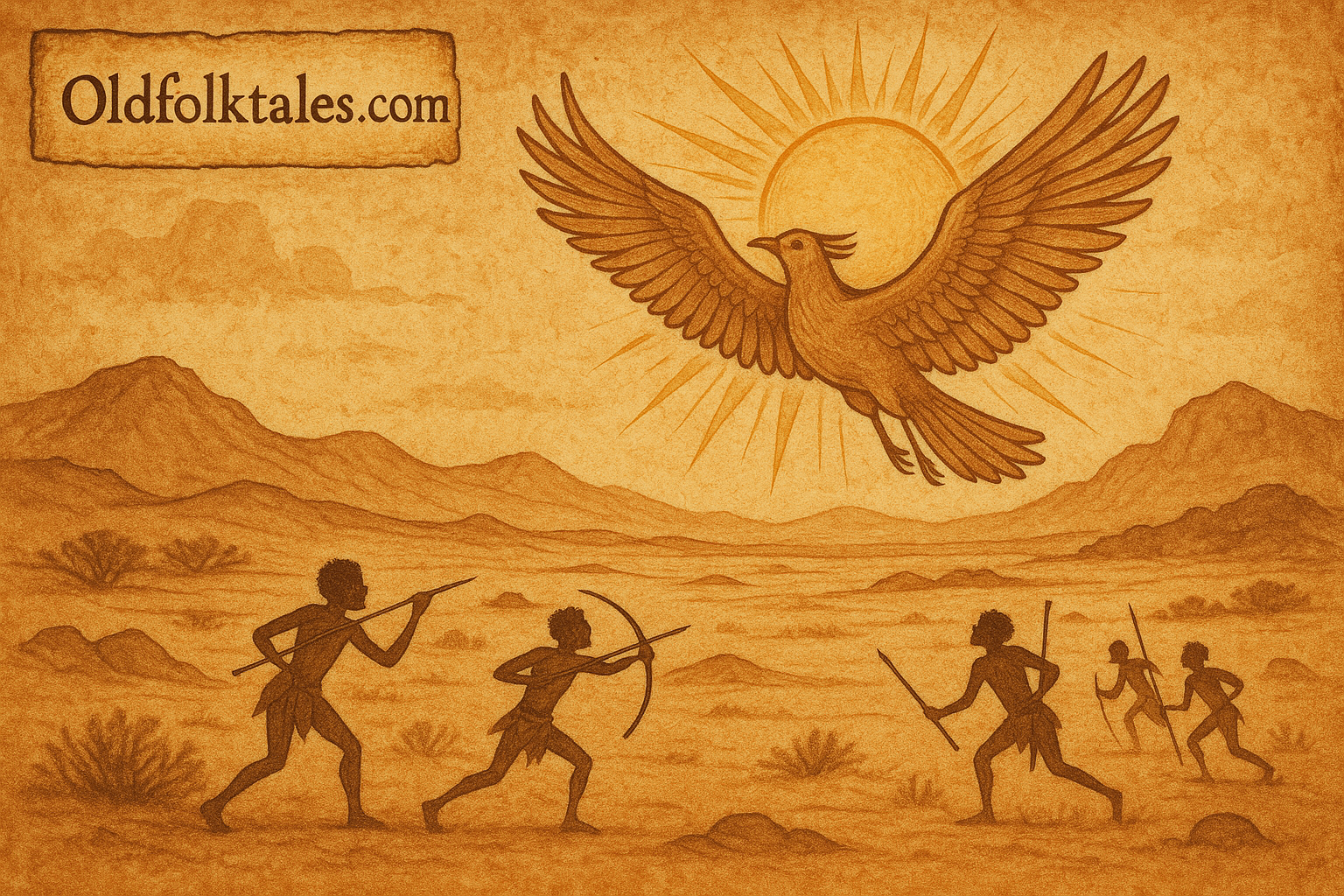
Long ago, before the first morning ever came, the land of the Ashanti lay in endless night. The moon floated in by firelight, children played in the glow of burning torches, and hunters carried clay pots filled with glowing embers to guide their steps. Yet no one had felt the warmth of the Sun for many years. The elders told that the Sun had once shone brilliantly over the Ashanti lands. It had ripened the yams, gilded the cocoa pods, and filled the river waters with shimmering life. But one day, the greedy Sky King captured the Sun. He locked it inside a brass cage high in his palace among the clouds. He wanted all the warmth and light for himself. Without the Sun, the earth grew cold and weak. Crops failed, fish left the shallow waters, and sickness spread among the people.
The Council of Despair
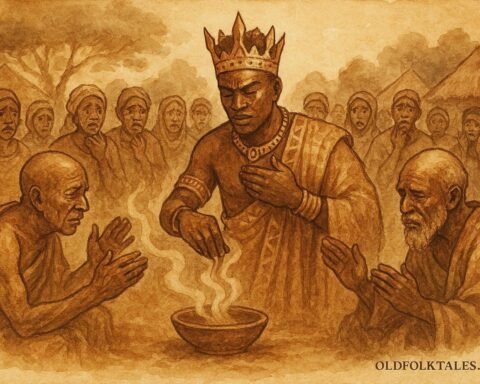
One night, the chiefs and elders gathered in the great drum house to speak of the disaster. Smoke from oil lamps curled into the rafters, and every face was shadowed with worry. “We have sent warriors to climb the mountains,” said Chief Kwaku, “but the palace of the Sky King cannot be reached.” Elder Abena shook her head. “We have prayed to the river spirits and the forest gods, yet they remain silent.” Just then, a voice as small as a flute’s whisper came from above them. “I will bring back the Sun.” All heads turned toward the rafters. There, perched among the beams, sat a tiny yellow weaver bird named Anene. The chiefs burst into laughter. “How can such a small bird face the Sky King?” one asked. “You will be crushed like a millet seed,” another warned. But Anene’s eyes glimmered like polished beads. “I have no spear,” she said, “but I have wings to ride the wind where no man can walk.” The laughter faded. Even the smallest messenger can carry the greatest hope.
The Bird’s Brave Flight
Before the dark hour before dawn, Anene took to the air. She flew over sleeping villages, across vast forests that whispered in the wind, and above tall mountains that pierced the clouds. The higher she climbed, the colder and thinner the air became. Yet she pressed on. Finally, she reached the Sky King’s palace. It floated on towers of white cloud, with gates of gold guarded by thunder and lightning. At its center stood the brass cage, glowing faintly with the Sun’s trapped light. Anene perched quietly, watching. She could not fight the guards, nor could she break the cage with her beak. But she could sing.
The Song that Tricked the Sky King
Anene began to sing a song unlike any heard in the palace. It started softly, like palm leaves brushing in the wind. Then it grew richer, like the beating of harvest drums. Her song told of the beauty of the earth below: the taste of ripe mango, the laughter of children playing by the river, the warmth of yam porridge shared at morning. The Sky King stepped onto his balcony to listen. His great eyes followed the small bird as she danced in the air. She darted left, then right, weaving a path that made the key to the Sun’s cage jingle at his belt. When she saw her chance, she swooped down and caught the key in her beak. Before the Sky King could move, she sped to the cage.
The Return of the Sun
The Sun, pale but still burning, opened its fiery eyes. Anene turned the key and the cage door swung wide with a sound like a clap of thunder. In an instant, the Sun blazed free, racing upward into the sky. The palace was flooded with golden light, and the Sky King’s cry was lost in the roar of the Sun’s return. Anene followed close behind, her feathers glowing with the new warmth.
Dawn Over Ashanti
In the villages below, people shielded their eyes against the brightness. Shadows fled. Rivers sparkled. The forests gleamed green for the first time in many years. Children danced barefoot in the fields, and the elders raised their hands to the warmth. When Anene landed in the drum house, the chiefs bowed their heads. “You have done what warriors could not,” Chief Kwaku said. “From this day, the yellow weaver bird shall be a sign of hope to our people.” And so the Ashanti say that every sunrise is the Sun remembering the little bird who freed it from the Sky King’s brass cage.
Moral Lesson
This story teaches that size does not decide worth. The smallest among us can change the fate of many when courage meets cleverness. Anene did not have the strength of warriors, yet she used her wings, her voice, and her wits to win. True power comes from using the gifts you already possess, not from wishing for those you do not. Every person holds a light within them, and sometimes it takes a small voice to bring the dawn.
Knowledge Check
- What is the cultural origin of “The Bird That Brought the Sun”?
This folktale belongs to the Ashanti people of Ghana and reflects their tradition of storytelling through animal fables. - Why did the Sky King keep the Sun locked away in “The Bird That Brought the Sun”?
He wanted the warmth and light only for himself, leaving the earth below in cold darkness. - How did Anene the bird free the Sun in the Ashanti folktale?
She distracted the Sky King with her song, stole the key from his belt, and unlocked the Sun’s cage. - What does the yellow weaver bird symbolize in “The Bird That Brought the Sun”?
It symbolizes hope, courage, and the belief that even the smallest can make a big difference. - What life lesson does “The Bird That Brought the Sun” teach?
The story shows that intelligence, creativity, and bravery can solve problems that strength alone cannot. - Why is sunrise important in Ashanti culture according to the folktale?
It serves as a reminder of the bird’s bravery and the return of light and warmth to the people.
Cultural Origin: Ashanti, Ghana