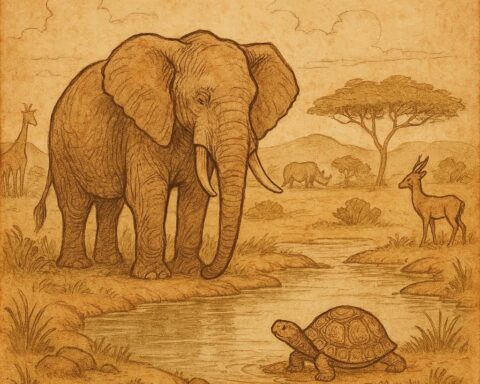
Long ago, in the heart of the Dahomey lands, a strange contest was declared between two unlikely rivals: Titagweti, a small but sharp-witted bird, and Elephant, the great beast who ruled the forest with his size. Each swore before the community that he would triumph.
“I will crush you beneath my tusk in one blow!” thundered Elephant, certain of his might.
But Titagweti flapped his wings and retorted, “I will strike you so fiercely that blood will pour from your eyes, and your brains will scatter on the earth!”
The words hung heavy. Elephant returned to his home without a worry—what threat could a bird be to him? Yet Titagweti, though small, was wise. He went to Fa, the diviner, who told him: “If you wish to win, go to Legba, the clever one who walks at the crossroads of trickery and truth.”
So the bird went to Legba’s shrine. Standing outside, he called, “Atacho, atacho!”
Legba opened the door and asked with a knowing smile, “What brings you here, little one?”
Gweti explained the contest, and Legba replied, “Victory over Elephant will not come from strength, but from cunning. Do as I say, and you will win.”
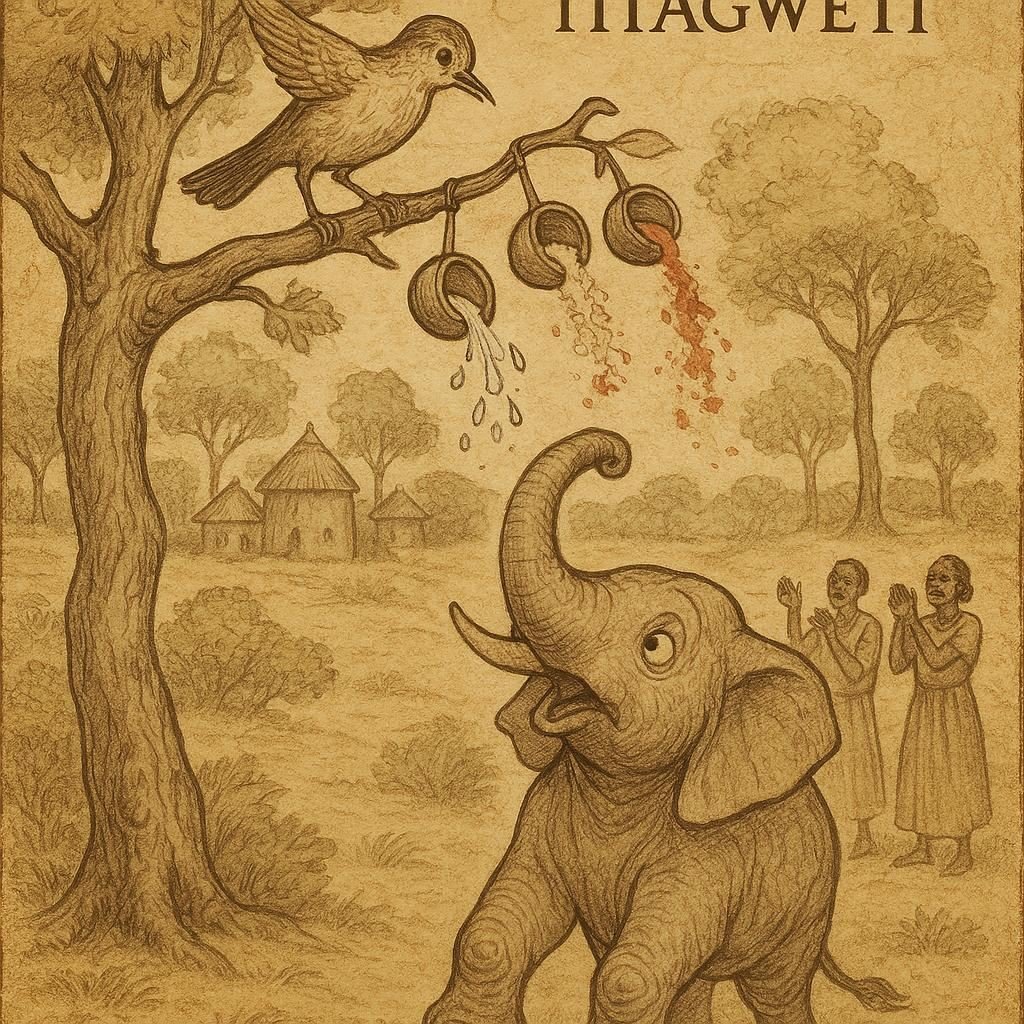
Legba asked for three small calabashes. When Titagweti brought them, the spirit filled the first with clear water, the second with white kaolin in water, and the third with fiery red pepper water, zakpwakpwe.
“These,” Legba said, “are Elephant’s tears, Elephant’s brains, and Elephant’s blood. Place them in the tree where your contest will be judged. Tomorrow, use them wisely.”
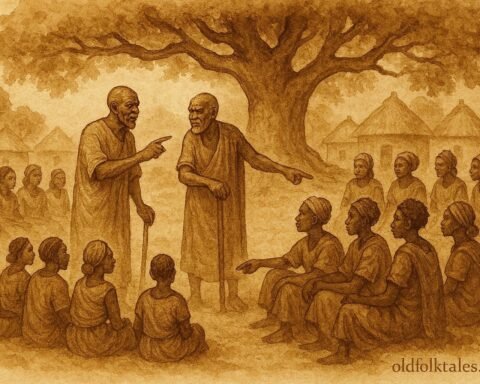
The following day, the whole village gathered. Elephant stood proudly, towering over Titagweti, who hopped lightly from branch to branch.
When Elephant charged, Titagweti leapt onto his back. When Elephant twisted, the bird perched on his ear. When Elephant stamped his foot, Titagweti soared into the nearest tree, where the calabashes lay hidden.
The bird seized the first gourd and spilled the water down Elephant’s head. The crowd gasped: “Elephant is weeping! He is crying already!”
Then Titagweti poured the white mixture. It clung to Elephant’s skin, and the people shouted, “His brains are spilling out! His brains are coming out!”
Finally, the bird dashed the red pepper water across Elephant’s back. The crowd shrieked, “Blood! His blood is flowing!”
Elephant, humiliated and enraged, stumbled and fell under the weight of his own shame. The people roared with laughter and amazement.
Metonofi, the chief hunter, arrived and declared, “This bird is greater than he seems. For though his body is small, his mind is larger than Elephant’s might. From this day forward, Titagweti shall be honored in death as though he were among the greatest beasts.”
And so it was. Whenever Titagweti was hunted, the same respect given to the largest animals was shown to him. Though little, he was remembered for the cunning that raised him above strength.
Moral Lesson
This Beninese tale teaches that wisdom and strategy are sharper than muscle and size. True honor comes not from brute power but from a mind that knows how to plan.
Knowledge Check
Who were the main characters?
Titagweti the bird, Elephant, Legba, and Fa the diviner.
What did Elephant and Titagweti each boast?
Elephant promised to kill Titagweti with one tusk strike; Titagweti vowed to spill Elephant’s blood and brains.
Who guided Titagweti?
Legba, after Fa advised him, gave the bird three calabashes.
What did the three calabashes represent?
Tears (water), brains (kaolin-water), blood (red pepper-water).
How did Titagweti defeat Elephant?
By tricking the crowd into believing Elephant was crying, bleeding, and losing brains.
What honor was given to Titagweti?
He was ranked equal to the largest animals and respected in death.
Source: Beninese Folktale