There once was a boy named Japi, born in a village nestled between rolling green hills and the roaring Atlantic. The people of his village said Japi was no ordinary child. When he cried, the trees swayed. When he laughed, birds flew from their nests. His grandmother, Mama Kwei, whispered stories of how the spirit of the wind danced into the village the night he was born.
“Mark my words,” she said, pounding cassava, “that child carries the wind inside him.”
The village elders paid her no mind. Children were born all the time. Winds came and went. But as Japi grew, so did the wind inside him. At seven, when he was angered, huts lost their thatched roofs. At ten, when he raced with the other boys, dust storms followed his heels. His parents were frightened but gentle. They reminded him daily, “Strength without control is like rain without clouds.”
Japi tried. Oh, he tried. But the wind had moods of its own.
One dry season, when crops had failed and the rivers grew thin, a stranger arrived. He was an old man with hair the color of dried baobab leaves and a staff carved with the image of a whirlwind. His name was Saapo, and he claimed to be the Keeper of the Four Winds.
“I have come for the boy,” he said.
Japi’s mother wept. His father stood silent. But the elders allowed it. “He is not like us,” they said. “He must learn what he is.”
Japi followed Saapo into the wilderness. They traveled through tall grasslands, across dry rivers, and into caves that hummed with ancient energy. Saapo said little, only: “Listen.”
At night, the wind whispered names to Japi: names of ancestors, names of forgotten mountains, names of rivers that no longer flowed.
“You are not just a boy,” Saapo said one night, feeding fire with dried herbs. “You are a vessel. The wind chose you.”
Japi’s training began. He was taught how to summon a breeze with his breath, how to trap a storm in a gourd, and how to calm thunder with a lullaby. But the greatest lesson was restraint.
“There is no power in release,” Saapo told him. “Power lies in knowing when not to use it.”
One morning, a message bird found them. The village was dying. The Harmattan had come early and fierce. Dust covered the yams. The riverbed had cracked open. Old men were fainting from thirst. Children cried in their sleep.
Japi stood. “It is time.”
He and Saapo returned. The villagers stared. The wind-boy was taller, calmer, and his eyes held storms.
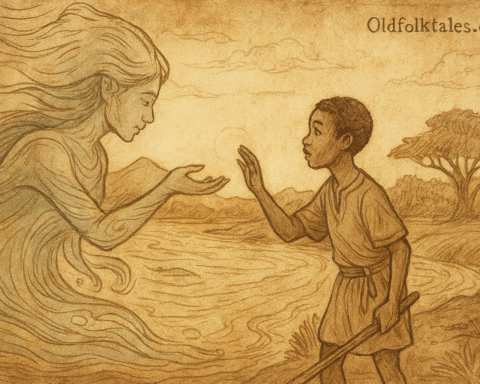
Japi walked to the center of the village. He raised his arms. The sky darkened. Clouds gathered. The trees bowed. Then—he whistled.
A soft wind blew.
The clouds wept.
Rain fell gently for three days. Enough to soften the earth and fill the riverbeds, but not enough to flood. The people cheered. The elders fell to their knees.
That night, Japi stood beneath the stars. Saapo placed a hand on his shoulder. “You have learned what no other could. The wind does not belong to you. But you can guide it.”
And from that day forward, whenever drought threatened or storms raged, the villagers looked to the hills and waited. For they knew the boy who carried the wind would always return.
✧ Commentary
This folktale from Liberia is more than a story of magic—it’s a reflection on responsibility, self-mastery, and the burden of inherited power. The image of a child carrying nature’s might speaks deeply to cultural traditions that revere nature spirits and elemental forces. Japi’s journey mirrors that of many who grow up gifted but misunderstood, and teaches that wisdom and humility must guide all strength.
✧ Moral
True power lies in knowing when to act and when to be still.
✧ Questions & Answers
1. Q: What made Japi different from other children? A: He had the wind inside him, which reacted to his emotions.
2. Q: Who came to train Japi and why? A: Saapo, the Keeper of the Four Winds, came to teach Japi control and purpose.
3. Q: What was the greatest lesson Japi learned? A: That true power lies in restraint and not just in action.
4. Q: Why did Japi return to the village? A: To help end a drought that was killing the village.
5. Q: How did Japi bring the rain? A: He summoned clouds and used his wind powers to bring soft rain.