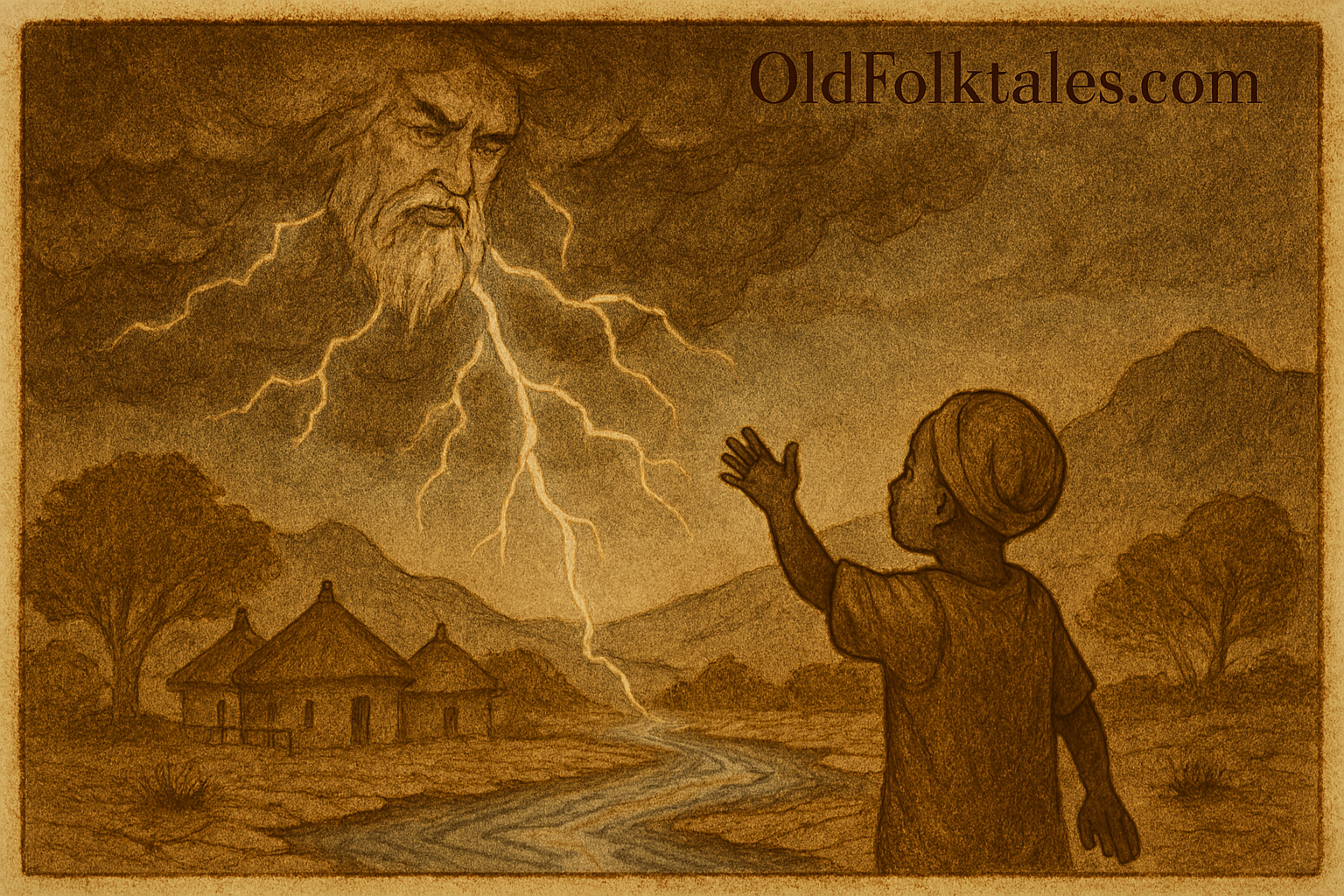
Gather close, children of the lightning’s children, gather as the storm clouds gather over the peaks of Thaba Bosiu! Let your hearts beat strong like the drums that call the rain, for tonight I bring you a tale that thunders across the generations like the voice of the sky father himself. This is the story of Lehlohonolo, the child who dared to speak with thunder.
Sefefo se bua, lefatshe le mamela. The whirlwind speaks, the earth listens, and so must we when the ancestors tell their mightiest tales!
In the time when the world was still learning to dance between earth and sky, when the first rains were still teaching the mountains how to sing, there lived in a village beneath the shadow of the sacred peaks a child whose courage burned bright as the morning star. Her name was Lehlohonolo, which means “good fortune,” though the people would soon learn that her greatest fortune was a heart that feared nothing save the suffering of others.
This child was born in the season of great storms, when Mmamolimo, the mother lightning, danced her brightest dances across the heavens and Ntate Lethadi, the father thunder, rolled his mighty voice from peak to peak like boulders tumbling down the mountainsides. The wise women said that any child born when the sky gods walked so close to earth would carry their power in her bones.
Ngwana wa pula o tla le maatla a lehodimo A child of the rain comes with the strength of heaven, and indeed, little Lehlohonolo could hear whispers in the wind that others could not hear, could see shapes in the clouds that remained invisible to older eyes.
But in those days, children, a great sorrow had settled over the land like dust over a drought-stricken field. Mohau, the Thunder God, lord of storms and bringer of the life giving rains, had grown angry with the people of earth. His rage shook the mountains daily, his lightning struck without warning, and his rains fell with such fury that they washed away fields, homes, and hope itself.
What had caused this divine anger? Ah, children, it was the old story of mortals forgetting their place in the great circle of life. The people had grown proud in seasons of plenty, had forgotten to make offerings to the sky spirits, had begun to believe they could tame the earth without honoring the heavens. They took the rains for granted like children taking their mothers’ love for granted, never thinking such gifts might one day be withdrawn.
Ha o lebala badimo, badimo ba o lebala When you forget the ancestors, the ancestors forget you, and so it was that Mohau’s patience wore thin as morning mist.
The thunder god’s anger grew like storm clouds building on the horizon. His voice became a constant roar that split rocks and shattered the peace of sleep. His lightning turned from silver to gold to angry red, striking not just the high places but the homes and hearts of the people below. His rains became torrents that flooded the rivers and turned the peaceful valleys into raging seas.
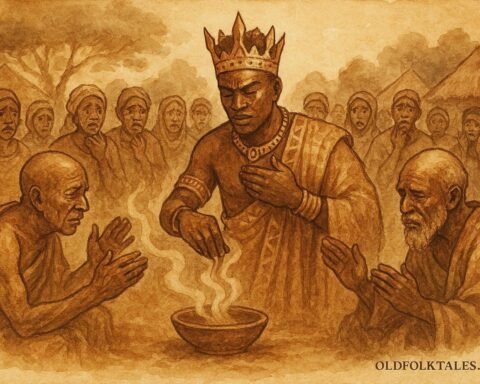
The people tried everything they could think of to appease the furious deity. The priests burned sweet incense until the smoke rose thick as fog. The elders sacrificed their finest cattle, pouring blood and milk upon the sacred stones. The young men danced until their feet bled, and the young women sang until their voices cracked like breaking pottery.
But nothing worked. If anything, Mohau’s rage seemed to grow stronger with each passing day, as if their desperate attempts only reminded him of how long they had ignored him.
Boroko bo felile, letsatsi le kgutlile Sleep is finished, the day has returned, but for the people, no day brought rest from the thunder god’s wrath.
It was then that young Lehlohonolo, barely old enough to carry water from the well, did something that made even the bravest warriors gasp in amazement and terror. She announced that she would climb alone to the highest peak of the Maluti Mountains, to the place called Leboea la Badimo, the North of the Ancestors, where it was said that Mohau kept his throne of storm clouds.
“Child,” cried her grandmother, her voice breaking like a stick in the fire, “you cannot face a god! The thunder will turn your bones to dust, the lightning will burn your spirit to ash!”
But Lehlohonolo’s eyes held the calm certainty of deep mountain pools. “Nkgono,” she said, using the sweet name for grandmother, “someone must speak for the people. Someone must ask why the sky father punishes his children so harshly. And perhaps,” her voice dropped to a whisper soft as falling snow, “perhaps a child’s voice can reach places where adult voices cannot go.”
Ngwana o bolela ‘nete e hloekileng A child speaks clean truth, and sometimes clean truth is the only key that opens locked hearts.
Before dawn on the day of the new moon, when the darkness was deepest and the storms raged strongest, Lehlohonolo began her climb. The mountain path was treacherous, slick with rain and torn by lightning strikes. The wind howled like a hundred hyenas, trying to tear her from the rocky slopes. The hail struck her small shoulders like stones thrown by angry giants.
But the child climbed on, her feet finding purchase where grown men would have slipped, her hands gripping stones that should have crumbled under any touch. It was as if the mountain itself recognized her pure intention and lent her strength for the impossible journey.
As she climbed higher, the storm grew wilder. Trees bent like grass in the supernatural wind. The very rocks groaned under the pressure of Mohau’s rage. Lightning struck so close she could taste metal in the air and feel her hair stand on end with each flash.
Finally, as the first hint of dawn touched the eastern peaks, Lehlohonolo reached the summit. There, surrounded by whirling clouds and dancing lightning, sat Mohau on his throne of crystallized thunder. He was magnificent and terrible a giant whose beard was made of rain clouds, whose eyes were pools of liquid lightning, whose voice was the sound of a thousand storms speaking as one.
“Who dares approach the throne of heaven?” his voice boomed, shaking snow from distant peaks. “What mortal child thinks to stand before the lord of storms?”
But little Lehlohonolo did not tremble. Instead, she bowed deeply, as she had been taught to bow before elders, and spoke in a voice clear as mountain water:
“Great Mohau, Thunder Father, I am Lehlohonolo, smallest of your children. I come not to demand or bargain, but to ask forgiveness for my people and to understand your great anger.”
Hlonepha e bula dithebe Respect opens doors, and the thunder god, surprised by such humility from one so young, leaned forward on his storm throne.
“Speak, little one. Why should I listen to you when I have ignored the pleas of priests and kings?”
Lehlohonolo’s answer came from her heart, pure and simple: “Because, great father, I speak not as one who knows much, but as one who knows how much she does not know. I speak not as one who has earned your attention, but as one who needs your mercy. We are your children, and children sometimes forget to say thank you for the gifts they receive every day. But forgetting is not the same as not loving.”
The thunder god sat silent for a long moment, his lightning eyes studying the small figure before him. Here was something he had not expected courage without arrogance, humility without servility, truth without excuses.
Pelo e nyenyane e ka nka sebaka se seholo A small heart can take up a large space, and so it was that Lehlohonolo’s honest words filled the vast sky with their simple wisdom.
Slowly, Mohau’s expression began to change. The storm clouds around his throne lightened from black to gray to silver. The wild lightning gentled to a soft golden glow. His voice, when he spoke again, was like distant thunder, powerful but no longer threatening.
“Child of courage,” he said, “you have done what armies could not do. You have reminded me that anger, even righteous anger, must be tempered with love. Your people forgot to honor me, yes, but I forgot to be patient with them. You have shown me that the strongest storms are not always the ones that serve life best.”
From that day forward, Mohau’s rains fell gently, his thunder spoke in measured tones, and his lightning danced in the sky like celebration rather than threat. The people learned to honor the sky spirits properly, but more than that, they learned that sometimes the bravest thing you can do is admit your mistakes and ask for forgiveness.
And Lehlohonolo? She grew up to become a great peacemaker, one who could speak truth to power because she understood that real courage comes not from fearlessness, but from loving others more than you fear for yourself.
The Wisdom of the Ancestors
Thus do the storm clouds teach us, children of earth and sky, that true courage is not the absence of fear, but the presence of love that makes us act despite our fear. The child who faced the thunder god shows us that the mightiest powers in the universe can be moved not by force or cleverness, but by honesty, humility, and genuine care for others.
When we stand before forces greater than ourselves whether they be the powers of nature, the authority of leaders, or the mysteries of the divine we must remember that respect and humility are not signs of weakness but of wisdom. The thunder god was moved by Lehlohonolo’s approach not because she was fearless, but because she was respectful. Not because she was powerful, but because she was honest.
Let us learn from this brave child that sometimes the smallest voice can speak the loudest truth, that sometimes the youngest heart can teach the oldest wisdom. When we face challenges that seem too big for us, when we must speak difficult truths to those in power, when we must stand up for what is right even when we are afraid, let us remember that courage is not about being the strongest or the smartest it is about being the most loving.
And let us never forget to honor the forces that sustain our lives, whether they be the rains that feed our crops, the earth that supports our feet, or the people who care for us each day. For gratitude is the bridge between earth and heaven, the path that leads from fear to faith, and the key that opens every door that needs to be opened.
Knowledge Check
What divine powers and characteristics does Mohau, the Thunder God, possess in this Sotho tale?
Mohau is portrayed as the lord of storms who controls thunder, lightning, and rain. He sits on a throne of crystallized thunder, has a beard made of rain clouds, eyes like pools of liquid lightning, and a voice that sounds like a thousand storms. His emotions directly affect weather patterns, causing destructive storms when angry and gentle rains when pleased.
Why had the Thunder God become angry with the people in the story?
Mohau became angry because the people had grown proud during prosperous times and forgotten to honor the sky spirits with proper offerings and respect. They took the life giving rains for granted and believed they could control nature without acknowledging the divine powers that sustain life, violating the sacred relationship between humans and the spiritual realm.
What makes Lehlohonolo’s approach to the Thunder God successful where others failed?
Lehlohonolo succeeds through genuine humility, honest admission of human failings, and respectful communication. Unlike the desperate attempts of priests and elders who tried to appease the god through sacrifices and rituals, she approaches with sincere respect, acknowledges her people’s mistakes, and speaks from love rather than fear or obligation.
How does this African mythology story teach children about environmental respect and stewardship?
The tale teaches that natural forces like weather are not just physical phenomena but have spiritual dimensions requiring human respect and gratitude. It shows how human behavior and attitudes toward nature can affect environmental conditions, emphasizing the need for humility and proper relationship with natural forces that sustain life.
What role do Sotho cultural values play in the story’s moral framework?
The story emphasizes key Sotho values including respect for elders and divine authority, the power of honest communication, community responsibility, and the belief that spiritual and natural worlds are interconnected. The proverbs woven throughout reinforce traditional wisdom about courage, respect, and the relationship between humans and divine forces.
How can educators use this folktale to discuss courage and conflict resolution with students?
Teachers can use Lehlohonolo’s example to show students that effective conflict resolution often requires humility, honest communication, and genuine concern for others rather than aggression or manipulation. The story demonstrates that even children can make a difference when they approach problems with courage, respect, and sincere desire to understand and heal relationships.