There are moments in life when words are not enough, when promises must be proven through action. In many communities, especially in times long past, a person’s character was not judged by what they said, but by what they were willing to endure.
In a village where customs were deeply respected and traditions carefully preserved, marriage was not simply a union between two people. It was a bond between families, a joining of responsibilities, and a commitment that required strength, patience, and understanding.
It was in this village that a young woman was chosen to become a bride.
She was known for her quiet nature and respectful behavior. She spoke gently, worked diligently, and carried herself with dignity. Many admired her, but admiration alone was not enough.
For in that community, a bride was expected to prove her readiness.
When the time came for her to enter her husband’s household, the elders of the family gathered. They spoke among themselves, considering the responsibilities that awaited her.
“She must be tested,” one of them said.
It was not said with cruelty, but with seriousness. The test was not meant to harm her, but to reveal her strength and character.
Want more? Read more West African folktales now
The young bride was informed of what lay ahead.
She listened quietly, without protest or fear. She understood that this was part of the path she had chosen.
Her tasks would not be easy.
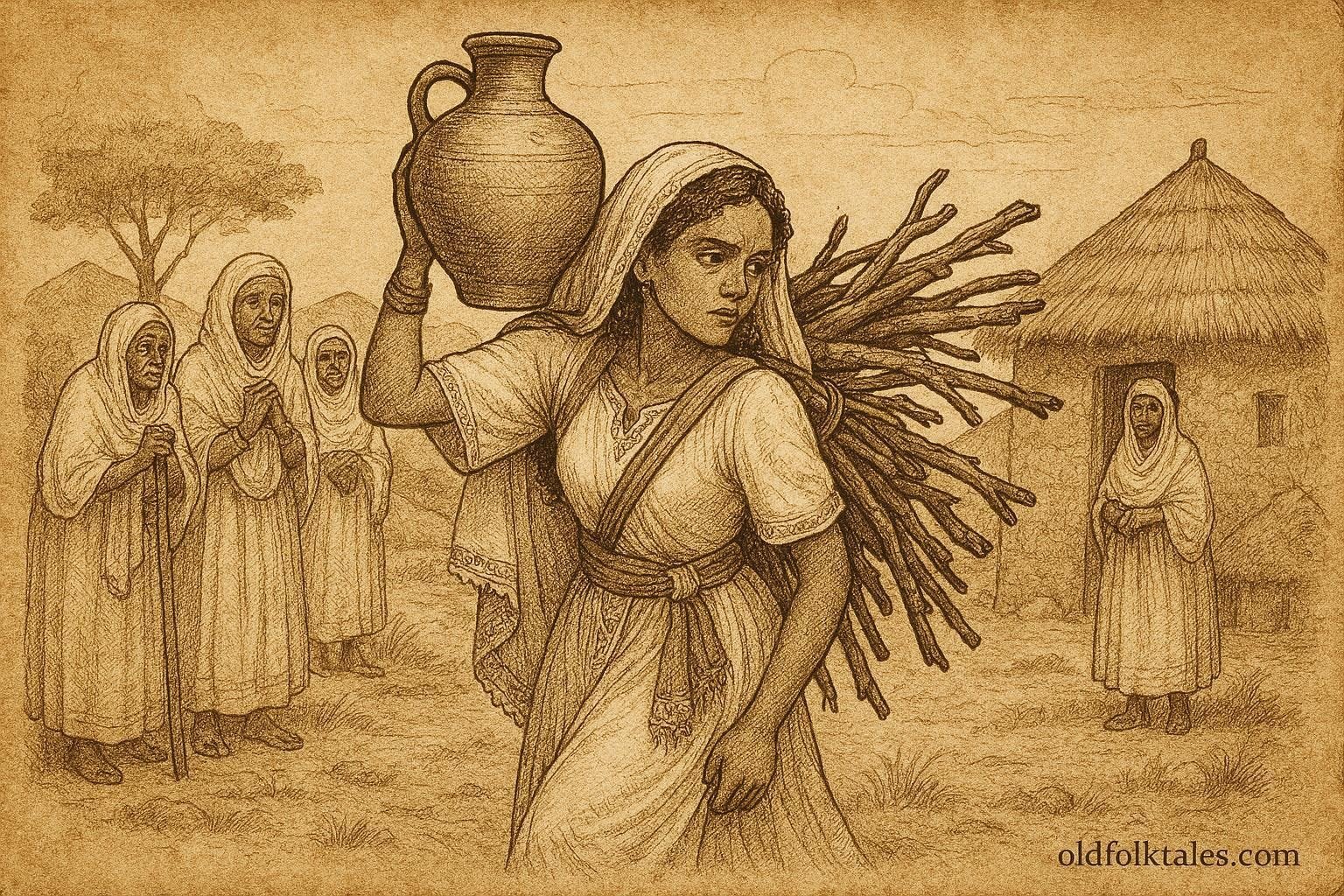
On the first day, she was asked to fetch water from a distant source.
The journey was long, stretching across uneven ground and under the weight of the sun. The container she carried was heavy even when empty, and heavier still when filled.
She walked the path steadily, her steps careful and measured.
There was no one to assist her. No one to lighten her load.
Yet she did not complain.
When she returned, the elders observed her closely.
They noted the steadiness of her steps, the way she carried herself, and the absence of resentment in her expression.
But the test was not complete.
On the second day, she was given another task.
She was asked to prepare food for the entire household, a responsibility that required both skill and patience. The ingredients were many, the process long, and the expectations high.
She worked from morning until the light began to fade, tending to every detail with care.
There were moments when the work became overwhelming, when fatigue settled into her hands and her thoughts.
Still, she continued.
The family watched as she served the meal.
They tasted the food, not only for its flavor, but for the effort behind it.
They said little, but their silence carried meaning.
On the third day, the test grew more difficult.
She was asked to complete tasks that required both physical strength and endurance. She was sent to gather firewood from a place far beyond the village, where the terrain was rough and the path uncertain.
The journey tested her in ways the previous tasks had not.
The ground was uneven, the air heavy, and the distance greater than she had expected.
At one point, she paused.
Not out of weakness, but to gather her strength. She looked ahead, understanding that the path would not become easier simply because she wished it to be so.
Then she continued.
When she returned, carrying the wood she had gathered, the signs of effort were visible.
Her steps were slower, her hands marked by the work she had done.
Yet her posture remained steady.
The elders spoke among themselves once more.
“She has endured,” one said.
“But endurance alone is not enough,” another replied.
“There must also be patience.”
The next task was designed to test her spirit.
She was given instructions that were difficult to follow, not because they were unclear, but because they required attention, care, and persistence.
Mistakes would be easy to make.
Frustration would be natural.
As she worked, small challenges arose.
Things did not go as expected. Tasks had to be repeated. Time passed slowly.
Yet she did not allow frustration to overcome her.
She corrected her mistakes, adjusted her efforts, and continued with determination.
Those who watched her began to understand something deeper.
Her strength was not only in her ability to endure physical hardship, but in her willingness to remain calm and focused when things became difficult.
At last, the time came for the elders to decide.
They gathered together, speaking quietly among themselves as the young bride waited.
She stood with humility, neither demanding approval nor showing doubt.
She had done all that was asked of her.
After a time, the elders turned to her.
“You have been tested,” they said. “Not to weaken you, but to understand who you are.”
They spoke of what they had seen.
They spoke of her endurance, her patience, and her willingness to fulfill her responsibilities without complaint.
“You have shown that you are ready,” they concluded.
The young bride lowered her head in respect.
She had not sought praise, but she understood the meaning of their words.
Her place in the household was now secure, not because she had been chosen, but because she had proven herself worthy.
From that day forward, she became an integral part of the family.
Her actions continued to reflect the qualities she had shown during the test. She worked with diligence, treated others with respect, and carried her responsibilities with quiet strength.
The story of her trial was told in the community, not as a tale of hardship alone, but as an example of character.
It reminded others that true worth is not revealed in moments of ease, but in times of challenge.
It taught that patience, endurance, and dedication are the foundations upon which trust is built.
Continue your journey: Read more East African folktales
Moral Lesson
True character is proven through patience, endurance, and the willingness to fulfill responsibilities without complaint.
Knowledge Check
- Why was the bride tested in the story?
To prove her readiness and character before joining her husband’s household. - What kind of tasks was she given?
Difficult physical and domestic tasks requiring endurance and patience. - How did the bride respond to the challenges?
She completed them with determination, patience, and without complaint. - What qualities did the elders observe?
Endurance, patience, responsibility, and humility. - What was the result of the test?
She was accepted as a worthy member of the household. - What lesson does the story teach?
That true worth is shown through actions, not words.
Source
Tigre folktale, Eritrea. Recorded by Leo Reinisch (1883).